




Let’s start with a quick question you might see on a certification exam. For the purposes of CPR, an infant is someone under the age of _______. Select one answer: 6 months, 1 year, or 2 years. If you hesitated, you’re not alone. This single detail is one of the most critical distinctions in pediatric CPR, and it’s just the beginning. The techniques for performing child CPR on a baby versus a toddler are fundamentally different—from where you place your hands to the depth of compressions. Using the wrong method can be ineffective or even harmful. This guide will walk you through the step-by-step differences, ensuring you have the correct knowledge to act confidently.
Key Takeaways
- Master age-specific techniques: Performing CPR on an infant is different from performing it on a child. Proper training teaches you the correct hand placement and compression depth for each age group, ensuring you can provide effective and safe care.
- Go beyond theory with hands-on practice: A good CPR class does more than just explain the steps; it builds muscle memory through practice on manikins. This hands-on experience is what gives you the confidence to act correctly and calmly during a real emergency.
- Choose your training course wisely: Look for three key things in a CPR class: accredited certification to guarantee you’re learning current standards, experienced instructors who can build your confidence, and a format (like in-person or blended) that fits your life.
Why You Need to Know Infant & Child CPR
As a parent or caregiver, your top priority is keeping the children in your life safe. While you can’t prevent every accident, you can prepare for them. Learning infant and child CPR is one of the most powerful things you can do to protect a little one. It gives you the skills to act confidently and effectively in a crisis. When a child stops breathing, every second counts, and having the right training can make all the difference. This knowledge isn’t just for medical professionals; it’s a fundamental skill for anyone who looks after a child.
What Are the Most Common Childhood Emergencies?
Young children are naturally curious, which can sometimes lead to dangerous situations. Choking is one of the most common emergencies, often caused by small toys, hard foods, or other objects finding their way into a child’s mouth. Other critical situations include near-drowning incidents, severe allergic reactions, or sudden unresponsiveness from an illness. When an infant or child stops breathing for any reason, immediate and correct CPR is their best chance for survival. Knowing how to respond in these first few critical moments can prevent a tragedy and keep a child’s brain supplied with vital oxygen until help arrives.
Understanding the Causes of Cardiac Arrest in Children
Unlike adults, whose cardiac arrests are often triggered by existing heart problems, a child’s heart usually stops because of a breathing issue. This is a critical distinction because it changes how we respond. The most frequent culprits are things that obstruct the airway. Think about situations like choking on food or a small toy, suffocation, or a near-drowning incident. Other causes can include severe injuries, poisoning, or electric shock. In almost all these cases, the underlying problem is a lack of oxygen getting to the brain and vital organs, which is why rescue breaths are so important in pediatric CPR. With over 20,000 children and infants experiencing cardiac arrest each year in the U.S., understanding these root causes helps you see why specialized training is so essential for anyone caring for kids.
The Critical Minutes: How CPR Saves Lives
Cardiopulmonary resuscitation (CPR) is a life-saving technique that can be the bridge between a medical emergency and the arrival of first responders. When a child’s heart stops beating, CPR helps keep oxygen-rich blood flowing to the brain and other vital organs. By performing chest compressions and rescue breaths, you are essentially doing the work of the heart and lungs. This action can help a child start breathing again and dramatically improves their chance of a full recovery. Learning how to perform CPR is an invaluable skill that empowers you to take control in a scary situation and provide immediate, life-sustaining care.
The Timeline for Brain Injury
When a child stops breathing, the body’s oxygen supply is cut off. The brain is especially vulnerable, and the timeline for injury is shockingly fast. If a baby’s blood flow stops, permanent brain damage can begin in as little as four minutes, with death possible in just four to six minutes. This is why immediate action is so crucial. Every second you spend performing CPR, you are manually pumping oxygen-rich blood to the brain, protecting it from irreversible harm and giving that child the best possible chance of survival until professional help takes over. Your intervention is a lifeline during those critical moments.
Busting Common Myths About Pediatric CPR
Many people feel hesitant about learning CPR because of some common myths. Let’s clear a few of them up. First, infant and child CPR is not the same as adult CPR. A child’s body is smaller and more fragile, so the techniques for hand placement, compression depth, and rescue breaths are different. Another myth is that only trained medical professionals should perform CPR. While professional training is essential for proper technique, the goal of our CPR, AED & First Aid courses is to equip everyday people like you with the skills and confidence to act. You don’t need a medical degree to save a life.
Why Training Matters: A Look at the Stats
The statistics on cardiac emergencies are sobering, but they also highlight why training is so important. Around 70% of Americans may not know how to help during a cardiac emergency because they either haven’t learned CPR or their certification has lapsed. This is critical because the chance of survival from cardiac arrest decreases by 7-10% for every minute that passes without CPR. When you consider that many emergencies happen at home, it’s clear that having a trained family member present can be the deciding factor. Getting certified gives you the ability to step in immediately, turning what could be a helpless moment into one of hope.
How Often Does Pediatric Cardiac Arrest Happen?
It’s a scenario no one wants to imagine, but understanding the reality can be a powerful motivator for getting trained. More than 20,000 infants and children have a cardiac arrest each year in the U.S., and of those, about 7,000 happen outside of a hospital. This means they occur at home, on the playground, or at school—places where a parent, teacher, or caregiver is the first person on the scene. When an emergency strikes, the person closest to the child is their first and best hope. This is why it’s so vital for everyday people, not just medical professionals, to have the skills to respond immediately. Your actions in those first few minutes can be the most important factor in a child’s survival.
Preventing Common Household Accidents
While knowing CPR is crucial, creating a safe environment is the first line of defense. Many childhood emergencies can be prevented with a little foresight. Choking is one of the most common emergencies, often caused by small toys, hard foods, or other objects finding their way into a child’s mouth. You can reduce this risk by cutting food into small, manageable pieces and keeping tiny objects out of reach. Similarly, near-drowning incidents are preventable with constant supervision around any amount of water, including bathtubs. Even with the best precautions, accidents can still happen. That’s why pairing prevention with preparedness—by learning CPR and First Aid—gives you a complete safety plan to protect the children in your care.
Who Can Learn CPR?
Absolutely anyone who cares for a child should learn CPR. You don’t need a medical background to save a life. Parents, grandparents, babysitters, teachers, and coaches are all perfect candidates for training. The goal of our CPR, AED & First Aid courses is to equip everyday people like you with the skills and confidence to act decisively in an emergency. We focus on hands-on practice in a supportive environment, so you build the muscle memory needed to perform the techniques correctly under pressure. The only prerequisite is the desire to protect a child. If you have that, we can teach you the rest and help you become a confident and capable first responder.
Infant vs. Child CPR: What’s the Difference?
When a baby or child is unresponsive and not breathing, the goal is always the same: restore blood flow to the brain and other vital organs. But a baby’s body is much smaller and more fragile than a child’s, so the way you perform CPR has to be different. It’s not a one-size-fits-all procedure, and using the wrong technique can be ineffective or even cause injury. Knowing these key distinctions is critical for providing life-saving care.
The primary reason for these differences lies in why children experience cardiac arrest. In adults, it’s often a sudden heart problem. In infants and children, however, cardiac arrest is typically the result of a respiratory issue, like choking, drowning, or a severe asthma attack. Their hearts are usually healthy but stop beating because of a lack of oxygen. This is why the approach to pediatric CPR emphasizes rescue breaths alongside compressions right from the start.
Many parents and caregivers worry they might hurt a small child while performing CPR, but the greatest risk comes from inaction. A child’s ribs are more flexible than an adult’s, and the techniques are designed to be both effective and safe for their smaller frames. Properly administered CPR is the most important intervention you can provide while waiting for emergency services to arrive. Understanding the right technique for each age group will give you the confidence to act correctly when every second counts. In the following sections, we’ll walk through the specific steps for infants and children, highlighting the differences in hand placement, compression depth, and how to use an AED.
Your Step-by-Step Guide to Infant CPR (Under 1 Year)
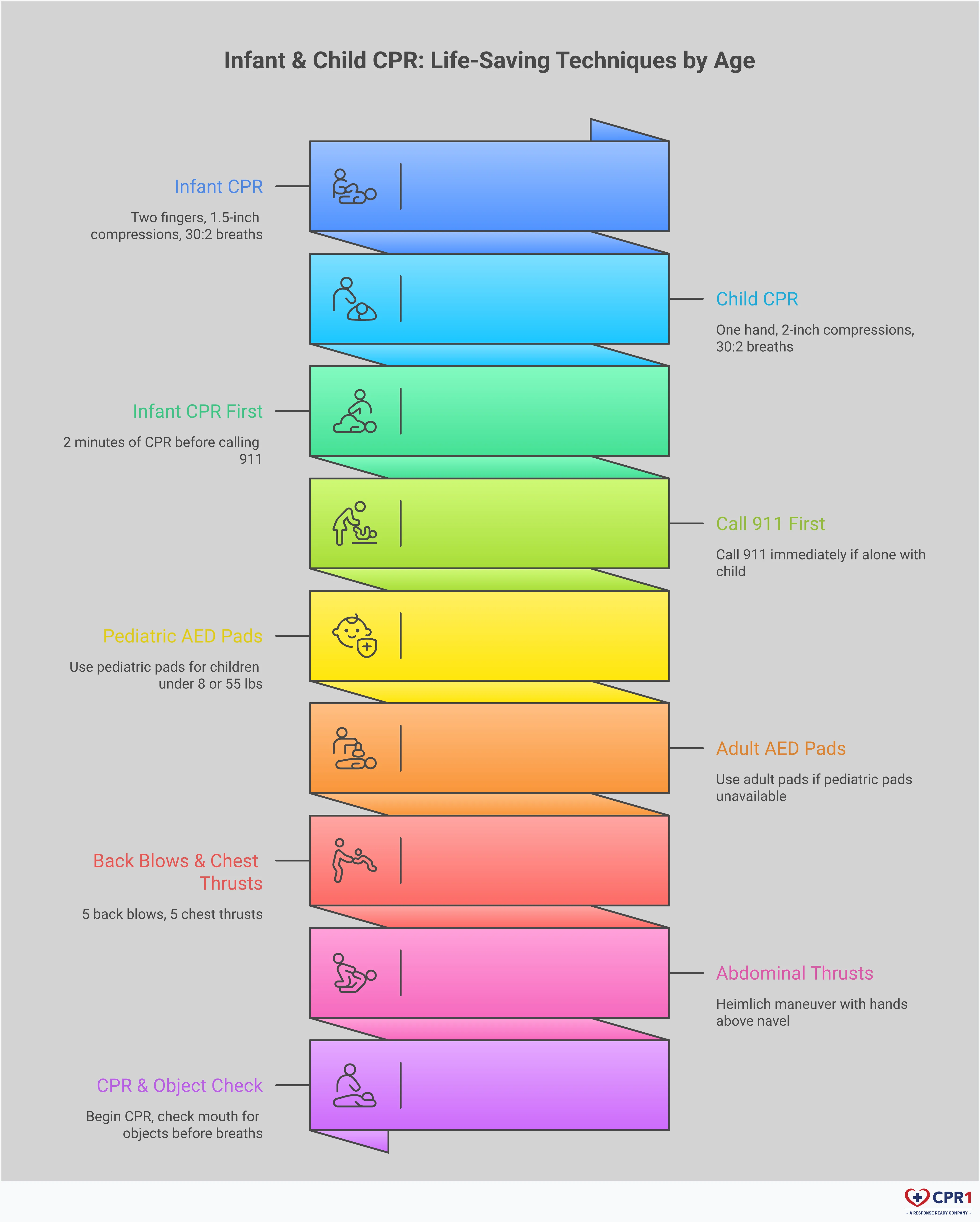
When an infant’s heart stops, it’s usually because they can’t breathe or are having trouble breathing. Unlike adults, who often suffer cardiac arrest from heart conditions, babies typically have healthy hearts. This is why giving CPR right away, with both chest compressions and rescue breaths, is the most important thing you can do. The American Heart Association stresses that immediate infant CPR is crucial until help arrives. To perform compressions, place two fingers in the center of the baby’s chest, just below the nipple line. Gently push down about 1.5 inches deep at a steady, quick rhythm of 100 to 120 compressions per minute.
Step 1: Check for Responsiveness and Breathing
Before you begin CPR, you need to quickly assess the situation. Is the infant conscious? Gently tap the bottom of their foot and call their name to check for a response. At the same time, scan their chest for any signs of breathing for no more than 10 seconds. If the baby is unresponsive and not breathing, or only gasping, it’s time to act. This quick but thorough check is vital to confirm that CPR is necessary. Immediately have someone call 911. If you are alone, shout for help, but if no one responds, perform two minutes of CPR before pausing to call 911 yourself. Every moment is critical.
Step 2: Position the Infant for Compressions
Proper positioning is key to performing effective CPR. Carefully place the infant on their back on a firm, flat surface, like the floor or a table. A soft surface like a bed or couch will absorb the force of your compressions, making them less effective and wasting precious energy. Make sure the baby’s head is in a neutral position—not tilted too far back or forward—to keep their delicate airway open. This simple step ensures that every compression you deliver is directed toward circulating blood and that the airway is clear for rescue breaths. It’s a foundational part of the process that sets you up for success.
Step 3: Performing Chest Compressions
Once the infant is positioned correctly, begin chest compressions immediately. Place two fingers—your index and middle finger—in the center of the infant’s chest, just below the nipple line. With your fingers in place, push down hard and fast, compressing the chest about 1.5 inches deep. The goal is a rate of 100 to 120 compressions per minute. To keep a steady rhythm, you can push to the beat of a song like “Stayin’ Alive.” This technique requires a specific amount of pressure, which is why hands-on practice in a certified CPR class is so valuable for building muscle memory and confidence.
Step 4: Giving Rescue Breaths
After 30 compressions, you’ll give two rescue breaths. Gently tilt the infant’s head back slightly to open the airway. Place your mouth over the infant’s nose and mouth, creating a complete seal. Give a gentle puff of air for about one second, just enough to make their chest visibly rise. Let the chest fall, then give a second breath. It’s important not to breathe too forcefully, as a baby’s lungs are small. These breaths are essential because, as we mentioned, infant cardiac arrest is often caused by a lack of oxygen, and rescue breaths help solve that problem directly.
Understanding Compression-to-Breath Ratios
The life-saving rhythm of infant CPR is a continuous cycle of 30 chest compressions followed by 2 rescue breaths. You will continue this 30:2 pattern without interruption until the infant shows signs of life, an AED is ready to use, or emergency responders arrive to take over. This ratio is designed to keep oxygenated blood flowing to the brain and other vital organs, providing a critical bridge of support. Following this sequence consistently is the most effective way to help an infant in cardiac arrest. Learning to perform these cycles smoothly and confidently is a core focus of our Basic Life Support (BLS) courses.
Your Step-by-Step Guide to Child CPR (Ages 1 to Puberty)
Once a child is over one year old, their body is larger and more developed, so the CPR technique changes slightly. Instead of two fingers, you’ll use the heel of one hand to give compressions in the center of the chest. The depth also increases to about 2 inches to ensure you’re effectively pumping the heart. The rate stays the same: a quick 100 to 120 compressions per minute. This adjustment provides the necessary force for a larger child while still being safe. This one-hand method is a key transition between the two-finger infant technique and the two-hand technique used for adults.
Step 1: Scene Safety and Checking for Response
Before you do anything else, your first priority is to make sure the area is safe. Quickly scan your surroundings for any immediate dangers, like traffic or falling objects. Once you’ve confirmed the scene is secure, check if the child is responsive. Kneel beside them, gently tap their shoulder, and ask loudly, “Are you okay?” If they don’t respond, they need help immediately. Shout for someone to call 911 and get an AED if one is available. If you are alone, put your phone on speaker and call 911 yourself before starting CPR. Every moment is critical, and alerting emergency services is a vital first step.
Step 2: The 30:2 Compression to Breath Ratio
The rhythm of CPR is based on a simple, repeating cycle: 30 chest compressions followed by 2 rescue breaths. This 30:2 ratio is the standard for a single rescuer performing CPR on a child. Think of it as a continuous loop you’ll repeat until help arrives, an AED is ready to use, or the child starts breathing on their own. This combination ensures that you are circulating existing oxygenated blood with compressions while also supplying fresh oxygen with rescue breaths. Maintaining this consistent pattern is the most effective way to support a child’s vital organs during a cardiac emergency.
Step 3: Proper Hand Placement and Depth
For a child, you’ll use the heel of one hand placed directly in the center of their chest, on the breastbone between the nipples. Keep your arm straight and position your shoulders directly over your hand to use your body weight for leverage. Press down hard and fast, compressing the chest about 2 inches deep. The goal is a rate of 100 to 120 compressions per minute—the beat of the song “Stayin’ Alive” is a great guide. It’s also important to allow the chest to fully recoil, or rise back to its normal position, between each compression. This allows the heart to refill with blood before the next push.
Step 4: Opening the Airway and Giving Breaths
After 30 compressions, it’s time to give two rescue breaths. Gently tilt the child’s head back and lift their chin to open the airway. This simple “head-tilt, chin-lift” maneuver prevents the tongue from blocking the back of the throat. Pinch the child’s nose shut, take a normal breath, and form a complete seal over their mouth with yours. Give one breath lasting about a second, just enough to make their chest visibly rise. Let the chest fall, then give a second breath. If the chest doesn’t rise, reposition the head and try again. Then, immediately return to chest compressions. This process is a core part of the child CPR guidelines from organizations like the American Red Cross, which emphasize how crucial these breaths are.
What’s the Main Difference? Hand Placement, Depth, and Airway
The most obvious differences between infant and child CPR are hand placement and compression depth. For infants, you use two fingers to press down about 1.5 inches. For children, you use one hand to press down about 2 inches. Another critical distinction is the importance of rescue breaths. While hands-only CPR is often recommended for adults, breathing problems are the primary cause of cardiac arrest in young children. Because of this, both infants and children require rescue breaths along with chest compressions to supply their bodies with the oxygen they desperately need.
How to Safely Use an AED on Infants and Children
If an Automated External Defibrillator (AED) is available, you should use it as soon as possible. These devices are designed to be used by anyone, and they provide clear voice instructions. For children under 8 years old or weighing less than 55 pounds, you should use pediatric pads if they are available. These pads deliver a lower, safer dose of electricity. If you only have adult pads, you can still use them, but make sure they don’t touch each other on the child’s chest. Place one on the center of the chest and the other on the back. Continue performing CPR until medical help arrives or the child starts breathing again.
Common Mistakes to Avoid in Pediatric CPR
When you’re faced with an unresponsive child, your adrenaline spikes, and it’s completely normal to feel a surge of panic. The fear of doing something wrong can be paralyzing. However, the biggest mistake you can make in a life-or-death situation is doing nothing at all. Understanding the most common errors in pediatric CPR can help you prepare mentally, turning that potential panic into a clear, actionable plan. Proper training is designed to build muscle memory and confidence so that your hands know what to do even when your mind is racing. It’s about replacing fear with a focused response.
The most critical errors often happen in the first few moments of an emergency. They usually fall into three categories: hesitating to start, using the wrong technique for the situation, or misinterpreting the child’s condition. Knowing these pitfalls ahead of time is half the battle. By learning to recognize them, you can ensure that the help you provide is both immediate and effective. Let’s walk through these common mistakes so you can feel more prepared to act correctly and confidently when it matters most.
Not Starting CPR Soon Enough
Hesitation is the single greatest barrier to saving a life. Many people freeze because they’re afraid of hurting the child or doing CPR incorrectly. But when a child stops breathing, every second counts. The brain can only survive for a few minutes without oxygen before permanent damage begins. In a situation where a child is unresponsive and not breathing, providing immediate CPR is their best and only chance. The risk of inaction is far greater than the risk of performing compressions imperfectly. Our hands-on training is specifically designed to build the confidence you need to overcome this hesitation and start life-saving compressions right away.
Incorrect Airway Technique for Suspected Neck Injuries
Opening a child’s airway is a critical step, but the technique changes if you suspect a head or neck injury, such as after a fall. The standard method is the head-tilt, chin-lift. However, this movement could worsen a spinal injury. In these cases, you must use a different technique called the jaw-thrust maneuver. To do this, you gently pull the jaw forward without tilting the head back. This subtle but crucial difference is something that’s difficult to master from a diagram. It’s a skill that requires hands-on practice to perform safely and effectively, ensuring you can open the airway without causing further harm.
Performing CPR When It Isn’t Needed
Just as it’s critical to act when needed, it’s also important not to perform CPR on a child who doesn’t need it. Before you begin, you must quickly assess the situation. Is the child truly unresponsive? Are they breathing? According to MedlinePlus, you should not start chest compressions if the child is breathing, coughing, or moving. Performing compressions on a child whose heart is still beating can interfere with their natural heart rhythm and potentially cause harm. This is why every CPR class begins with the most fundamental step: checking for responsiveness and signs of life. A proper assessment ensures you only intervene when it is absolutely necessary.
What to Expect in Your Infant & Child CPR Class
Walking into a CPR class can feel a little intimidating, but it’s one of the most empowering things you can do as a parent, teacher, or caregiver. The goal isn’t just to teach you a set of steps from a manual; it’s about building the muscle memory and confidence you need to act calmly and effectively in a real emergency. A great class moves beyond lectures and gets you practicing hands-on with infant and child manikins. Your instructor, often a first responder or healthcare professional, will guide you through every technique, from chest compressions to rescue breaths.
You’ll learn how to handle some of the most common pediatric emergencies, including choking and sudden unresponsiveness. The training covers the entire sequence of a response, starting with how to spot a problem and knowing exactly when to call for help. By the time you leave, you won’t just have a certification card. You’ll have the practical skills and the self-assurance to protect the children in your care. It’s about turning fear and uncertainty into a clear, actionable plan, so you’re prepared for the moments that matter most.
First Steps: How to Recognize an Emergency
The first and most critical step in any emergency is recognizing that it’s happening. In your class, you’ll learn to quickly assess a situation and identify the signs that a child or infant needs immediate help. This goes beyond just seeing an obvious injury. You’ll learn to spot subtle but serious signs of distress, like changes in breathing, unresponsiveness, or a sudden loss of consciousness. As experts often say, when an infant stops breathing or becomes unresponsive, immediate and correct CPR can save their life. This training gives you the framework to stay calm, evaluate the scene for safety, and determine the right first move, ensuring you can act without hesitation.
Building Your Skills with Hands-On Practice
This is where knowledge becomes a life-saving skill. Your infant and child CPR class is built around hands-on practice. Using realistic infant and child manikins, you’ll learn the correct hand placement, compression depth, and rhythm for delivering effective CPR. An experienced instructor will provide real-time feedback to ensure your technique is right. CPR certification helps caregivers learn correct positioning because gentle but effective compressions are key for infants. This practical experience is what builds true competence. You’ll leave the class not just knowing what to do, but feeling the motions in your hands, ready to apply them if you ever need to.
How to Help a Choking Child
Choking is a terrifyingly common and silent emergency for young children. Your CPR class will dedicate time to teaching you the specific, age-appropriate techniques to help a choking infant or child. For infants, you’ll practice the “five-and-five” method of back blows and chest thrusts. For older children, you’ll learn how to perform abdominal thrusts (the Heimlich maneuver). The training also covers what to do if a child becomes unresponsive from a blocked airway. You’ll learn the proper sequence of care, which includes when to call 911 and how to begin CPR if the child stops breathing, giving you a clear plan for this high-stress scenario.
When and How Should You Call for Help?
Knowing how to perform CPR is vital, but so is knowing how to get professional help on the way. Your training will cover the critical question of when to call 911. In some situations, you’ll call immediately, while in others, you might start CPR for a short period first, especially if you’re alone. Your instructor will walk you through these different scenarios so you understand the best course of action. You’ll also learn what to tell the dispatcher, like your exact location and the child’s condition, to ensure first responders can get to you as quickly as possible. This part of the training connects your individual actions to the larger system of emergency response.
The “Call First vs. Care First” Rule
One of the most important things you’ll learn is the “Call First vs. Care First” rule, which guides your first move when you’re the only rescuer on the scene. For infants and children, the guideline is almost always “Care First.” This is because cardiac arrest in children is typically caused by a breathing problem, not a heart problem. Providing two minutes of immediate CPR—giving care first—can deliver critical oxygen and may even resolve the issue before you pause to call 911. The main exception is if you witness a child suddenly collapse, which could signal a cardiac event. In that case, you would “Call First” to get an AED and paramedics on the way as quickly as possible. Making this split-second decision correctly is a core part of our hands-on training, where we use scenarios to build your confidence.
Building the Confidence to Act in an Emergency
Ultimately, a CPR class is about building your confidence. Many people worry they might do something wrong or make the situation worse, but professional training helps replace that fear with readiness. By practicing in a supportive environment, you’ll see that anyone can learn and perform CPR. The hands-on repetition and guidance from your instructor ensure you are prepared to act decisively. As one pediatrician and mom advises, having those first aid and CPR skills you can pull from your back pocket may mean the difference for your child. You’ll leave the class feeling empowered, knowing you have the ability to step in and make a life-saving difference.
How to Choose the Right CPR Class for You
Picking a CPR class can feel like a big decision, but it doesn’t have to be complicated. The most important thing is finding a course that leaves you feeling capable and confident, not just checked-off and certified. You want training that sticks with you, so if an emergency ever happens, you can act without hesitation. Think about what you need personally or professionally. Are you a new parent wanting peace of mind, or do you need a specific certification for your job as a teacher or healthcare provider? The right class will align with your goals and give you the specific skills you need for the situations you’re most likely to face.
Your learning style also matters. Do you learn best with hands-on practice in a classroom, or do you need the flexibility of an online course you can fit into a busy schedule? Other factors like the instructor’s experience, the course schedule, and the cost all play a role. A great course is more than just a video and a quiz; it’s an experience that prepares you for a real-life crisis. Let’s walk through the key things to look for so you can find the perfect fit and get the skills you need to be prepared for the moments that matter most.
Why Accredited Certification Matters
First things first, make sure the class you choose offers an accredited certification. This is a non-negotiable. Accreditation means the course content meets current, nationally accepted guidelines from organizations like the American Heart Association or the American Red Cross. It’s your guarantee that you’re learning the most effective, up-to-date techniques. For professionals in fields like childcare, healthcare, or education, an accredited certification is often required for licensing and employment. But even if you’re just learning for your own family, you want to know the skills you’re acquiring are correct and reliable.
What Makes a Great Instructor?
A great instructor can make all the difference. They do more than just teach the steps; they build your confidence. Look for instructors with real-world experience, like paramedics, firefighters, or nurses. They can share practical insights that you won’t find in a textbook and answer your “what if” questions with firsthand knowledge. The best instructors create a supportive, judgment-free environment where you feel comfortable practicing and asking questions. Remember, anyone can learn and perform CPR. A skilled instructor ensures you leave the class not just knowing what to do, but truly believing you can do it.
In-Person, Online, or Blended: Which Class Is Right for You?
Your life is busy, so your training should fit your schedule. CPR courses come in a few different formats, so you can pick what works for you. Traditional in-person classes are perfect if you learn best by doing and want direct feedback from an instructor. If your schedule is packed, a fully online course offers maximum flexibility. A blended learning option gives you the best of both worlds: you can complete the coursework online at your own pace and then attend a short, in-person session to practice your hands-on skills.
What to Know About Scheduling and Recertification
CPR skills are perishable. To keep them sharp and stay current with any new guidelines, it’s recommended that you renew your certification every two years. When you’re choosing a provider, think long-term. Does the company offer easy-to-schedule recertification classes? Do they send out reminders when your certification is about to expire? Finding a training partner who makes it simple to stay up-to-date is a huge plus. This ensures you’re always prepared to respond effectively in an emergency.
How Much Does a CPR Class Cost?
Finally, let’s talk about cost. Think of a CPR class as an investment in your ability to save a life. Course fees typically cover the instructor’s time, training materials, and your official certification card upon successful completion. Prices can vary based on the type of class and the provider. If you’re taking the course for your job, ask your employer about reimbursement. Many companies will cover the cost of safety training, especially if it’s required for your role. When you sign up, make sure you understand what’s included in the fee so there are no surprises.
Related Articles
- Pediatric First Aid CPR Class 101: A Full Guide
- CPR for All Ages | Expert Guidance & Certification — CPR1
- Pediatric CPR: A 6-Step Guide for Parents
Frequently Asked Questions
I’m worried I might hurt a baby or small child by performing CPR. Is this a valid concern? This is a very common and understandable fear, but the techniques taught in a certified class are specifically designed for the delicate bodies of infants and children. The greatest danger in a cardiac emergency is inaction. A child’s ribs are flexible, and the goal of CPR is to keep oxygenated blood flowing to the brain. Proper training ensures you use the right amount of force, and it’s important to remember that an injury from CPR is treatable, while a lack of oxygen to the brain can have permanent consequences.
Why are rescue breaths so important for children when I hear about “hands-only” CPR for adults? This is a key difference in pediatric care. While adult cardiac arrest is often caused by a sudden heart problem, in children it’s usually the result of a breathing issue, like choking or a severe asthma attack. Their hearts are typically healthy but stop because of a lack of oxygen. That’s why providing rescue breaths along with chest compressions is so critical for them; you are directly addressing the most likely cause of the emergency.
Can I learn what I need from an online video instead of taking a certified class? While watching a video can give you a general idea of the steps, it can’t replace the value of a hands-on, accredited course. In a proper class, you get to practice on realistic manikins, which helps build the muscle memory you need to perform compressions at the correct depth and rate. An experienced instructor also provides immediate feedback to correct your technique, ensuring you are truly prepared to act effectively.
How will I remember all the steps during a real, high-stress emergency? This is precisely why professional training focuses so much on hands-on repetition. By practicing the sequence of checking for responsiveness, calling for help, and performing compressions and breaths, you are training your body to respond automatically. In a real crisis, when adrenaline is high, this muscle memory takes over. The goal of a class isn’t just to teach you the steps; it’s to build the confidence and competence to use them when it counts.
What is the difference between infant and child CPR? The core principles are the same, but the techniques are adapted for a child’s size and development. For an infant (under one year), you use two fingers for chest compressions, pressing down about 1.5 inches. For a child (from one year to puberty), you typically use the heel of one hand and press down about 2 inches. These specific methods ensure the compressions are both safe and effective for their smaller frames.


