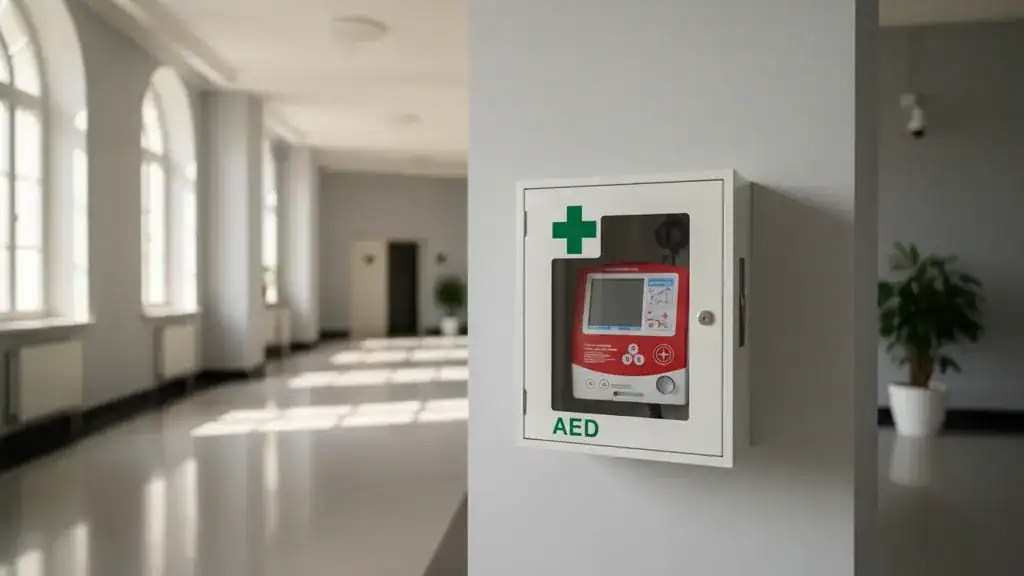
Correct AED pad placement helps the automated external defibrillator send a shock through the heart instead of around it. In a real cardiac emergency, the goal is simple: call 911, start CPR, turn on the AED, expose and prepare the chest, place the pads where the diagrams show, and follow the voice prompts without delay.
Need a team that can use an AED with confidence? Schedule CPR and AED training with CPR1 for practical instruction delivered nationwide.
This guide explains where AED pads go for adults, children and infants, plus what to do when you see a pacemaker, medication patch, wet skin, chest hair, pregnancy or a larger body type. Use it as a training reference, not as a replacement for the instructions printed on your AED pads or spoken by the device.
Quick Answer: Where Do AED Pads Go?
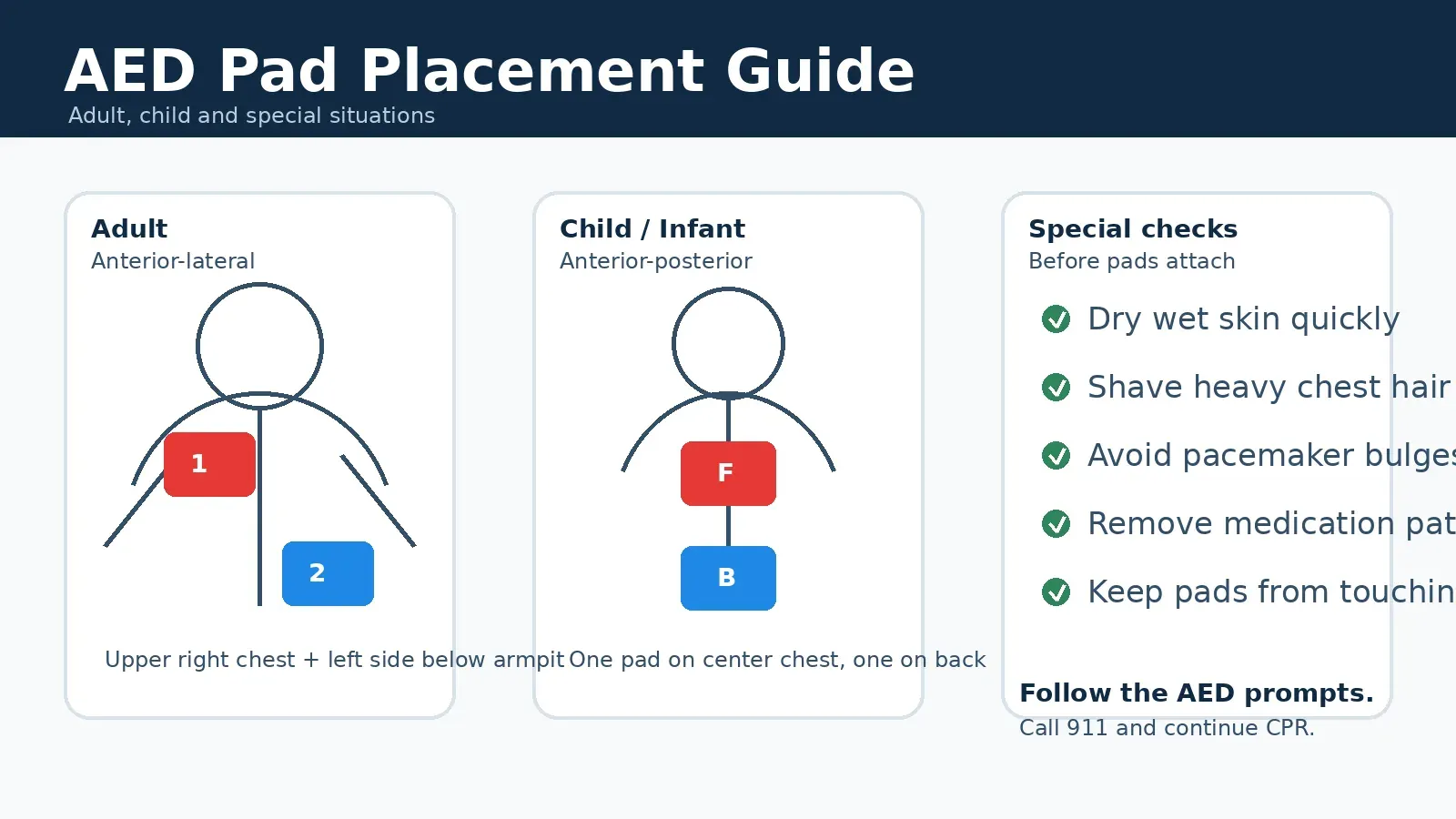
For most adults and older children, use anterior-lateral AED pad placement. Place one pad on the upper right side of the bare chest, just below the collarbone. Place the other pad on the left side of the chest, below the armpit and along the ribs. This creates a pathway across the heart.
For infants and smaller children, use pediatric pads if available. If the pads might touch on the chest, use anterior-posterior placement: one pad in the center of the chest and one pad in the center of the back between the shoulder blades. The American Red Cross notes that pediatric AED pads and AED-specific placement instructions should be used when possible, and adult pads may be used for infants and children if pediatric pads are unavailable and the pads do not touch.
| Person | Preferred pad placement | Key reminder |
|---|---|---|
| Adult | Upper right chest and left side below armpit | Keep pads on bare, dry skin |
| Older child | Same as adult if pads do not touch | Use pediatric pads if the AED has them |
| Infant or small child | One pad on chest, one pad on back | Prevent pad overlap |
| Special situations | Adjust slightly as needed | Do not place pads over patches or implanted devices |
Before Pad Placement, Do These Safety Steps
AEDs are designed to guide rescuers, including people who are not healthcare professionals. The best pad placement still depends on a few fast preparation steps.
- Call 911 and send someone for the AED. If you are alone, call 911 on speaker, get the AED if it is nearby, and return quickly.
- Start CPR. Push hard and fast in the center of the chest until the AED is ready to analyze.
- Turn on the AED. Open the lid or press the power button. Follow the prompts exactly.
- Expose the chest. Remove clothing from the chest area so pads stick directly to skin.
- Prepare the skin. Dry moisture, remove medication patches, and clear heavy hair only if it prevents pad contact.
- Place the pads, plug in the connector if required, and clear the person. Do not touch the person while the AED analyzes or delivers a shock.
Speed matters. Do not spend unnecessary time trying to make pad placement perfect. Place the pads correctly enough for the AED to work, make sure nobody is touching the person during analysis and shock, then resume CPR immediately when prompted.
Standard Adult AED Pad Placement
Adult AED pad placement usually follows the anterior-lateral position. “Anterior” means the front of the body. “Lateral” means the side. The pads sit on opposite sides of the chest so the shock can travel through the heart muscle.
Pad 1: Upper Right Chest
Place the first pad on the person’s upper right chest, below the collarbone and to the right of the breastbone. Keep the pad flat against the skin. Avoid placing it over clothing, jewelry, thick chest hair or a visible implanted device.
Pad 2: Left Side Below the Armpit
Place the second pad on the person’s left side, a few inches below the armpit and along the ribs. The pad should be on the side of the chest, not on the stomach. If breast tissue is in the way, place the pad slightly lower or more to the side so it stays flat against the chest wall.
The AED pad package usually shows this placement with clear diagrams. When the diagram and a general rule seem different, follow the device-specific diagram and the AED’s spoken prompts.
AED Pad Placement for Children and Infants
Children need the same fast response: call 911, start CPR, turn on the AED and follow the prompts. The difference is pad size, energy dose and the chance that pads could overlap on a smaller chest.
Use Pediatric Pads When Available
If the AED has pediatric pads, a child key or a child mode, use it for infants and children according to the manufacturer’s instructions. Pediatric pads are designed to reduce the shock dose for smaller bodies. Many AEDs label pediatric pads for children under 8 years old or under a certain weight, but always follow the instructions for your model.
Use Adult Pads if Pediatric Pads Are Not Available
Do not delay defibrillation because pediatric pads are missing. Adult pads may be used for infants and children when pediatric pads are not available, as long as the pads do not touch each other. If the chest is too small for both pads on the front, place one pad on the center of the chest and the other on the center of the back.
Anterior-Posterior Placement for Small Chests
Anterior-posterior placement means one pad goes on the front and one goes on the back. Place the front pad in the center of the chest. Place the back pad between the shoulder blades. This layout helps the electrical current pass through the heart while keeping the pads separated.
For more detail on age and pad selection, see CPR1’s guide to whether you can use adult AED pads on an infant.
What If the Person Has a Pacemaker or ICD?
A pacemaker or implantable cardioverter defibrillator may appear as a firm bump under the skin, often in the upper chest. Do not put an AED pad directly over that bump. Place the pad at least about an inch away while still following the correct general pad position.
You should still use the AED. An implanted device does not replace the AED in a sudden cardiac arrest response. The key is to avoid placing the adhesive pad directly on top of the device so the shock pathway and pad seal are not compromised.
Building or updating an AED program? Explore AED program management with CPR1 to support equipment readiness, tracking and compliance.
What If There Is a Medication Patch?
Medication patches can include nitroglycerin, pain medication, nicotine, hormone medication and other transdermal treatments. Do not place AED pads over a medication patch. A patch can interfere with pad contact and may increase the risk of a burn.
If a patch is where the AED pad needs to go, remove it quickly, wipe the skin clean if possible, and place the AED pad on bare skin. Use gloves if available. Do not spend extra time identifying the medication if the person is unresponsive and not breathing normally. Remove the obstruction, place the pad and follow the AED prompts.
What If the Chest Is Wet?
If the person is in standing water, move them to a drier area if you can do so safely. If the chest is wet from sweat, rain, a pool or another source, dry the chest quickly before placing the pads. The pads need to stick securely to skin, and a dry surface helps the AED work as intended.
You do not need the person to be perfectly dry from head to toe. Focus on the chest where the pads will attach. Wipe quickly, attach the pads, clear the person and let the AED analyze.
What If the Person Has a Hairy Chest?
AED pads must stick to skin. Heavy chest hair can keep the adhesive gel from making good contact. If the pad does not stick or the AED tells you to check the pads, use the razor in the AED kit if one is available. Shave only the areas where pads will go.
If there is no razor and pads will not stick, some AED kits include a second set of pads. One practical emergency method is to press the first set firmly onto the hair and pull it off quickly to remove enough hair for the second set to stick. Use this only when hair is clearly preventing pad contact. Do not delay shock delivery for minor hair that does not affect adhesion.
AED Pad Placement During Pregnancy or on Larger Bodies
Use the AED on a pregnant person in cardiac arrest. Place the pads in the standard adult positions unless the AED instructions say otherwise. The shock is intended to pass through the heart, and rapid defibrillation gives both the pregnant person and fetus the best chance of survival.
For larger bodies, use the same anatomical landmarks: upper right chest and left side below the armpit. Make sure each pad is flat, fully adhered and placed on the chest wall rather than the abdomen. If needed, move breast tissue out of the way and place the left pad slightly more lateral so it has firm contact.
Common AED Pad Placement Mistakes to Avoid
- Placing pads over clothing. Pads must touch bare skin.
- Letting pads touch each other. This is especially important for infants and small children.
- Putting a pad over a pacemaker or medication patch. Move the pad slightly or remove the patch.
- Placing the left pad too low on the abdomen. Keep it on the side of the chest along the ribs.
- Touching the person during analysis or shock. Loudly say “clear” and make sure everyone is clear.
- Stopping CPR too long. Resume compressions immediately after the shock or when the AED says no shock is advised.
How Training Helps Pad Placement Feel Automatic
In an emergency, even simple steps can feel difficult. Hands-on training helps employees, teachers, coaches, caregivers and safety teams practice the sequence before a real event: recognize cardiac arrest, call 911, start CPR, power on the AED, place pads correctly and rotate compressors.
CPR1 provides onsite CPR and AED training for organizations across all 50 states, with instructors who bring real EMS, fire and healthcare experience. Courses can help teams understand not just where pads go, but how to manage the scene, communicate clearly and keep compressions moving while the AED is prepared.
If your organization also manages devices, pads, batteries and inspections, review CPR1’s article on AED pad expiration dates. Expired or missing pads can stop a rescue before it starts.
Frequently Asked Questions About AED Pad Placement
Where should AED pads be placed on an adult?
Place one pad on the upper right chest below the collarbone. Place the other pad on the left side of the chest below the armpit. This is the most common adult AED pad placement.
Where do AED pads go on a child?
Use pediatric pads if available. If the child is large enough that pads will not touch, use the adult-style upper right chest and left side placement. If the pads might touch, put one pad on the center of the chest and one on the center of the back.
Can you use adult AED pads on an infant?
Yes, if pediatric pads are not available. Do not let the pads touch each other. For most infants, that means placing one pad on the chest and the other on the back.
Can AED pads go over a bra?
No. AED pads must attach to bare skin. Remove clothing from the chest. If a bra interferes with pad placement, remove or cut it away quickly while maintaining as much privacy as the emergency allows.
Do AED pads go over or under a pacemaker?
Do not place an AED pad directly over a pacemaker or implanted defibrillator. Place the pad slightly away from the visible or felt bump while keeping the pad in the correct general chest area.
Key Takeaways
- Adult AED pads usually go on the upper right chest and the left side below the armpit.
- Infants and small children often need one pad on the chest and one on the back.
- Use pediatric pads or child mode when available, but do not delay AED use if only adult pads are available.
- Dry wet skin, remove medication patches, avoid pacemaker bumps and clear heavy hair if it prevents pad contact.
- Always follow the AED diagrams and voice prompts for the device in front of you.
Prepare your team before the emergency happens. Book CPR and AED training with CPR1 so your staff can respond quickly, place pads correctly and keep CPR going with confidence.
For additional rescue context, read CPR1’s guide to special considerations when using an AED and the step-by-step overview of how an automated external defibrillator works.