


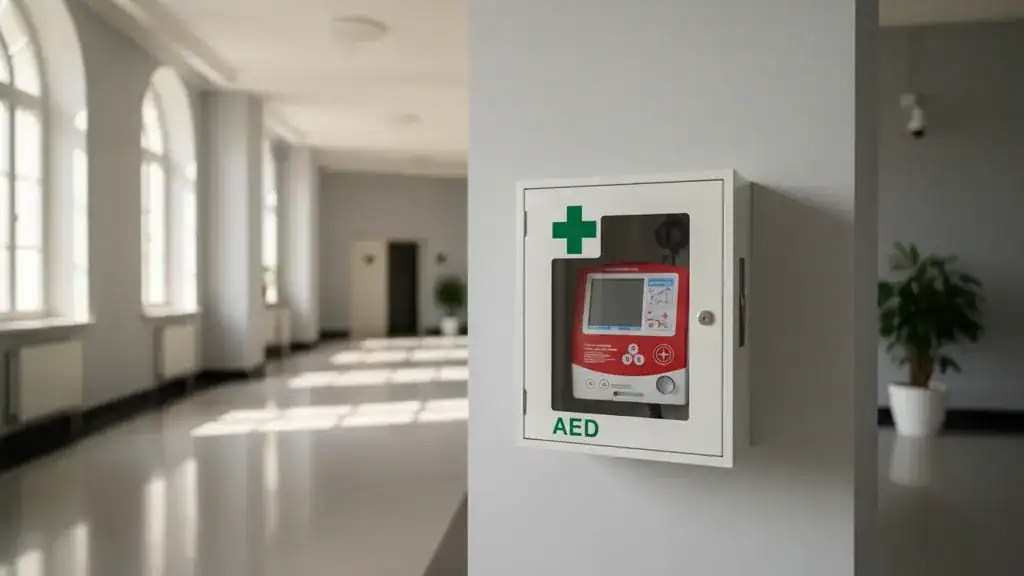
AED Laws by State: Where Defibrillators Are Required (2026)
AED requirements by state vary widely, but the stakes are the same everywhere: sudden cardiac arrest kills more than 350,000 Americans outside of a hospital each year, and survival rates can double or triple when a bystander uses an AED within the first few minutes. More than half of U.S. states now mandate AEDs in at least one category of public location, school, or workplace. If you manage a building, school, gym, or business, understanding your state’s law is no longer optional.
Quick answer: At least 16 states require AEDs in K-12 schools. More than 20 states require them in health clubs and fitness centers. Several states also mandate AEDs in government buildings, dental offices, golf courses, and other public spaces. Federal law covers certain federal properties and funds state programs, but does not impose a universal private-sector mandate.
Need to meet AED requirements for your state? CPR1 provides certified CPR and AED training for schools, businesses, gyms, and organizations in all 50 states. Book AED training today and keep your team compliant.
Federal AED Legislation Overview
No single federal law requires private businesses to install AEDs, but several federal statutes set the foundation for public access defibrillation programs across the country.
The Cardiac Arrest Survival Act of 2000 directed the federal government to place AEDs in federal buildings and created Good Samaritan protections for lay rescuers who use an AED on federal property. It also funded state grant programs to expand public access defibrillation.
The OSHA General Duty Clause (Section 5(a)(1) of the Occupational Safety and Health Act) requires employers to provide a workplace free from recognized hazards that could cause serious injury or death. OSHA has cited sudden cardiac arrest as a recognized hazard in workplaces where employees are at elevated cardiovascular risk or where the nearest EMS response exceeds four minutes. OSHA has also issued letters of interpretation encouraging AED programs in workplaces, particularly those that are remote from emergency services.
The Public Health Service Act (42 U.S.C. Section 238p) provides liability protection to AED users and to entities that acquire AEDs for community use, provided certain conditions are met: the AED is properly maintained, users are trained, and the program includes physician oversight.
Federal aviation rules require AEDs on commercial passenger aircraft. The Department of Education has issued guidance encouraging schools to implement cardiac emergency response plans. Veterans Affairs facilities and military installations are required to maintain AED programs.
For a full overview of CPR and AED laws across the United States, including workplace requirements and state funding programs, see CPR1’s federal and state legislation guide.
State-by-State AED Requirements: At a Glance
The table below summarizes AED requirements for the states with the broadest mandates. Requirements change as legislatures update statutes, so always verify current law with your state health department or legal counsel.
| State | Schools | Fitness Centers | Government Buildings | Other |
|---|---|---|---|---|
| California | Required | Required | Many public buildings | High-voltage worksites; youth sports by 2028 |
| New York | Required | Health clubs required | Public buildings | Dental offices; physician agreement required |
| Florida | High school athletics | Encouraged | State buildings required | AED registration with local EMS required |
| Illinois | Required | Required | Encouraged | Public pools |
| New Jersey | Required | Health clubs required | State and county buildings | Dental offices |
| Massachusetts | Required | Health clubs required | Encouraged | Worksites encouraged |
| Texas | Schools with athletics | Encouraged | Encouraged | Large event venues encouraged |
| Oregon | Encouraged | Health clubs required | Encouraged | Public pools |
| Rhode Island | Required | Health clubs required | State buildings required | Golf courses (pending) |
| Arkansas | Encouraged | Fitness centers required | Encouraged | Long-term care facilities |
| Pennsylvania | Required | Encouraged | Encouraged | Schools and camps |
| Ohio | Required | Encouraged | Encouraged | Summer camps with athletic programs |
| Maryland | Required | Encouraged | Public libraries (2026) | Local government facilities |
| Virginia | Required | Encouraged | Encouraged | Youth athletics |
| Georgia | Required | Encouraged | Encouraged | Youth sports |
| Connecticut | Required | Encouraged | Encouraged | Senior living facilities (2026) |
| Washington | Required | Encouraged | Encouraged | Youth sports |
| Arizona | Required | Encouraged | Encouraged | Youth athletics |
| Michigan | Required | Encouraged | Encouraged | Schools must post AED location |
States with School AED Requirements
Protecting student athletes and staff from sudden cardiac arrest is the driving force behind school AED mandates. Student athletes are at higher risk during physical exertion, and cardiac emergencies can occur in any school building. As of 2026, at least 16 states have enacted laws requiring AEDs in K-12 schools or on school grounds. Many more encourage them without a hard mandate.
What most school AED laws require:
- At least one AED accessible on school grounds during school hours and sporting events
- Designated trained responders who hold current CPR and AED certification
- A written cardiac emergency response plan (CERP)
- Annual inspection and maintenance documentation
- Notification of AED location to local EMS
California (Health and Safety Code Section 104113) requires AEDs at public schools and mandates that AED users receive CPR training. A 2024 law adds a requirement for AEDs at organized youth sports practices and games by 2028, with CPR/AED certification for coaches by 2027.
New York (Public Health Law Article 30) requires AEDs in public and nonpublic schools. Nonpublic schools must install AEDs, post signage with AED location, and report all AED activations to local EMS. Schools must have a physician agreement or collaborative protocol with a licensed physician.
Florida (Florida Statutes 1006.165) requires public high schools that participate in interscholastic athletics to have at least one AED on campus and one available at all athletic practices and events. Trained AED responders must be present when the device is deployed at events.
Texas (Texas Education Code 22.902) requires school districts with athletic programs to acquire and maintain AEDs at each campus, train coaches and athletic trainers in CPR and AED use, and develop cardiac emergency response plans.
Schools in Pennsylvania, Ohio, Maryland, Virginia, Georgia, Connecticut, Michigan, Washington, Arizona, and Massachusetts face similar requirements with varying scope. If your state is not listed, check your state’s department of education for current guidance, as requirements are expanding.
Schools: Get AED-certified staff in place. CPR1 offers onsite AED and CPR training for educators, coaches, and school staff in all 50 states. View school training packages or contact us to schedule a session.
States with Gym and Fitness Center AED Requirements
High-intensity exercise elevates cardiac risk, which is why fitness centers were among the first private businesses targeted by state AED laws. More than 20 states now require health clubs and fitness facilities to maintain AEDs on their premises.
Key requirements for fitness centers in most states with mandates:
- At least one AED accessible in the facility at all times it is open
- Staff trained in CPR and AED operation, often a minimum number per shift
- Annual AED inspection and battery/pad replacement per manufacturer schedule
- A written emergency action plan
- 911 notification protocols and documentation of any AED use
New York (Public Health Law Section 3000-aa) requires health clubs with 500 or more members to have an AED and a trained operator present during business hours. Smaller clubs are covered by physician agreement provisions in the same statute.
California (Health and Safety Code Section 104113) requires AEDs at staffed fitness facilities and mandates that at least one staff member per shift be trained in CPR and AED use. Facilities must maintain AEDs per manufacturer specifications and report use to local EMS.
Illinois (210 ILCS 74) requires health clubs to maintain at least one AED and ensure a trained responder is on duty whenever the facility is open to members.
New Jersey (N.J.S.A. 2A:62A-25) mandates AEDs in health clubs and requires training for staff members who work at the facility.
Oregon, Massachusetts, Rhode Island, and Arkansas have similar health club mandates with variations in facility size thresholds, staff training hours, and reporting requirements. If you operate a gym or fitness center, verify requirements with your state health department because thresholds for member count and facility size differ significantly.
Even in states without a formal mandate, fitness centers face potential OSHA liability and civil litigation risk if a member suffers cardiac arrest and no AED is available. Most insurance carriers now recommend AED programs for any commercial gym or fitness operation.
States with Government Building Requirements
Several states require AEDs in government-owned facilities, recognizing that public buildings host large numbers of people and serve populations with higher average age and cardiac risk.
Florida requires AEDs in all state government buildings and mandates registration of each device with local emergency medical services. State agency heads are responsible for ensuring trained personnel are available and that AED programs are documented and maintained.
New Jersey mandates AEDs in state and county government buildings. The law specifies that AEDs must be placed in areas accessible within a short response time and that designated employees must be trained to use them.
Rhode Island requires AEDs in state buildings and is expanding requirements to public golf courses and other recreational facilities.
Maryland passed legislation requiring AEDs in public libraries by 2026, with trained staff designated as AED responders. This reflects a broader trend of states expanding AED requirements beyond schools and gyms to libraries, recreation centers, and senior services locations.
Connecticut is requiring AEDs in senior living facilities by 2026, a mandate driven by the elevated cardiac risk among older adults in congregate settings.
At the federal level, the General Services Administration requires AEDs in all federally owned and leased buildings above a minimum occupancy threshold, and all federal employees assigned as building wardens receive AED training.
Good Samaritan Protections for AED Use
One of the most important points for any bystander or organization: every U.S. state has a Good Samaritan law that provides some degree of protection to individuals who use an AED on a person in cardiac arrest. Fear of legal liability should never stop a trained person from using an AED.
What Good Samaritan laws generally cover:
- Civil immunity for lay rescuers who act in good faith during a cardiac emergency
- Protection for organizations that acquire, maintain, and make AEDs available to the public
- Immunity for physicians or medical directors who provide oversight for a community AED program
- Protection that is strengthened when the user has completed CPR and AED training
The scope of protection varies by state. Some states provide near-absolute immunity for any good-faith AED use. Others limit protection to trained individuals, to specific device types, or to situations where the AED owner has met maintenance and registration requirements. A few states condition immunity on the entity having notified local EMS of the AED’s location.
The practical takeaway: Training increases your legal protection in most states. An untrained bystander who uses an AED is generally still protected, but a trained user operating within a documented program faces far lower legal risk and is far more likely to deploy the device correctly and save a life.
For California-specific AED laws and Good Samaritan protections, including the physician oversight requirement and written plan provisions, see CPR1’s California AED law guide.
How to Comply with AED Laws in Your State
Compliance involves more than buying a device. Most state laws require an operational AED program, not just a box on the wall. Here is a practical compliance checklist for any organization subject to AED requirements.
Step 1: Determine your state’s specific requirements
Your state health department or department of education is the authoritative source for current AED law. Requirements depend on your organization type (school, gym, employer, government agency), your state, and in some cases your facility size or member count. Do not rely solely on a general summary for compliance decisions.
Step 2: Purchase an FDA-cleared AED
All AEDs sold in the U.S. for human use must be cleared by the FDA. Common compliant models include the Philips HeartStart, ZOLL AED Plus, Cardiac Science Powerheart, and HeartSine Samaritan PAD. Many state programs have approved device lists, so confirm your device meets state specifications before purchasing.
Step 3: Register your AED with local EMS
Several states require AED registration with local emergency medical services, and many more strongly recommend it. Registration allows dispatchers to direct bystanders to the nearest AED during a 911 call. In most states this is a straightforward online process through the state health department.
Step 4: Train your designated responders
Most state laws require at least one, and often multiple, trained responders per facility or shift. Training requirements commonly include CPR plus AED operation. Some states specify American Heart Association, American Red Cross, or HSI certification. Certifications are valid for two years and must be renewed before expiration to maintain compliance.
Step 5: Get medical oversight if your state requires it
California, New York, and several other states require a physician oversight agreement for any AED program. This is a formal relationship with a licensed physician who prescribes the AED and provides a written protocol for its use. CPR1’s partner, MDSIMedical.com, provides physician oversight services nationally for organizations subject to this requirement.
Step 6: Maintain the device and document everything
AED manufacturers require regular maintenance checks, battery replacement, and pad replacement on defined schedules. Most state laws require documented maintenance records. Neglected AEDs have failed during cardiac emergencies, creating both life-safety and legal liability exposure. Use a maintenance tracking system to stay current.
Step 7: Develop a written emergency response plan
Many state laws require a documented cardiac emergency response plan that includes: the AED location, the names of trained responders, the procedure for calling 911, and a protocol for post-event AED data review. Your plan should be reviewed annually and updated when staff or procedures change.
For comprehensive ongoing compliance, including maintenance tracking, medical oversight, and program management, see CPR1’s AED compliance management guide.
Ready to build a compliant AED program? CPR1 offers AED equipment, CPR and AED training, physician oversight through MDSIMedical, and compliance management through AEDTotalSolution. Get started with AED training or contact our team for a full program assessment.
Frequently Asked Questions About AED Laws
Is my business required to have an AED by law?
It depends on your state, your industry, and your facility type. Schools, gyms, and government buildings face the broadest mandates. Private employers without one of those designations are rarely legally required to have an AED under state law, but OSHA’s General Duty Clause creates potential liability for workplaces where cardiac risk is elevated and EMS response time is long. Even without a mandate, most legal and safety experts recommend AEDs for any workplace with more than 50 employees or where physical exertion is part of the job.
Which states require AEDs in schools?
As of 2026, at least 16 states require AEDs in K-12 schools, including California, New York, Florida, Texas, Illinois, New Jersey, Massachusetts, Pennsylvania, Ohio, Maryland, Virginia, Georgia, Connecticut, Michigan, Washington, and Arizona. Requirements vary: some apply only to schools with athletics programs, while others cover all school buildings. Most states also require a trained responder, a written emergency plan, and annual maintenance documentation.
Do gyms and fitness centers need AEDs?
More than 20 states require health clubs and fitness centers to have AEDs on premises and trained staff during all operating hours. States with gym AED mandates include California, New York, Illinois, New Jersey, Massachusetts, Oregon, Rhode Island, Arkansas, and several others. Even in states without a specific law, fitness centers face civil liability exposure if a cardiac emergency occurs and no AED is available.
Am I protected from lawsuits if I use an AED on someone?
Yes. All 50 states have Good Samaritan laws that provide civil immunity to individuals who use an AED in good faith during a cardiac emergency. Protection is generally stronger when the user has completed CPR and AED training and when the AED is properly maintained and registered. An improperly maintained AED or an untrained user acting recklessly could face reduced protection in some states, but the threshold for losing Good Samaritan immunity is very high.
Do I need a physician’s prescription to own an AED?
Most AEDs for public access programs require a physician’s prescription, which is typically part of setting up a physician oversight agreement. California and New York explicitly require a physician oversight plan for any AED program. In practice, AED vendors and training providers often facilitate the physician prescription process. CPR1’s partner, MDSIMedical, provides nationwide physician oversight services for organizations that need to meet this requirement.
How often do AED pads and batteries need to be replaced?
AED electrode pads typically expire every two to three years, and AED batteries last four to five years depending on the model and how often the device is used. Most states that mandate AEDs also require maintenance per the manufacturer’s specifications. Organizations should document all maintenance activities, including pad and battery replacement dates, and conduct monthly or quarterly AED readiness checks.
Disclaimer for information purposes only:
The information provided on this website is intended for general educational and informational purposes only. It is not medical advice and should not be used as a substitute for professional diagnosis, treatment, or care. Always consult a qualified healthcare or medical professional regarding any health-related questions or concerns.
While we strive to ensure the information shared is accurate and up to date, no guarantees are made regarding completeness, accuracy, or applicability to any individual situation. Use of this content is at the reader’s sole discretion and risk.
This website is part of the Response Ready family of emergency preparedness and training resources, including CPR & first aid training and compliance services, AED sales and program support, AED program management software, and medical oversight solutions provided through our affiliated platforms:
• AEDLeader.com
• ResponseReady.com
• AEDTotalSolution.com
• MDSIMedical.com
By accessing or using this website, you agree to release, indemnify, and hold harmless the website owners, authors, contributors, and affiliated entities from any claims, losses, damages, or liabilities arising from the use or reliance on the information presented.

Save Lives with the Right AED Today
Buy Trusted AEDs from AED Leader Today!
Get Certified in CPR and Make a Difference!


