




CPR certification requirements by state are not identical. Most states do not require every adult to hold a CPR certification, but many states do require CPR, AED, or first aid training for specific jobs, workplaces, schools, childcare providers, healthcare roles, coaches, lifeguards, and public safety teams.
Need CPR, AED, or First Aid certification for your state or workplace? Review CPR1 training options.
The practical rule is simple: your certification must match the requirement set by your employer, licensing board, school district, state agency, or industry regulator. In many cases, that means choosing a recognized program from the American Heart Association, American Red Cross, Health & Safety Institute, or another nationally accepted provider with a hands-on skills evaluation.
**Quick answer:** In most states, CPR certification is valid for two years when issued by major providers such as the American Heart Association, American Red Cross, or HSI. Some jobs or agencies may require annual refreshers, in-person skills checks, BLS instead of layperson CPR, or additional First Aid/AED training.
CPR1 helps individuals, businesses, schools, healthcare teams, and multi-location organizations meet these requirements with CPR, AED, First Aid, BLS, and workplace safety training options nationwide.
What Counts as CPR Certification?
A CPR certification confirms that a person has completed training in cardiopulmonary resuscitation and, depending on the course, AED use, choking response, rescue breathing, and emergency action steps.
A complete CPR certification course commonly includes adult CPR, child CPR, infant CPR when required by the course or role, AED use, choking response, emergency scene safety, and hands-on skills practice. Some courses include First Aid, while others focus only on CPR/AED.
Healthcare workers may need Basic Life Support, often called BLS, which is more advanced than standard workplace CPR training. If you are unsure which course you need, start with the requirement source. Employers, licensing boards, school districts, and state agencies often specify whether they accept CPR/AED, First Aid/CPR/AED, BLS, or a provider-specific program.
Main CPR Certification Providers Accepted Across the U.S.
Most state and employer requirements refer to nationally recognized providers rather than creating their own CPR curriculum.
American Heart Association
American Heart Association courses are widely accepted for healthcare, public safety, workplace, and professional licensing needs. AHA BLS is commonly required for healthcare providers and clinical staff.
American Red Cross
American Red Cross CPR, AED, First Aid, and BLS courses are widely accepted by employers, schools, childcare programs, and many state-regulated roles.
Health & Safety Institute
Health & Safety Institute, also known as HSI, provides OSHA-aligned workplace safety, CPR, AED, First Aid, and BLS training options accepted by many employers and organizations.
Employer-Approved or Agency-Specific Training
Some employers, state boards, or agencies may accept equivalent training if it includes hands-on skills testing and follows current evidence-based CPR guidelines. Always verify before registering if your job or license depends on a specific provider.
Summary Table: CPR Certification Requirements by State
The table below summarizes common CPR certification expectations by state. State rules change, and requirements often depend on the role. Treat this as a planning guide, then confirm with the employer, licensing board, or state agency responsible for your specific requirement.
| State | Commonly Accepted Providers | Typical Renewal | Common Requirement Notes |
|---|---|---|---|
| Alabama | AHA, Red Cross, HSI, equivalents | 2 years | Childcare, healthcare, lifeguards, workplace responders |
| Alaska | AHA, Red Cross, HSI, equivalents | 2 years | Healthcare, childcare, remote worksites, public safety |
| Arizona | AHA, Red Cross, HSI, equivalents | 2 years | Childcare, healthcare, schools, lifeguards |
| Arkansas | AHA, Red Cross, HSI, equivalents | 2 years | Childcare, healthcare, schools, public safety |
| California | AHA, Red Cross, HSI, equivalents | 2 years | Childcare, healthcare, lifeguards, coaches, school staff |
| Colorado | AHA, Red Cross, HSI, equivalents | 2 years | Childcare, healthcare, recreation, workplace teams |
| Connecticut | AHA, Red Cross, HSI, equivalents | 2 years | Childcare, healthcare, lifeguards, school personnel |
| Delaware | AHA, Red Cross, HSI, equivalents | 2 years | Childcare, healthcare, first responders, workplace teams |
| Florida | AHA, Red Cross, HSI, equivalents | 2 years | Schools, childcare, healthcare, lifeguards, fitness facilities |
| Georgia | AHA, Red Cross, HSI, equivalents | 2 years | Childcare, healthcare, schools, public safety |
| Hawaii | AHA, Red Cross, HSI, equivalents | 2 years | Healthcare, childcare, aquatics, tourism, schools |
| Idaho | AHA, Red Cross, HSI, equivalents | 2 years | Childcare, healthcare, education, workplace responders |
| Illinois | AHA, Red Cross, HSI, equivalents | 2 years | Healthcare, childcare, coaches, schools, lifeguards |
| Indiana | AHA, Red Cross, HSI, equivalents | 2 years | Childcare, healthcare, schools, lifeguards |
| Iowa | AHA, Red Cross, HSI, equivalents | 2 years | Childcare, healthcare, public safety, schools |
| Kansas | AHA, Red Cross, HSI, equivalents | 2 years | Childcare, healthcare, schools, safety-sensitive roles |
| Kentucky | AHA, Red Cross, HSI, equivalents | 2 years | Childcare, healthcare, schools, public safety |
| Louisiana | AHA, Red Cross, HSI, equivalents | 2 years | Childcare, healthcare, schools, aquatics |
| Maine | AHA, Red Cross, HSI, equivalents | 2 years | Childcare, healthcare, outdoor programs, aquatics |
| Maryland | AHA, Red Cross, HSI, equivalents | 2 years | Childcare, healthcare, coaches, lifeguards |
| Massachusetts | AHA, Red Cross, HSI, equivalents | 2 years | Childcare, healthcare, lifeguards, licensed roles |
| Michigan | AHA, Red Cross, HSI, equivalents | 2 years | Childcare, healthcare, schools, athletics |
| Minnesota | AHA, Red Cross, HSI, equivalents | 2 years | Childcare, healthcare, schools, athletic roles |
| Mississippi | AHA, Red Cross, HSI, equivalents | 2 years | Childcare, healthcare, public safety, workplaces |
| Missouri | AHA, Red Cross, HSI, equivalents | 2 years | Childcare, healthcare, schools, lifeguards |
| Montana | AHA, Red Cross, HSI, equivalents | 2 years | Childcare, healthcare, schools, remote jobs |
| Nebraska | AHA, Red Cross, HSI, equivalents | 2 years | Childcare, healthcare, schools, aquatics |
| Nevada | AHA, Red Cross, HSI, equivalents | 2 years | Childcare, healthcare, hospitality, lifeguards |
| New Hampshire | AHA, Red Cross, HSI, equivalents | 2 years | Childcare, healthcare, recreation, schools |
| New Jersey | AHA, Red Cross, HSI, equivalents | 2 years | Childcare, healthcare, coaches, lifeguards |
| New Mexico | AHA, Red Cross, HSI, equivalents | 2 years | Childcare, healthcare, education, public safety |
| New York | AHA, Red Cross, HSI, equivalents | 2 years | Healthcare, childcare, schools, lifeguards, public facilities |
| North Carolina | AHA, Red Cross, HSI, equivalents | 2 years | Childcare, healthcare, schools, aquatics |
| North Dakota | AHA, Red Cross, HSI, equivalents | 2 years | Employer, childcare, healthcare, workplace safety policies |
| Ohio | AHA, Red Cross, HSI, equivalents | 2 years | Childcare, healthcare, schools, athletics |
| Oklahoma | AHA, Red Cross, HSI, equivalents | 2 years | Childcare, healthcare, schools, lifeguards |
| Oregon | AHA, Red Cross, HSI, equivalents | 2 years | Childcare, healthcare, schools, outdoor programs |
| Pennsylvania | AHA, Red Cross, HSI, equivalents | 2 years | Childcare, healthcare, coaches, lifeguards |
| Rhode Island | AHA, Red Cross, HSI, equivalents | 2 years | Childcare, healthcare, lifeguards, schools |
| South Carolina | AHA, Red Cross, HSI, equivalents | 2 years | Childcare, healthcare, schools, workplace teams |
| South Dakota | AHA, Red Cross, HSI, equivalents | 2 years | Childcare, healthcare, schools, aquatics |
| Tennessee | AHA, Red Cross, HSI, equivalents | 2 years | Childcare, healthcare, coaches, lifeguards |
| Texas | AHA, Red Cross, HSI, equivalents | 2 years | Childcare, healthcare, schools, athletics, public facilities |
| Utah | AHA, Red Cross, HSI, equivalents | 2 years | Childcare, healthcare, schools, recreation |
| Vermont | AHA, Red Cross, HSI, equivalents | 2 years | Childcare, healthcare, outdoor programs, workplace teams |
| Virginia | AHA, Red Cross, HSI, equivalents | 2 years | Childcare, healthcare, coaches, lifeguards |
| Washington | AHA, Red Cross, HSI, equivalents | 2 years | Childcare, healthcare, maritime, construction, schools |
| West Virginia | AHA, Red Cross, HSI, equivalents | 2 years | Childcare, healthcare, public safety, schools |
| Wisconsin | AHA, Red Cross, HSI, equivalents | 2 years | Childcare, healthcare, coaches, lifeguards |
| Wyoming | AHA, Red Cross, HSI, equivalents | 2 years | Childcare, healthcare, outdoor work, remote sites |
| Washington, D.C. | AHA, Red Cross, HSI, equivalents | 2 years | Childcare, healthcare, schools, public facilities |
State-by-State CPR Certification Guidance
West Region
In California, Oregon, Washington, Nevada, Arizona, Utah, Idaho, Montana, Wyoming, Alaska, Hawaii, Colorado, and New Mexico, CPR certification requirements are most often tied to childcare, healthcare, school, recreation, aquatics, outdoor work, remote work, and workplace safety roles. California, Washington, and Oregon employers may be especially specific about First Aid/CPR/AED for workplace teams and youth-facing staff. Remote or outdoor work settings in Alaska, Montana, Wyoming, and Idaho may also require broader First Aid training because emergency medical response can take longer.
If you work with children in any western state, confirm whether the course must include adult, child, and infant CPR. If you work in healthcare, confirm whether BLS is required instead of standard CPR/AED.
Midwest Region
In Illinois, Indiana, Iowa, Kansas, Michigan, Minnesota, Missouri, Nebraska, North Dakota, Ohio, South Dakota, and Wisconsin, CPR certification requirements are commonly connected to childcare licensing, healthcare employment, schools, athletic programs, lifeguarding, and employer safety policies. Many organizations accept AHA, Red Cross, HSI, or equivalent two-year certification.
Midwest employers with manufacturing, warehouse, logistics, agricultural, or construction operations may require designated responders to complete First Aid/CPR/AED training as part of a workplace emergency plan. When the course is for employment or licensing, choose a program with a documented skills evaluation.
Northeast Region
In Connecticut, Delaware, Maine, Maryland, Massachusetts, New Hampshire, New Jersey, New York, Pennsylvania, Rhode Island, Vermont, and Washington, D.C., CPR certification is often required for childcare providers, healthcare staff, school personnel, coaches, lifeguards, public facility teams, and certain licensed professionals.
New York, New Jersey, Massachusetts, and Pennsylvania employers may be particularly specific about provider type, renewal timing, and AED inclusion. If your certification is for a board, agency, or school system, verify the exact accepted providers before registering.
South Region
In Alabama, Arkansas, Florida, Georgia, Kentucky, Louisiana, Mississippi, North Carolina, Oklahoma, South Carolina, Tennessee, Texas, Virginia, and West Virginia, CPR certification requirements are commonly role-based. Childcare, healthcare, schools, athletics, aquatics, public safety, and workplace responder roles are frequent examples.
Florida and Texas have many public-facing workplaces, schools, fitness facilities, and childcare settings where CPR/AED or First Aid/CPR/AED may be expected. In all southern states, pediatric CPR may be required for childcare and youth program staff, while healthcare roles usually require BLS.
Online vs In-Person CPR Certification: What States Usually Accept
Online CPR training is convenient, but acceptance depends on the requirement. For general knowledge, online training may be useful. For employment, licensing, healthcare, childcare, lifeguarding, and many school roles, a skills evaluation is often required.
Online-only CPR may be acceptable when the employer only requires awareness-level training, the course is for personal knowledge, or a state agency specifically accepts online-only certification. Blended or in-person CPR is safer when the certification is for a job, license, healthcare role, childcare setting, BLS requirement, or adult/child/infant CPR competency.
A blended course usually includes online coursework followed by an instructor-led skills session. This format is common because it provides flexibility while still documenting hands-on competency.
How Long Does CPR Certification Last?
Most CPR certification cards from major providers are valid for two years. That includes many AHA, American Red Cross, and HSI CPR/AED and First Aid/CPR/AED courses.
However, renewal timing can vary by role. Some employers require annual refresher training, especially for high-risk workplaces, healthcare settings, childcare programs, and emergency response teams. If your employer or licensing board has a stricter renewal policy, follow that policy even if your card has not expired.
For a deeper explanation of the two-year renewal cycle, see CPR1’s guide on [how long CPR certification lasts](https://cpr1.com/cpr-certification-duration/).
CPR vs BLS: Which Certification Do You Need?
Standard CPR/AED certification is usually designed for lay rescuers, workplace responders, teachers, coaches, childcare staff, fitness professionals, and community members. BLS is designed for healthcare providers and clinical roles.
Choose standard CPR/AED or First Aid/CPR/AED if you need workplace safety training, childcare or school staff certification, coach or fitness instructor certification, general emergency response training, or CPR and AED skills for non-clinical roles.
Choose BLS if you need healthcare provider certification, clinical employment or school program compliance, team-based resuscitation skills, or more advanced airway, breathing, and cardiac emergency training. If you are comparing the two, read CPR1’s guide to [BLS vs CPR certification](https://cpr1.com/bls-vs-cpr-certification/).
Workplace CPR Certification Requirements
Workplace CPR certification requirements usually depend on the industry, risk level, distance from medical care, and whether employees are assigned emergency response duties. OSHA standards generally require employers to provide adequate first aid response when medical care is not near the worksite. That can make CPR, AED, and First Aid training an important part of a compliant safety program.
CPR certification is especially common in construction, manufacturing, warehousing, schools, childcare, healthcare, dental offices, fitness centers, recreation facilities, hospitality, event venues, government agencies, and municipal teams.
For employer-focused guidance, see CPR1’s guide to [CPR certification for workplace requirements](https://cpr1.com/workplace-first-aid-certification/).
How to Choose the Right CPR Certification Course
Use this checklist before registering:
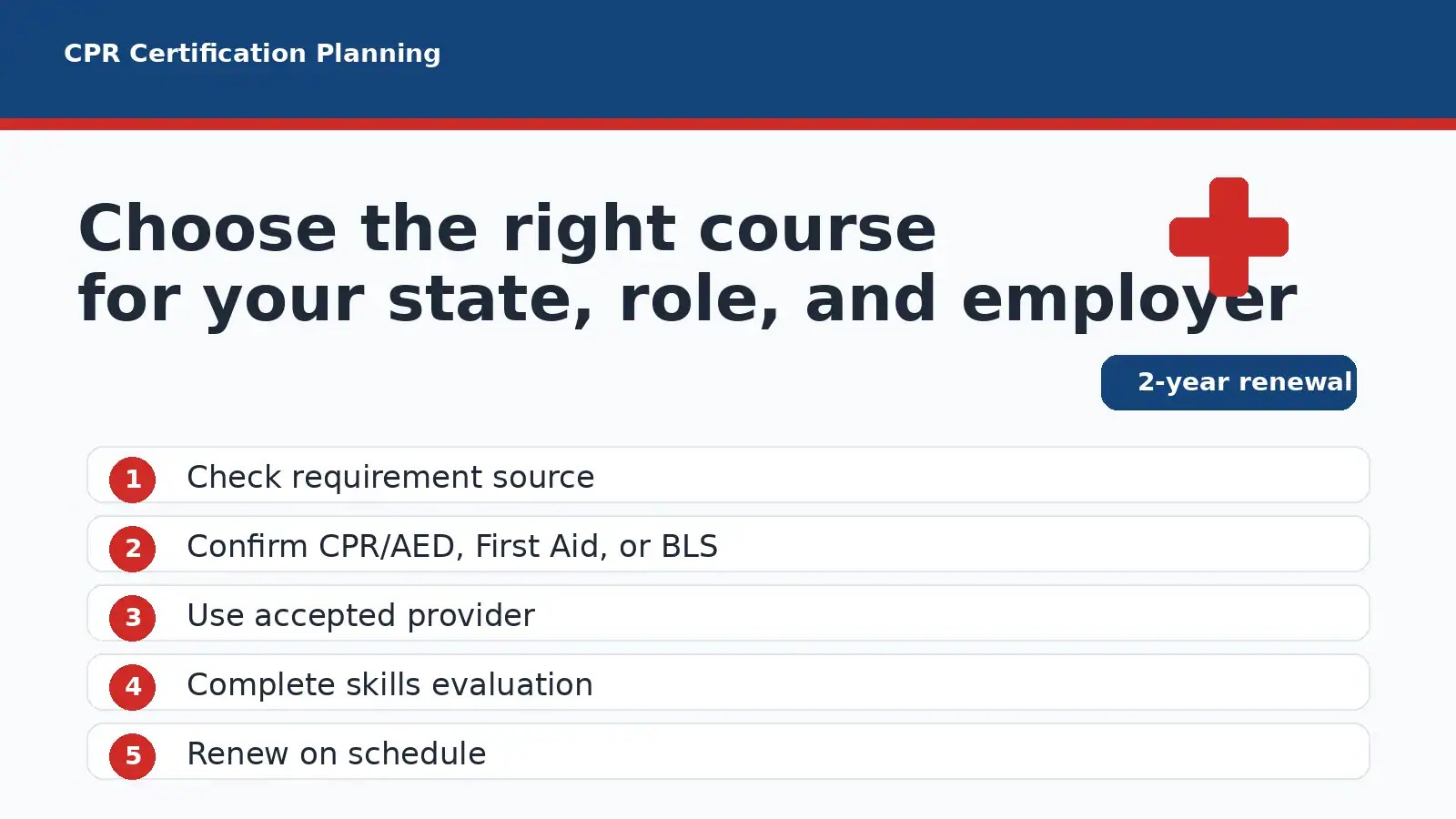
- **Identify the requirement source.** Is it from an employer, state license, school, healthcare program, or professional board?
- **Confirm the course type.** Do you need CPR/AED, First Aid/CPR/AED, pediatric CPR, or BLS?
- **Check provider acceptance.** Verify whether AHA, Red Cross, HSI, or another provider is required.
- **Confirm skills evaluation rules.** Do not choose online-only training if a hands-on skills test is required.
- **Check renewal timing.** Most cards last two years, but your employer may require annual refreshers.
- **Keep documentation.** Save your digital card or certificate for employer, license, or audit records.
If you need a course that covers CPR, AED, and First Aid, review CPR1’s [CPR, AED & First Aid training](https://cpr1.com/product/cpr-aed-first-aid/). If your organization only needs CPR and AED training, see CPR1’s [CPR & AED course](https://cpr1.com/product/cpr-aed/).
Related CPR1 Resources
FAQ: CPR Certification Requirements by State
Are CPR certification requirements the same in every state?
No. CPR certification requirements vary by state, employer, licensing board, and job role. Most states do not require every resident to hold CPR certification, but many roles require it.
Which CPR certification provider is accepted in my state?
Many states and employers accept nationally recognized providers such as the American Heart Association, American Red Cross, and Health & Safety Institute. Some agencies or employers specify a preferred provider, so verify before registering.
Does CPR certification expire?
Yes. Most CPR certifications from major providers are valid for two years. Some employers or agencies may require more frequent refreshers.
Can I get CPR certified online?
Sometimes. Online-only CPR may be accepted for awareness-level training or personal knowledge, but many employers, licensing boards, healthcare programs, childcare roles, and lifeguard roles require a hands-on skills evaluation.
Do I need CPR or BLS certification?
You likely need standard CPR/AED or First Aid/CPR/AED if you are a workplace responder, coach, teacher, childcare worker, fitness professional, or community member. You likely need BLS if you work in healthcare or a clinical training program.
Is AED training required with CPR certification?
Often, yes. Many modern CPR courses include AED training, and many workplaces or public safety programs expect responders to know how to use an AED. Check the wording of your requirement.
Get CPR Certified with CPR1
CPR certification requirements by state can be confusing because the right answer depends on the role, employer, and agency behind the requirement. CPR1 makes the process easier with nationally recognized CPR, AED, First Aid, BLS, and workplace safety training options for individuals and organizations.
Whether you need one certification or a nationwide training program for multiple locations, CPR1 can help you choose the right course and document completion for your compliance needs.
**Next step:** [Contact CPR1](https://cpr1.com/contact-us/) or review CPR1’s [CPR, AED & First Aid training options](https://cpr1.com/product/cpr-aed-first-aid/).


