




In the chaos of a cardiac emergency, confidence is everything. Even with an AED nearby, hesitation can cost precious seconds. The difference between a bystander and a first responder often comes down to feeling prepared and empowered to act. A physician oversight service builds that confidence. When your team knows a medical expert has designed and approved your emergency plan, it removes the guesswork and fear. They can act decisively, knowing they are following a medically sound protocol. This provides the structure and validation needed to turn your staff into a team of capable, confident lifesavers.
Key Takeaways
- Protect Your Organization from Liability: Physician oversight provides the medical authority and documentation needed to demonstrate due diligence, strengthening your legal protection far beyond what Good Samaritan laws can offer.
- Streamline Your Entire AED Program: A provider does more than write a prescription; they create response protocols, approve training, guide device placement, and manage post-event reporting, ensuring every detail is handled correctly.
- Build a Confident and Effective Response Team: Knowing a medical expert has approved the emergency plan gives your team the confidence to act decisively. This structure turns bystanders into capable responders, which is essential for improving survival outcomes.
What Does AED Physician Oversight Actually Mean?
So, what exactly is AED physician oversight? Think of it as having a licensed doctor on your team who manages your entire AED program from a medical standpoint. This expert ensures everything is done correctly, from the device you choose to how your team responds during a cardiac arrest. This oversight confirms that your program follows established medical protocols and will be truly effective when a life is on the line. It’s the critical piece of the puzzle that turns a well-intentioned safety plan into a medically sound, life-saving operation that you can count on.
How a Doctor Guides Your AED Program
A physician’s role in your AED program is both active and essential. In many states, having a doctor provide medical direction is a legal requirement. This doctor is responsible for supervising all the medical aspects of your program. They write and approve the emergency protocols your team will follow, ensure the AED is properly maintained, and review any event where the device is used. Their guidance confirms that the care provided meets current medical standards and that your program is compliant with all local and state regulations, giving you confidence that you’re prepared for an emergency.
Is AED Oversight Legally Required?
Beyond being a best practice, physician oversight is often a legal mandate. Many states require it to ensure your AED program meets specific medical standards. This requirement is also closely tied to legal protection for your organization. While Good Samaritan laws offer a shield to those who provide reasonable aid in an emergency, having formal physician oversight strengthens that protection. It demonstrates that you’ve taken the proper steps to create a responsible and well-managed program, which is crucial for protecting your organization and your responders from liability. It’s about doing things the right way—both for the person in need and for your team.
The Real Reasons You Need Physician Oversight
So, you’ve invested in an AED for your workplace, school, or community center. That’s a fantastic first step, but placing a device on the wall is only part of the equation. To create a truly effective and legally sound AED program, you need physician oversight. This isn’t just red tape; it’s the critical component that ensures your program is medically sound, compliant, and ready to work when a life is on the line. Think of it as having a medical expert on your team who validates your entire emergency response plan, from training to post-event review.
Stay Compliant with State Laws
Let’s start with the law. Many states have specific regulations that require a licensed physician to oversee an organization’s AED program, often called “Medical Direction.” These rules exist to ensure life-saving equipment is managed responsibly and according to established medical standards. Requirements for device registration and training protocols can vary significantly. Navigating these state-specific AED laws is complex, but physician oversight simplifies the process by putting an expert in charge of compliance, so you can be confident your program meets all legal mandates.
Protect Your Organization from Liability
While Good Samaritan laws offer legal protection to rescuers, they don’t always extend to the organization that owns the AED. This is where physician oversight becomes your best defense. By having a doctor guide your program, you demonstrate that your organization has performed its due diligence. This oversight ensures your AEDs are properly maintained, your staff is correctly trained, and your response protocols align with medical guidelines. It establishes a clear standard of care that significantly reduces your liability risk, proving you’ve taken every reasonable step to prepare for an emergency.
Create a Stronger Emergency Response
Beyond compliance, physician oversight directly improves your ability to save a life. A doctor’s involvement ensures your emergency plan is built on a solid medical foundation. They help determine the best locations for your AEDs, approve your training curriculum, and establish clear response protocols. We know that a victim’s chance of survival plummets with each passing minute. A physician-led program eliminates guesswork and hesitation, empowering your team to act quickly and confidently. This guidance turns a well-intentioned plan into a high-functioning, life-saving system.
Beyond AEDs: Other Forms of Physician and Healthcare Oversight
The concept of having a medical expert guide your safety program isn’t unique to AEDs. Physician oversight is a foundational principle throughout the healthcare industry, designed to ensure patient safety, maintain high standards of care, and meet legal requirements. Think of it as a system of checks and balances that places a qualified medical professional at the helm of any health-related process. This structure ensures that decisions are based on sound medical knowledge, not just good intentions. From managing complex patient care at home to supervising medical professionals, this model of expert guidance is everywhere.
Understanding these other forms of oversight helps clarify why it’s so critical for your AED program. It’s not an arbitrary rule; it’s part of a proven, system-wide approach to responsible healthcare. When a doctor oversees a patient’s care plan or collaborates with a nurse practitioner, they provide the same essential function as an AED medical director: they offer expert validation, ensure compliance, and create a framework for the best possible outcome. This principle is the bedrock of a safe and effective health and safety culture, whether it’s in a hospital, a clinic, or your workplace.
Care Plan Oversight (CPO) for Medicare Patients
One of the clearest examples of physician oversight is Care Plan Oversight, or CPO. This happens when a doctor supervises the care of Medicare patients who are receiving services from a home health agency or hospice. These patients often have complex medical needs that require coordination between multiple caregivers and services. The physician’s role is to review the case, coordinate with the home health or hospice staff, and make sure the patient’s care plan is being followed correctly. This oversight ensures that a qualified medical expert is keeping a close eye on the patient’s progress and that the care provided is both safe and effective.
Key Rules and Requirements for Billing Medicare CPO
This process is highly regulated to ensure accountability. For a physician to bill for CPO, they must be the same doctor who initially signed the home health or hospice care plan. Furthermore, these oversight services must be provided while the patient is actively receiving Medicare-covered care. These strict rules confirm that the oversight is consistent, documented, and directly connected to the patient’s ongoing treatment, preventing gaps in supervision and ensuring a high standard of care.
Collaborating Physicians for Advanced Practice Providers
Another common form of medical oversight involves collaborating physicians for advanced practice providers, such as Nurse Practitioners (NPs) and Physician Assistants (PAs). In many states, these highly skilled professionals are required to work in collaboration with a licensed physician. The doctor doesn’t micromanage their work but provides consultation, reviews complex cases, and is available for support. This structure allows NPs and PAs to provide excellent care to more patients while ensuring a physician is involved for guidance and ultimate medical responsibility. It’s a partnership that balances autonomy with expert supervision, and it’s a standard practice across the country.
Governmental and Payer Oversight
Oversight also exists on a much larger scale. Both government bodies and private insurance companies (payers) have systems in place to monitor healthcare quality, compliance, and costs. This top-level supervision ensures that entire healthcare systems, hospitals, and provider networks adhere to national standards and regulations. It’s less about a single doctor overseeing a single program and more about ensuring the integrity of the healthcare landscape as a whole. This framework is designed to protect patients, manage resources responsibly, and maintain public trust in medical institutions.
Federal Oversight of Health Insurance
At the federal level, agencies like the Center for Consumer Information and Insurance Oversight (CCIIO) play a huge role. The CCIIO is responsible for implementing the provisions of the Affordable Care Act (ACA) related to private health insurance. This government oversight ensures that insurance plans meet specific requirements for coverage and consumer protection, making sure that the health insurance market is fair and transparent for everyone.
Payer Oversight of Provider Networks
Insurance companies also conduct their own oversight. They continuously monitor the doctors, clinics, and hospitals within their networks to ensure they meet quality standards and follow contractual rules. This is especially true for programs like Medicare Advantage, where providers must adhere to strict federal regulations. This payer oversight helps guarantee that members receive high-quality, compliant care from the providers available in their plan.
What Does a Physician Oversight Program Include?
When you bring an AED into your workplace, you’re also bringing in a set of responsibilities. Physician oversight isn’t just about checking a legal box; it’s an active partnership that ensures your emergency response plan is sound, effective, and ready for a real-world crisis. Think of it as having a dedicated medical expert on your team who guides every aspect of your AED program, from initial setup to post-event review.
A comprehensive oversight program provides the medical direction required to run a successful and compliant program. The physician’s involvement turns a well-intentioned safety measure into a life-saving system you can count on. They provide the clinical authority that supports your team, protects your organization, and ultimately gives everyone the confidence to act decisively during an emergency. This partnership covers everything from creating response protocols and training plans to ensuring your equipment is always ready to go.
Get Clear Medical Protocols
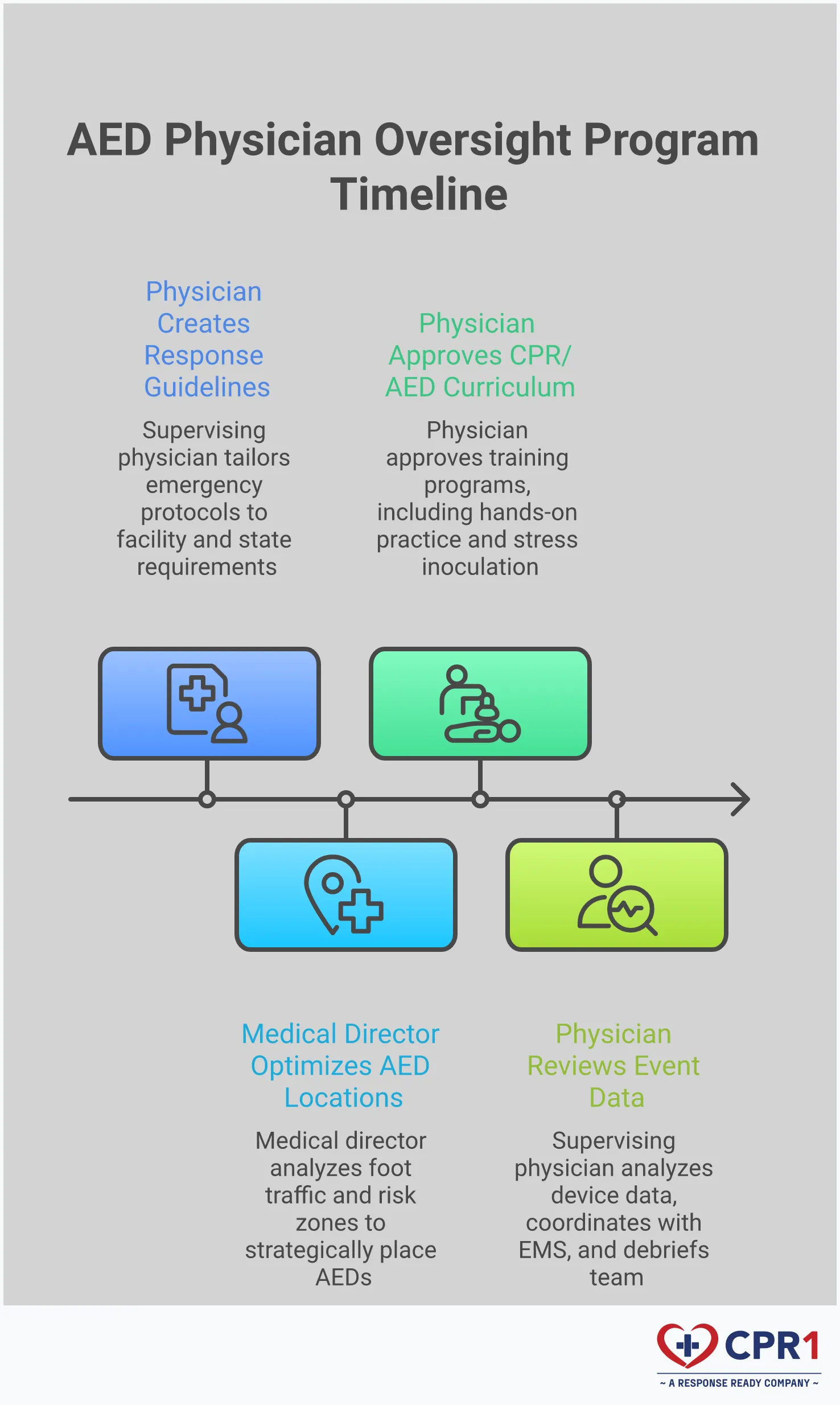
Every organization is different, and so is every emergency response plan. A supervising physician develops medical protocols tailored to your specific environment. These are the official guidelines that direct your team on how and when to use the AED, ensuring every action aligns with current medical best practices and local EMS procedures. Because each state has its own AED requirements, your physician ensures your protocols meet all legal standards, creating a clear, approved framework for your responders to follow without hesitation.
Ensure Your Training Plan is Medically Sound
Having an AED is one thing, but knowing how to use it confidently is another. A key role of the supervising physician is to review and approve your team’s training plan. They ensure your staff receives proper, certified CPR and AED instruction that prepares them for a high-stress cardiac emergency. This step confirms that your responders aren’t just familiar with the device but are truly competent, knowing exactly what to do from the moment an incident occurs until professional help arrives.
Get Expert Guidance on AED Placement
Where you place your AED can make the difference between life and death. A sudden cardiac arrest requires an immediate response, and a device that’s hard to find or too far away won’t do much good. As part of the oversight program, a physician will help you determine the most strategic locations for your AEDs. By analyzing your building’s layout, foot traffic, and high-risk areas, they can recommend placements that ensure a rescuer can retrieve and apply the device within three minutes of a collapse.
Learn From Every Emergency
After an AED is used, the work isn’t over. A critical part of physician oversight is the post-event review. The physician analyzes the data recorded by the AED and gathers feedback on the team’s response. This process provides invaluable insights into what went well and identifies opportunities for improvement. It’s a constructive, data-driven debrief that helps refine your protocols and strengthen your team’s skills for any future events, creating a cycle of continuous improvement for your entire safety program.
Make Sure Your AEDs Are Always Ready
An AED only works if it’s ready to perform at a moment’s notice. Physician oversight includes establishing and monitoring a maintenance schedule to ensure your device is always functional. This involves regular checks on battery life, electrode pad expiration dates, and overall device status. With a service like AED Total Solution, your physician helps implement a system that tracks these details, guaranteeing your equipment is compliant and ready to save a life whenever it’s needed.
How Physician Oversight Keeps Your Program Compliant
Think of physician oversight as the central nervous system of your AED program. It’s not just about getting a doctor’s signature on a form; it’s an active, ongoing partnership that ensures every part of your emergency response plan works correctly and meets legal standards. A well-managed program protects you from liability, but more importantly, it ensures your team is truly ready to save a life. Without it, you’re left managing a pile of equipment and paperwork with no clear direction.
An oversight service handles the complex administrative and medical details so you can focus on running your organization. This includes navigating the maze of state laws, maintaining meticulous records, and keeping up with ever-changing regulations. A dedicated medical director ensures your program isn’t just compliant on paper—it’s effective in practice. They connect the dots between the equipment, the training, and the people, creating a cohesive system that you can count on when every second matters. This approach moves your organization beyond simple compliance to full-scale emergency readiness, giving you confidence that your response will be swift and effective.
Stay on Top of State-Specific Rules
AED program requirements are not one-size-fits-all; they change significantly from one state to another. What’s required in California might be different from the rules in Texas or New York. These state-specific laws can dictate everything from who can use an AED to what kind of training they need and which post-event reports you must file. Trying to figure this out on your own can be overwhelming and risky.
A physician oversight service eliminates that guesswork. A qualified medical director understands the specific legal landscape where your organization operates. They ensure your AED prescription, response protocols, and training plans are tailored to meet local and state mandates, keeping your program fully compliant from day one.
Keep Accurate, Compliant Records
If you ever need to prove your AED program was managed responsibly, solid documentation is your best defense. Compliance requires you to keep detailed records of everything, including monthly AED readiness checks, battery and electrode pad expiration dates, and the certification status of your trained responders. After an emergency, you’ll also need to document the event and the actions taken.
This is where a great oversight provider truly shines. Many, like our partner AEDTotalSolution.com, offer cloud-based software that automates tracking and sends reminders for maintenance and training renewals. This creates an archived and detailed history of your program, giving you an easily accessible, audit-proof record that demonstrates due diligence and keeps your entire program organized and ready.
Keep Up with Changing Regulations
Emergency response guidelines and state laws are constantly evolving. The American Heart Association periodically updates its CPR and ECC guidelines, AED manufacturers release new software or recall notices, and state legislatures can amend compliance rules. Staying on top of these changes is critical for keeping your program effective and legally sound, but it’s a lot to manage on your own.
A key role of your physician oversight provider is to monitor these developments for you. They keep you informed about new rules or changes that could impact your program. When a new guideline is released or a law is updated, they provide clear instructions on how to adapt. This proactive management ensures your program never becomes outdated or falls out of compliance.
How Much Does a Physician Oversight Service Cost?
When you’re building an AED program, thinking about the budget is a practical and important step. It’s helpful to view physician oversight not as a simple expense, but as a critical investment in the safety of your community and the legal standing of your organization. The cost covers the expertise and legal authority of a licensed physician who ensures your program is effective, compliant, and ready for an emergency. Without it, even the best AED can become a liability.
The pricing for these services is designed to be straightforward and predictable. It typically includes the initial AED prescription, the development of medical protocols, and ongoing support, such as reviewing event data if your device is ever used. This comprehensive approach ensures every part of your program meets both medical and legal standards. While it might be tempting to cut corners, the cost of non-compliance—whether through fines or litigation—is always far greater than the cost of a professionally managed oversight program. Investing in a service like the one offered by MDSIMedical.com gives you peace of mind, knowing that every detail is handled by experts whose sole focus is emergency readiness.
Breaking Down Annual Service Costs
For most organizations, physician oversight is managed through a simple annual service fee. This fee keeps your program active and ensures you have a doctor’s prescription on file for your AED, which is a requirement in most states. Typically, you can expect this service to be priced at around $149.99 for one year. This predictable cost covers the essential medical direction needed to run a compliant program. It’s a small price to pay for knowing that your protocols are medically sound and that you have a clear plan in place for responding to a sudden cardiac arrest event. Think of it as your program’s annual check-up to keep it healthy and effective.
How Multi-Year Plans Can Save You Money
If you’re looking for ways to streamline your budget and reduce administrative tasks, multi-year plans are an excellent option. Many providers offer significant savings when you commit to a three- or five-year service plan. For example, you might find options to extend your coverage for three years for an additional $250 or five years for $450, which brings down the average annual cost. This approach not only saves money but also locks in your compliance for the long term. It’s a smart choice for any organization—from schools to corporate offices—that wants to ensure continuous, uninterrupted oversight without the hassle of yearly renewals.
In-House vs. Provider: A Cost Comparison
It’s natural to wonder if you can handle AED oversight internally to save money. However, the do-it-yourself approach often comes with hidden costs and significant risks. Managing compliance in-house requires dedicated staff time to track changing state laws, document maintenance checks, and handle post-event reporting. If any step is missed, your organization could be exposed to serious liability. A professional provider eliminates this guesswork. Using a dedicated AED compliance management service is almost always more cost-effective when you factor in the value of your team’s time and the high cost of a potential mistake. It’s the most reliable way to ensure your program is always ready.
Understanding Costs for a Collaborating Physician
While our main focus has been on AED programs, the idea of physician oversight extends into many other parts of healthcare. For advanced practice providers like Nurse Practitioners (NPs), this partnership is known as a collaborating physician relationship. If you’re an NP, you already know that finding a collaborating physician is a crucial step, and the cost is a big part of that puzzle. There’s no single “market rate” for these services, and the fees can be surprisingly flexible. Most providers can expect to pay between $700 and $900 per month, though the actual cost can range from $500 to over $1,200. Understanding what influences these prices will help you find an arrangement that works for your practice and your budget.
Factors That Influence Collaborating Physician Fees
So, what causes such a wide range in cost? A huge factor is your state’s specific regulations. Every state has its own set of rules for how physicians and advanced practice providers can work together. For instance, some states limit the number of providers a single doctor can oversee, which creates more competition for fewer available physicians and drives up the price. Other states might require in-person meetings or mandate that the collaborating physician lives and practices in-state. These types of restrictions can significantly influence the final fee, because they narrow your search to a much smaller, local pool of doctors.
Your medical specialty also plays a major role in the cost. Just like with anything else, it comes down to supply and demand. In fields where there’s a shortage of supervising physicians available for collaboration, the fees are naturally going to be higher. Psychiatry is a perfect example of this. Finding a collaborating physician in this specialty can be challenging, which makes it more expensive—it’s not uncommon for these arrangements to cost between $1,500 and $3,500 per month. This higher price reflects the simple fact that fewer psychiatrists are available to take on these partnerships, making their time and oversight a premium service.
How Oversight Directly Improves Emergency Outcomes
Having an AED on the wall is a great first step, but a physician-led oversight program is what turns that device into a life-saving tool. It’s about creating a system that works flawlessly under pressure. When a medical expert guides your program, you’re not just checking a box for compliance; you’re building a response plan that gives a person experiencing sudden cardiac arrest the best possible chance of survival. That expert guidance creates a more prepared, confident, and effective team, ensuring that when an emergency happens, your response is immediate and correct. From ensuring the device is ready to go to building your team’s confidence, every part of physician oversight is designed to produce better outcomes.
Does Oversight Actually Improve Survival Rates?
When someone suffers a sudden cardiac arrest, every second counts. The single most important factor in survival is how quickly they receive a defibrillation shock. Physician oversight ensures your AED program is built for speed and effectiveness. A doctor helps establish protocols for routine checks, making sure batteries are charged and pads are within their expiration date. This readiness is critical because prompt AED use is directly linked to higher survival rates. An evidence review on public access defibrillation confirms that AEDs significantly increase the chance of survival. By having a medically directed plan, you ensure your device is always ready and your team is prepared to act without hesitation, closing the gap between collapse and care.
Create a Consistent, High-Quality Response
In a crisis, you don’t want your team guessing what to do next. Physician oversight provides clear, medically sound protocols that create a standardized response every single time. A medical director reviews and approves your training, AED placement, and post-event procedures, ensuring everything aligns with current best practices. This consistency is key to a high-quality response. While modern AEDs are designed for high usability even by untrained individuals, a well-managed program removes any room for error. It ensures that anyone on your team, from a new hire to a seasoned manager, can step in and provide effective care, confident they are following a physician-approved plan.
Give Your Team the Confidence to Act
An AED can be intimidating, and hesitation can cost precious time. One of the biggest benefits of physician oversight is the confidence it instills in your responders. Knowing that a medical professional has designed and approved the emergency plan empowers your team to act decisively. This structure turns bystanders into confident first responders. Studies show that when trained lay responders use AEDs in community programs, survival after sudden cardiac arrest increases. That training, backed by a doctor’s oversight, gives your team the assurance that they are doing the right thing. This confidence is contagious and creates a culture of preparedness where everyone feels ready and able to help save a life.
Administrative Oversight: Managing Third-Party Services
The same principles that make physician oversight essential for an AED program apply to many other critical areas of your organization. Whenever you partner with a third-party service to handle a specialized function, you’re entrusting them with your compliance, your reputation, and your bottom line. Outsourcing a task doesn’t mean you can outsource the responsibility. Whether it’s managing your IT, your legal compliance, or your medical billing, effective oversight is the key to a successful and secure partnership. It ensures the service you’re paying for is actually protecting you, not creating hidden risks.
Just as a medical director ensures your AED program is sound, you need to provide administrative oversight for any vendor handling sensitive operations. This is especially true in healthcare, where the stakes are incredibly high. One of the most common and critical outsourced services for medical practices is billing. While hiring a billing company can streamline your revenue cycle, it also introduces new complexities and potential liabilities. Without careful management, you could find yourself facing serious legal and financial consequences. Let’s look at how to properly oversee this vital partnership.
Overseeing Your Medical Billing Company
Handing your billing over to a third-party company feels like a huge weight off your shoulders. They promise to increase collections and reduce administrative headaches, and a great partner can do just that. However, it’s crucial to remember that the government and insurance payers ultimately hold you—the healthcare provider—responsible for every claim filed under your name. That’s why it’s so important to actively manage your billing partner and start with a contract that truly protects your interests. Before you sign anything, you need to be clear on who is responsible for what, especially when it comes to errors, data security, and hidden costs.
Key Risks in Medical Billing Contracts
A medical billing contract can seem straightforward, but the fine print often contains clauses that shift nearly all the risk onto you. Many agreements state that the billing company isn’t liable for coding or claims errors, even if they are the ones doing the work. This means if an audit uncovers mistakes, you’re the one on the hook for fines and penalties. Legal experts stress the importance of a clear understanding of the nuances in these contracts before you sign. Also, watch out for the fee structure. A simple percentage of collections can quickly grow with added charges for handling denied claims, filing appeals, or even using their software, making the service far more expensive than you budgeted for.
Protecting Patient Data and Ensuring Data Ownership
Your billing company will handle a massive amount of sensitive patient information, which makes them a business associate under HIPAA. This relationship must be governed by a strong Business Associate Agreement (BAA) that clearly outlines their responsibilities for protecting patient data. This agreement is your primary defense if they experience a data breach. Beyond security, you also need to think about your exit strategy. What happens if you decide to switch vendors? Your contract must guarantee that you own your data and that the company will return it to you in a usable format without holding it hostage or charging excessive “data extraction” fees. This ensures a smooth transition and keeps you in control of your most valuable asset: your patient information.
Common Myths About AED Oversight, Debunked
When setting up an AED program, it’s easy to get tangled in misinformation. Let’s clear up a few common myths that can prevent organizations from creating a truly effective and compliant safety plan. Understanding the facts helps you protect both your people and your organization.
Myth #1: “Good Samaritan Laws Are All We Need”
Many people believe that Good Samaritan laws provide all the legal protection an organization needs. While these laws are designed to protect individuals who offer reasonable assistance in an emergency, they don’t fully cover an organization’s legal duty of care. Relying on them alone is a risky strategy. For a business, school, or public facility, simply having an AED isn’t enough; you must also demonstrate that you’ve implemented a responsible and well-managed program. Physician oversight is a key part of showing that your organization has taken the necessary steps to prepare for an emergency, strengthening your liability protection far beyond what a basic Good Samaritan law provides.
Myth #2: “We Have an AED, So Training is Optional”
This is one of the most dangerous misconceptions. While it’s true that modern AEDs are designed for use by the public, that doesn’t make training obsolete. In the chaos of a real emergency, confidence is everything. Without hands-on practice, people hesitate, forget steps, or are too intimidated to act. Effective CPR and AED training ensures your team feels competent and ready to use the device correctly and without delay. A physician oversight program validates your training plan, confirming it meets medical standards and prepares your responders to act decisively when seconds count. The goal isn’t just to have an AED on the wall—it’s to have a team of confident lifesavers ready to use it.
Myth #3: “What Happens After an Event Doesn’t Matter”
The emergency doesn’t end once the ambulance leaves. What happens next is critical for both compliance and improving future outcomes. After an AED is used, the device’s data must be reviewed by a physician, reports may need to be filed with local EMS, and the device needs to be serviced and resupplied. This post-event support is a core function of a physician oversight service. A provider handles the data review, manages the necessary paperwork, and guides you through getting your AED ready for service again. This continuous loop of action, review, and improvement is essential for maintaining a high-quality emergency response program and ensuring you’re always prepared.
How to Choose the Right Physician Oversight Service
Selecting a physician oversight provider is one of the most important decisions you’ll make for your AED program. This isn’t just about checking a box for legal compliance; it’s about finding a true partner who will strengthen your emergency response plan and support your team when it matters most. The right provider brings medical expertise, comprehensive program management, and round-the-clock availability to ensure your people and your organization are protected. As you evaluate your options, focus on these three key areas to find a service that goes beyond a simple signature and delivers real value. A strong partner helps build a culture of safety and readiness, giving your team the confidence to act decisively in a crisis.
Look for Real Emergency Medicine Experience
When you’re looking for a physician to oversee your program, their specific background matters. You want a doctor with experience in emergency medicine, not just any physician. These specialists understand the realities of pre-hospital care and know what it takes to save a life outside of a clinical setting. They use this knowledge to write effective, practical protocols that your team can actually follow during a high-stress event. Each state has its own requirements for medical direction, and a physician well-versed in emergency response will ensure your program is built on a solid, compliant foundation. Their expertise is what transforms a box on the wall into a life-saving tool.
Make Sure They Offer Comprehensive Support
Effective oversight is much more than a prescription for an AED. Your provider should offer comprehensive support that covers every aspect of your program. This includes helping you develop training plans, advising on the best locations for your AEDs, and providing detailed post-event reviews to help your team improve. Think of them as a collaborator in your safety strategy. A great provider offers a complete AED program management system that tracks device readiness, sends reminders for expiring pads and batteries, and keeps all your compliance documentation in one place. This partnership ensures your program is always ready for an emergency and simplifies the administrative work for you.
Is Their Support Available 24/7?
A cardiac arrest can happen at any time, and your oversight provider’s support shouldn’t be limited to business hours. After an AED is used, immediate follow-up is critical. Your provider needs to be available 24/7 to review the event data, file necessary reports with local EMS, and provide a plan to get your AED back into service as quickly as possible. Every moment an AED is out of commission is a moment your facility is less prepared. Having round-the-clock access to medical expertise ensures that the post-event process is handled correctly and efficiently, so you can restore your life-saving capabilities without delay and give every person the best possible chance of surviving a sudden cardiac arrest.
How to Get Your Team On Board with Oversight
Physician oversight isn’t just about fulfilling a legal requirement; it’s about building a team that feels confident and ready to act in an emergency. When your staff understands the why behind your AED program and feels supported, they’re more likely to step up when it matters most. The key is to weave these safety protocols into your company culture so they feel like a natural part of how you operate.
Getting everyone on the same page doesn’t have to be complicated. It starts with integrating AED awareness into your existing routines, communicating clearly, and offering consistent reinforcement. By making your AED program visible and accessible, you turn a piece of equipment on the wall into a life-saving tool your team is prepared to use.
Weave Oversight into Your Training
The best way to build confidence is through practice. Instead of treating the AED as a separate, intimidating device, make it a standard part of your workplace safety training. During CPR and First Aid drills, have your team physically handle the AED, open the pads, and follow its voice prompts. This hands-on experience removes the fear of the unknown. Research shows that training programs that include AEDs significantly improve the likelihood of a bystander stepping in during an emergency. Your physician oversight service helps ensure this training is medically sound, effective, and gives your team the skills they need to respond correctly.
Create Clear and Transparent Policies
Hesitation can cost lives. A clear, simple policy is one of your most powerful tools for empowering your team to act decisively. Everyone should know the answers to a few basic questions: Who is authorized to use the AED? (Hint: In most states, anyone can!) When should it be used? What are the steps to take immediately after an event? This transparency helps create a culture of safety and preparedness where people feel secure in their roles. Your medical director is the perfect resource for drafting these protocols, ensuring they are easy to understand and follow while meeting all legal and medical standards.
Use Regular Reminders to Keep Everyone Informed
Skills and knowledge fade without reinforcement. Keep your AED program top-of-mind with simple, consistent reminders. This could be a short monthly email highlighting the location of your AEDs, a quick mention in a team meeting, or posters in common areas that review the basic steps of response. The goal isn’t to overwhelm people with information but to keep the core concepts fresh. Studies confirm that ongoing education and reminders can lead to higher rates of AED utilization during a real emergency. Using an AED program management tool can even help automate these check-ins and readiness alerts.
A Patient’s Perspective: Evaluating Your Doctor
We’re taught to put immense trust in our doctors, and for good reason—their expertise is essential to our well-being. But the doctor-patient relationship should be a partnership, not a one-way street. You are the leading expert on your own body, and your voice deserves to be a central part of every conversation about your health. A great healthcare provider doesn’t just give orders; they collaborate with you, listen to your experiences, and empower you to make informed decisions. This partnership is the foundation of good medical care, and like any healthy relationship, it requires open communication and mutual respect to work effectively.
So, how do you know if that partnership is strong? It often comes down to how you feel during and after your appointments. Do you leave feeling confident and clear on the next steps, or do you walk away with more anxiety and confusion than when you arrived? It’s important to pay attention to these feelings. Recognizing when a medical professional isn’t adequately addressing your health concerns is a critical skill. These signs, often called red flags, are your cue to take a closer look at the care you’re receiving and decide if it’s truly meeting your needs.
Red Flags That Signal It’s Time for a Change
Trusting your intuition is one of the most powerful things you can do for your health. If something feels off in your interactions with your doctor, it’s worth paying attention. One of the most significant warning signs is the dismissal of your symptoms without a thorough investigation. If you feel your concerns are being minimized or you’re told “it’s just stress” without any real follow-up, it may be time to seek a second opinion. A good doctor’s primary goal is to screen for and exclude serious issues, not make you feel like a nuisance for bringing up your concerns.
Another major red flag is poor communication. If you consistently leave appointments feeling rushed, confused, or like you weren’t truly heard, that’s a problem. The doctor-patient relationship thrives on clear dialogue. You should feel comfortable asking questions and confident that you’re getting the information you need to make decisions about your own body. When that foundation of communication is weak, it’s nearly impossible to build the trust required for effective, long-term care. Remember, you have the right to a provider who treats you as a partner.
How to Get Started with Physician Oversight
Ready to make your AED program safer, compliant, and more effective? Getting started with physician oversight is a straightforward process. Think of it as a simple, three-step plan to ensure your organization is truly prepared to handle a cardiac emergency. By taking these steps, you’re not just checking a box for compliance; you’re building a stronger, more confident emergency response system that can save a life. Let’s walk through how to get it done.
Step 1: Assess Your Current Program
First, take a clear look at where your program stands right now. This is more than just a headcount of your AEDs. Ask yourself: Are the devices easy to find and access in an emergency? Is the signage clear? Does your team know what to do and feel confident doing it? Assessing your program is the first step to understanding any gaps. The entire goal of having an AED is to provide a sudden cardiac arrest victim a chance of surviving the event, and that starts with having a solid foundation. A quick audit helps you identify what’s working well and where a physician oversight service can provide the most support.
Step 2: Select Your Provider
Once you know what you need, it’s time to find the right partner. Your provider should be more than just a name on a certificate; they should be an active part of your safety team. When choosing, look for a provider with deep experience in emergency medicine who offers comprehensive support. Remember, the prompt application of an AED is directly linked to better outcomes, and a great provider ensures your program is always ready for that moment. They’ll help with everything from medical direction and protocol development to post-event reviews, making sure your program is both compliant and effective when it matters most.
Step 3: Coordinate Training and Support
Finally, it’s time to integrate physician oversight into your team’s training and daily operations. This is where your program comes to life. Your provider will help approve your training plan and ensure it aligns with medical best practices and state laws. This collaboration is key to building a confident team. Effective training and ongoing support are proven to increase survival rates by ensuring responders know exactly what to do. A good oversight partner works with you to create a support structure that empowers your team, making them feel prepared and capable of making informed decisions during a high-stress emergency.
Related Articles
Frequently Asked Questions
My state doesn’t legally require physician oversight. Do I still need it? Even if your state doesn’t mandate it, physician oversight is the standard of care for any responsible AED program. Think of it as your best defense against liability. Having a doctor’s guidance demonstrates that you’ve taken every reasonable step to ensure your program is safe and effective. It validates your training, protocols, and maintenance, which protects your organization and gives your team the confidence that they’re following a medically sound plan.
What’s the difference between physician oversight and AED program management software? It’s helpful to think of them as two essential parts of the same system. Physician oversight provides the medical authority and expertise—the doctor sets the rules, writes the protocols, and reviews events. AED program management software is the tool you use to follow those rules efficiently. It automates maintenance reminders, tracks training certifications, and keeps all your compliance records organized in one place, ensuring nothing falls through the cracks.
Can our company’s on-call doctor or a local physician handle this for us? While it might seem convenient, using a non-specialist can be risky. AED program management involves a unique set of regulations that vary by state, specific post-event reporting procedures, and a deep understanding of pre-hospital emergency care. A dedicated oversight provider specializes in this field. They are experts in the specific legal and medical requirements of public access defibrillation programs, ensuring your program is built on a foundation of specialized knowledge.
What is the most important thing a physician does after an AED is used in an emergency? After an event, the physician’s role is critical. They conduct a post-event review by analyzing the data recorded by the AED to understand what happened. This review helps them provide feedback to your team, file necessary reports with local EMS agencies, and guide you through the process of getting your AED serviced and ready for use again. This step is essential for continuous improvement and maintaining compliance.
Does having physician oversight mean our responders have less personal liability? Good Samaritan laws are the primary protection for individuals who step in to help. However, having physician oversight adds a powerful layer of support. It shows that your responders were acting as part of a well-managed, medically approved program. This formal structure strengthens their legal standing and, just as importantly, gives them the confidence to act decisively, knowing they are following a plan created by a medical expert.


