



- Published
Free CPR Test Online: Practice CPR/AED Exam with Answers for Healthcare Providers
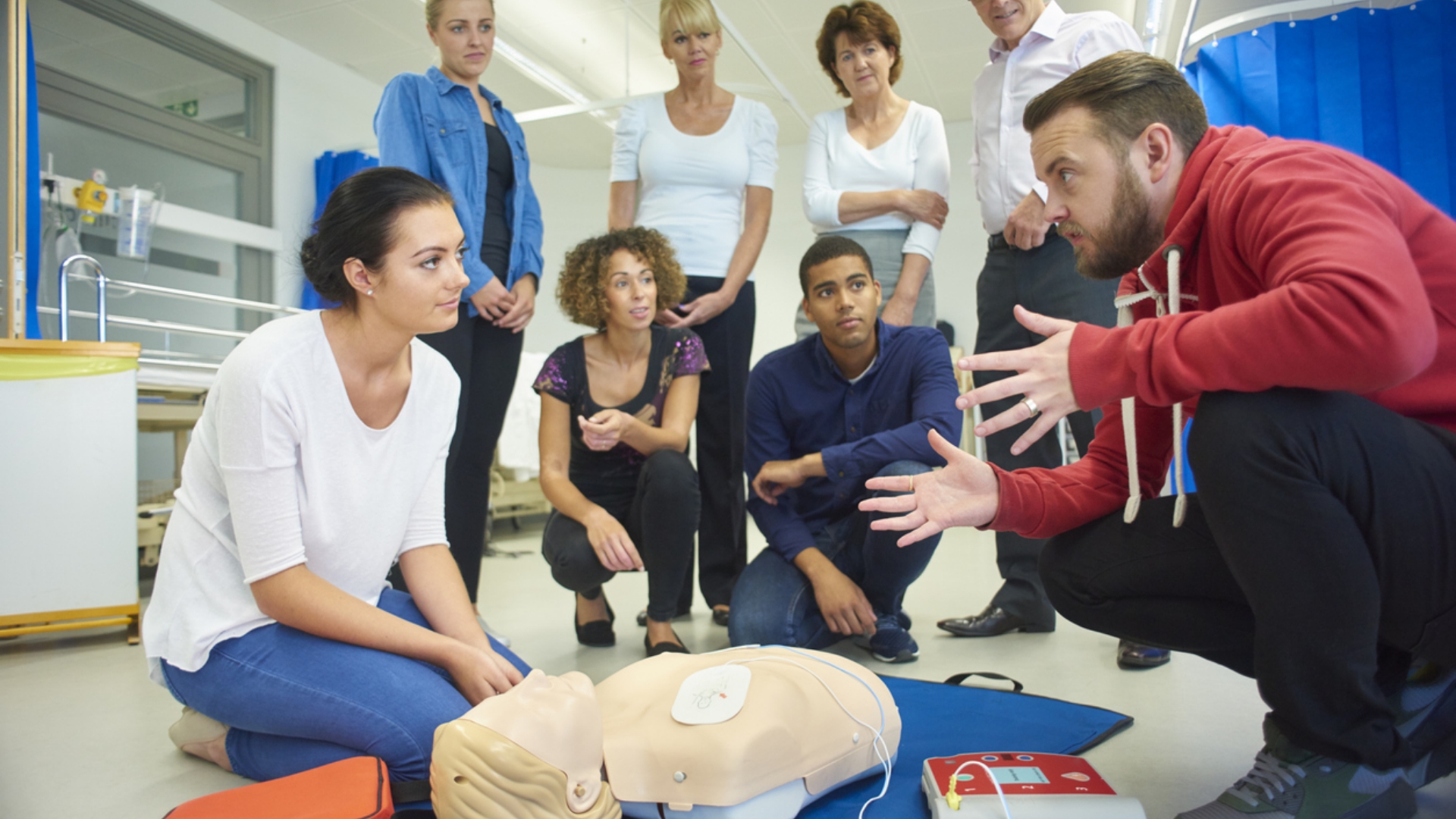
This free CPR practice test covers the 25 questions you are most likely to see on a CPR certification exam. Each question is based on real scenarios and aligned with current AHA, Red Cross, and HSI guidelines. After each question you will find the correct answer along with a short explanation so you can study as you go.
Whether you are preparing for your first CPR certification or brushing up before a renewal, working through these questions will help you identify weak spots and build confidence for the real exam.
Ready to get certified after you practice? Book a CPR and AED certification course with CPR1 and train with instructors who have real EMS, fire, and healthcare experience.
CPR Practice Test: 25 Questions with Answers
Read each question carefully, choose your answer, then check the correct response below it. Every answer cites the guideline or principle behind it so you can connect the “what” to the “why.”
1. When performing CPR, what is the recommended rate of chest compressions?
- 30 to 60 per minute
- 60 to 90 per minute
- 90 to 120 per minute
- 100 to 120 per minute ✔
The AHA recommends pushing at a rate of 100 to 120 compressions per minute. Pushing faster than 120 reduces compression depth, and pushing slower limits blood flow to the brain and heart.
2. What is the correct compression depth for an adult during CPR?
- 1 inch
- 1.5 inches
- At least 2 inches but no more than 2.4 inches ✔
- 3 inches
Per AHA guidelines, adult chest compressions should reach at least 2 inches (5 cm) but should not exceed 2.4 inches (6 cm). Compressions that are too shallow do not generate enough blood flow, while compressions that are too deep can cause rib fractures.
3. What are the key differences in CPR techniques for adults, children, and infants?
- For an adult or child, give 30 compressions before 2 rescue breaths. For an infant, give 15 compressions before 2 rescue breaths.
- The depth of compressions for an adult is 2 to 2.4 inches, for a child it is about 2 inches, and for an infant it is 1.5 inches. ✔
- In adults, start CPR before calling for help. In children, call for help first, then start CPR.
- None of the above.
The compression depths differ by age group because of differences in body size. Adults need at least 2 inches, children about 2 inches (one-third the depth of the chest), and infants about 1.5 inches.
4. What should rescuers do first before starting CPR when they arrive at an emergency scene?
- Call 911
- Wear their PPE
- Check the safety of the scene ✔
- Look for an AED
Scene safety is always the first priority. A rescuer who becomes a second victim cannot help anyone. Look for hazards like traffic, fire, electrical wires, or chemical spills before approaching the patient.
5. What is the correct sequence for operating an AED?
- Power on, analyze rhythm, attach pads, deliver shock
- Power on, attach electrode pads, let the AED analyze the rhythm, deliver shock if advised ✔
- Attach pads, power on, deliver shock, analyze rhythm
- Power on, deliver shock, attach pads, analyze rhythm
After turning on the AED, attach the pads to the patient’s bare chest following the diagrams on the pads. The AED will then analyze the heart rhythm and tell you whether a shock is needed. Never press the shock button until the AED instructs you to do so.
6. How do you check for responsiveness in an adult or a child over one year old?
- Pour cold water on the victim’s face
- Tap the person’s shoulder and shout “Are you OK?” ✔
- Wave strong scents near their nose
- Tap the bottom of the foot
For adults and children older than one year, tap the shoulder firmly and shout. Tapping the foot is only used for newborns. Never pour water or use ammonia capsules to check responsiveness.
7. When doing CPR on a child, pauses in chest compressions should be limited to:
- Less than 10 seconds ✔
- Less than 15 seconds
- Less than 20 seconds
- 1 minute
Any interruption in compressions drops the blood pressure you have built up. The AHA stresses that pauses should stay under 10 seconds for all patients, including children.
8. How do you open the airway of an unconscious choking victim?
- Head tilt and chin lift ✔
- Jaw thrust
- Head tilt and jaw thrust
- Lift the chin only
The head tilt-chin lift is the standard airway maneuver for unconscious victims when no spinal injury is suspected. The jaw thrust is reserved for cases where a spinal injury may be present.
9. Where should you place AED pads on a small child?
- One under the left armpit, one on the upper right chest
- One under the right arm, one on the upper left chest
- One under each armpit
- One on the center of the back, one on the center of the chest ✔
For small children, use pediatric pads in an anterior-posterior (front and back) placement. This keeps the pads from touching each other on a small chest, which would reduce the shock’s effectiveness.
10. What compression-to-ventilation ratio should two rescuers use for infant CPR?
- 100:4
- 15:2 ✔
- 30:2
- 60:3
Two-rescuer infant CPR uses a 15:2 ratio. A single rescuer performing infant CPR uses 30:2 instead. The lower ratio for two rescuers allows for more frequent ventilations, which is especially important because respiratory causes are the leading trigger of cardiac arrest in infants.
11. What is the correct duration for delivering each rescue breath?
- About 1 second per breath ✔
- About 2 seconds per breath
- About 3 seconds per breath
- About 4 seconds per breath
Each rescue breath should last about 1 second and deliver just enough air to make the chest visibly rise. Longer or harder breaths force air into the stomach, increasing the risk of vomiting.
12. What should you do if the chest does not rise after the first rescue breath?
- Immediately perform abdominal thrusts
- Reposition the head with a head tilt-chin lift and give the second breath ✔
- Give back blows until the obstruction clears
- Perform a finger sweep and try again
The most common reason the chest does not rise is an improper head position. Re-tilt the head, lift the chin, and attempt the second breath. Do not perform blind finger sweeps, as they can push an object deeper into the airway.
13. If a choking victim collapses while you are performing the Heimlich maneuver, what should you do?
- Call 911 a second time
- Place the victim in the recovery position
- Lower the victim to the ground and begin CPR ✔
- Reach into the throat to remove the object
When a choking victim becomes unresponsive, lower them to the ground and start CPR. Before giving each set of rescue breaths, look into the mouth. If you see the object, remove it. Never do a blind finger sweep.
14. What should you do if the chest does not rise after a second rescue breath on an unresponsive adult?
- Wait for the emergency medical team
- Stop CPR and look for a bag-valve mask
- Repeat the head tilt-chin lift and try the breath again
- Resume chest compressions ✔
If two attempts at ventilation both fail, do not keep trying. Resume chest compressions immediately. Compressions alone still circulate oxygenated blood, and continued interruptions to attempt breaths can do more harm than good.
15. Where should you check for a pulse on an unconscious child aged one year to puberty?
- On the inner wrist (radial artery)
- On the side of the neck (carotid artery) ✔
- On the inner thigh (femoral artery)
- On the top of the foot
For children aged one year through puberty, check the carotid artery on the side of the neck, just as you would for an adult. For infants under one year, check the brachial artery on the inside of the upper arm instead.
16. A resuscitated infant has a pulse but stops breathing while you are waiting for EMS. What should you do?
- Continue monitoring until EMS arrives
- Provide rescue breathing ✔
- Use an AED
- Perform hands-only CPR
If the infant has a pulse but is not breathing, give rescue breaths at a rate of one breath every 2 to 3 seconds (20 to 30 breaths per minute). Recheck the pulse every 2 minutes. If the pulse disappears, begin full CPR.
17. When you suspect a spinal injury, what should you avoid doing?
- Moving the victim ✔
- Allowing the victim to talk
- Taking an oral temperature
- Calling 911
Unnecessary movement can worsen a spinal cord injury. Keep the victim still and maintain spinal alignment. If you need to open the airway, use the jaw thrust technique instead of the head tilt-chin lift.
18. Which of the following is NOT one of the five links in the Adult Chain of Survival?
- Call 911 (activate EMS)
- High-quality CPR
- Rescue breaths ✔
- Rapid defibrillation
The five links in the AHA Adult Chain of Survival are: (1) recognition and activation of EMS, (2) high-quality CPR, (3) rapid defibrillation, (4) advanced life support, and (5) post-cardiac arrest care and recovery. “Rescue breaths” is a component of CPR, not a separate link.
19. Which two links in the Chain of Survival are primarily for professional responders?
- Rapid defibrillation and advanced life support
- Advanced life support and integrated post-cardiac arrest care ✔
- Early CPR and rapid defibrillation
- Rapid defibrillation and integrated post-cardiac arrest care
Bystanders can perform recognition, CPR, and defibrillation. Advanced life support (IV medications, advanced airways) and integrated post-cardiac arrest care (targeted temperature management, cardiac catheterization) require trained medical teams.
20. What does rapid defibrillation mean?
- Use the AED as soon as it becomes available ✔
- Use the AED only after confirming no pulse
- Get permission before using the AED
- Use the AED after 10 cycles of CPR
Every minute without defibrillation reduces a cardiac arrest victim’s chance of survival by 7 to 10 percent. Use the AED as soon as one arrives. You do not need permission from a doctor or bystander to use it.
21. What compression-to-ventilation ratio should a single rescuer use for adult CPR?
- 15:2
- 30:2 ✔
- 15:1
- 50:2
A single rescuer performing CPR on an adult should give 30 chest compressions followed by 2 rescue breaths. This 30:2 ratio also applies when a single rescuer is performing CPR on a child or infant.
22. When should you use the jaw thrust technique instead of the head tilt-chin lift?
- When the victim is a child under age 5
- When the victim is vomiting
- When you suspect a spinal or neck injury ✔
- When the victim has dentures
The jaw thrust opens the airway without moving the neck. If a spinal injury is possible (for example, after a fall, car crash, or diving accident), using the head tilt-chin lift could make the injury worse.
23. You are using an AED and it says “No shock advised.” What should you do?
- Remove the AED pads and continue CPR without the device
- Turn off the AED and wait for EMS
- Check for a pulse and stop CPR if one is present
- Leave the pads on and immediately resume CPR ✔
“No shock advised” means the AED did not detect a shockable rhythm (ventricular fibrillation or pulseless ventricular tachycardia). It does not mean the patient is fine. Leave the pads attached, resume CPR right away, and let the AED re-analyze after 2 minutes.
24. After resuscitating a cardiac arrest patient, they begin breathing on their own. What is the best recovery position?
- Flat on their back with arms at their sides
- Seated upright
- On their side in a stable lateral position with the head supported and no pressure on the chest ✔
- On their stomach with their head turned to one side
The recovery position keeps the airway clear by allowing fluids to drain from the mouth. The victim should be on their side with the head slightly elevated and supported. There should be no pressure on the chest so breathing is not restricted.
25. At what point do you switch from pediatric CPR techniques to adult CPR techniques?
- At age 8
- At age 10
- At the onset of puberty (around age 12) ✔
- At age 16
The AHA defines a “child” for CPR purposes as age 1 through the onset of puberty. Signs of puberty include chest or underarm hair in boys and breast development in girls. Once these signs are present, use adult compression depths and AED pads.
How Did You Score?
If you answered 20 or more questions correctly, you have a strong foundation in CPR knowledge. If you scored below 20, focus your study on the topics where you missed answers, especially compression depth and rate, AED use, and the differences between adult and pediatric CPR.
Keep in mind that a written test is only half of CPR certification. You also need hands-on skills practice with a manikin and a certified instructor. CPR1’s certification courses combine classroom training with practical skills sessions so you leave confident, not just certified.
What Are the 7 Steps of CPR?
The 7 steps of CPR provide a structured sequence that rescuers follow in a cardiac emergency. These steps apply to adult victims and follow AHA Basic Life Support guidelines:
- Check scene safety. Make sure the area is safe for you and the victim before approaching.
- Check responsiveness. Tap the victim’s shoulder and shout “Are you OK?”
- Call 911 (or have someone call). Activate the emergency response system. If you are alone with a phone, call on speaker.
- Send for an AED. If another person is present, ask them to find the nearest AED while you begin CPR.
- Check for breathing and a pulse. Take no more than 10 seconds. Look for normal breathing and feel the carotid pulse at the same time.
- Begin chest compressions. Place the heel of one hand on the center of the chest (lower half of the sternum), place your other hand on top, and push hard and fast at 100 to 120 compressions per minute.
- Give rescue breaths. After 30 compressions, open the airway with a head tilt-chin lift and give 2 breaths, each lasting about 1 second. Continue cycles of 30 compressions and 2 breaths until an AED arrives or EMS takes over.
According to the AHA, starting CPR within the first few minutes of cardiac arrest can double or triple a victim’s chance of survival. Speed matters. Every second without blood flow means brain cells are dying.
Is CPR Always 30 Compressions to 2 Breaths?
Not always. The 30:2 ratio is the standard for single-rescuer CPR on adults, children, and infants. However, there are several situations where the ratio or technique changes:
- Two-rescuer infant CPR: Use a 15:2 ratio. The higher ventilation rate is important because infant cardiac arrests are usually caused by breathing problems rather than heart problems.
- Two-rescuer child CPR: Also use a 15:2 ratio for the same reason.
- Hands-only CPR: If you are untrained or uncomfortable giving rescue breaths, the AHA recommends continuous chest compressions with no breaths at all. Hands-only CPR is better than no CPR.
- Advanced airway in place: Once a healthcare team inserts an advanced airway (such as an endotracheal tube or supraglottic device), compressions become continuous at 100 to 120 per minute. A second rescuer gives 1 breath every 6 seconds (10 breaths per minute) without pausing compressions.
For most bystanders and healthcare providers taking a BLS course, the 30:2 ratio is the most important one to memorize. It covers the majority of real-world rescue scenarios.
Tips for Passing Your CPR Certification Exam
CPR certification exams test both knowledge and skills. Here is how to prepare for each part:
For the written exam:
- Focus on compression rates, depths, and ratios for each age group (adult, child, infant). These appear on nearly every exam.
- Know the Chain of Survival and be able to identify each link.
- Study AED operation, including pad placement for adults and children.
- Review choking protocols for responsive and unresponsive victims.
- Practice with this test multiple times until you can answer every question correctly.
For the skills check-off:
- Practice on a manikin whenever possible. Correct hand placement and compression depth are hard to judge without physical practice.
- During the skills test, say your steps out loud (“Scene is safe, victim is unresponsive, calling 911”). This shows the evaluator you know the sequence.
- Allow full chest recoil between compressions. Leaning on the chest between pushes is one of the most common reasons people fail the skills portion.
CPR certifications from the AHA, Red Cross, and HSI are valid for two years. Learn more about CPR certification renewal timelines so you do not let your credential lapse.
Get CPR Certified with CPR1
CPR1 offers CPR, AED, and BLS certification courses nationwide. Our instructors bring real-world EMS, fire, and healthcare backgrounds into the classroom. Every course includes hands-on manikin practice and meets AHA, Red Cross, and HSI standards.
We offer training for individuals and groups:
- CPR and AED certification for groups of up to 25 people, with onsite instruction at your location.
- BLS for Healthcare Providers covering adult, child, and infant CPR plus two-rescuer techniques.
- Multiple certification levels so you can choose the course that fits your profession and state requirements.
Training is available in all 50 states. Book your CPR certification course today and train with instructors who have done this for real.
Frequently Asked Questions
What topics does the CPR practice test cover?
This practice test covers adult, child, and infant CPR techniques, AED operation, choking response, the Chain of Survival, rescue breathing, and recovery positioning. The questions are aligned with current AHA, Red Cross, and HSI guidelines.
How many questions are on a real CPR certification exam?
Most CPR certification exams have 20 to 25 multiple-choice questions. The passing score is typically 80 percent. Our 25-question practice test mirrors the format and difficulty of the real exam.
What are the 4 C’s of CPR?
The 4 C’s of CPR are: Check (assess scene safety and responsiveness), Call (dial 911 or your local emergency number), Compress (begin chest compressions), and Care (continue CPR and use an AED until professional help arrives). This memory aid helps bystanders remember the correct sequence during a high-stress emergency.
Can I get CPR certified entirely online?
Some organizations offer online-only CPR certificates, but most employers and regulatory bodies require a hands-on skills component. CPR1 offers blended courses that combine online learning with in-person skills sessions led by certified instructors.
How often do I need to renew my CPR certification?
CPR certifications are valid for two years. After that, you need to complete a renewal course to stay current. Read our guide on CPR certification renewal for details on the process.
Disclaimer for information purposes only:
The information provided on this website is intended for general educational and informational purposes only. It is not medical advice and should not be used as a substitute for professional diagnosis, treatment, or care. Always consult a qualified healthcare or medical professional regarding any health-related questions or concerns.
While we strive to ensure the information shared is accurate and up to date, no guarantees are made regarding completeness, accuracy, or applicability to any individual situation. Use of this content is at the reader’s sole discretion and risk.
This website is part of the Response Ready family of emergency preparedness and training resources, including CPR & first aid training and compliance services, AED sales and program support, AED program management software, and medical oversight solutions provided through our affiliated platforms:
• AEDLeader.com
• ResponseReady.com
• AEDTotalSolution.com
• MDSIMedical.com
By accessing or using this website, you agree to release, indemnify, and hold harmless the website owners, authors, contributors, and affiliated entities from any claims, losses, damages, or liabilities arising from the use or reliance on the information presented.

Anastasios Giannikas
Anastasios Giannikas
Save Lives with the Right AED Today
Buy Trusted AEDs from AED Leader Today!
Get Certified in CPR and Make a Difference!


