




A safety plan sitting in a binder on a shelf does little to protect anyone. For a plan to be effective, it has to live and breathe within your organization. It needs to be more than a document; it must become part of your culture. This is especially true for preparing for a violent critical incident. Generic, one-size-fits-all videos fall short because they aren’t tailored to your unique environment. To truly prepare your team, you need a program that is hands-on, customized to your facility, and reinforced over time. This is what transforms a paper plan into a practiced, reliable response, and it’s the core principle behind effective corporate active threat response training.
Key Takeaways
- Shift from Fear to Confidence: Active threat training is designed to empower your team, not scare them. Providing a clear plan and practical skills like the “Run, Hide, Fight” model replaces uncertainty with the confidence to act decisively under pressure.
- Build a Complete Skill Set: Effective training goes beyond a single response protocol. It equips your team with a full spectrum of skills, from recognizing warning signs and communicating with 911 to performing life-saving first aid like Stop the Bleed.
- Make Your Safety Plan Last: A one-time training session isn’t enough. To build a truly resilient team, choose a training format that fits your workplace, integrate the plan into your overall emergency strategy, and commit to regular drills to keep skills sharp.
What Is Active Threat Response Training?
Active threat response training is a program designed to prepare people for a violent critical incident, such as an active shooter event. The goal isn’t to create fear, but to build confidence by giving your team a clear, actionable plan. It educates employees on how to recognize potential indicators of workplace violence and what steps to take if a threat becomes real. Think of it like a fire drill—you practice the plan so that if the worst happens, you can react effectively instead of freezing.
Leading programs, like the ALICE Training® model, are designed to empower everyday people with proactive survival strategies. This training moves beyond passive lockdown-only drills, which can be limiting. Instead, it provides a flexible set of options that can be applied to various situations. By equipping your team with knowledge and skills, you give them the tools to protect themselves and others, turning anxiety into agency. It’s about preparing for the unthinkable so that everyone has a better chance of staying safe.
Why Your Business Needs a Plan
It’s easy to think, “that would never happen here,” but workplace violence can occur in any industry or location. Having a formal active threat response plan is a critical part of any modern safety program. Misconceptions about what this training involves can prevent teams from gaining the skills that could save lives. A plan does more than just check a box; it empowers your employees with the confidence to act decisively under extreme pressure.
The first step is to conduct a thorough risk assessment to identify vulnerabilities unique to your facility and operations. A generic plan won’t cut it. Your strategy should be tailored to your building layout, workforce, and specific industry risks. This proactive approach shows your employees you are invested in their safety and well-being.
What an Effective Program Looks Like
A strong active threat response program is never one-size-fits-all. The best training is customized to your company’s environment, industry, and team. It should be built on proven strategies recommended by law enforcement and federal agencies like the Department of Homeland Security. The most widely recognized of these is the “Run, Hide, Fight” model.
This framework provides clear, simple options that are easy to remember in a crisis. An effective program will walk your team through each of these strategies with practical examples relevant to your workplace. The training should be comprehensive, realistic, and delivered by qualified instructors who can answer tough questions and guide your team through difficult scenarios with confidence and professionalism.
Common Myths About Active Threat Training
One of the biggest myths is that this type of training will make employees more anxious. In reality, the opposite is true. Uncertainty is what causes fear. Providing a clear plan and practical skills actually builds confidence and reduces panic, empowering people to take control in a crisis. It replaces the feeling of helplessness with a sense of preparedness.
Another common misconception is that the training is only about responding to an attacker with a firearm. While that is a critical component, the principles learned are applicable to a wider range of workplace violence incidents. The skills—situational awareness, decisive action, and basic emergency response—are valuable in many different emergency scenarios, creating a more resilient and safety-conscious workforce overall.
What Skills Will Your Team Learn?
Active threat response training is about more than just a single protocol; it’s about building a layered skill set that empowers your team to think critically and act decisively. A comprehensive program moves beyond theory and gives your employees practical, life-saving tools they can use if the unthinkable happens. From recognizing potential dangers before they escalate to providing immediate care after an event, these skills create a resilient and prepared workforce. Let’s look at the core competencies your team will develop.
How to Recognize Warning Signs
One of the most critical parts of any training is learning to spot potential trouble before it starts. This involves teaching your team to recognize and report concerning behaviors that could be indicators of potential workplace violence. These aren’t about making assumptions, but about being aware of observable actions like sudden changes in behavior, increased aggression, or direct threats. The goal is to foster a culture where employees feel safe reporting concerns to HR or management, allowing for early and supportive intervention. This proactive approach is the first and most important step in preventing workplace incidents and keeping everyone safe.
Run, Hide, Fight: Core Response Strategies
When a threat is active, clear and simple instructions are essential. That’s why the “Run, Hide, Fight” model is the cornerstone of most response training. It provides a straightforward decision-making framework for high-stress situations. Your team will learn to first prioritize escaping the area if a safe path is available (Run). If evacuation isn’t possible, the next step is to find a secure place to shelter, barricade the door, and stay silent (Hide). As a final resort, and only when confronted with an immediate threat to life, they will learn how to disrupt or incapacitate the attacker (Fight). This Department of Homeland Security-endorsed strategy gives people clear, actionable options instead of freezing in fear.
Essential First Aid and Communication Skills
In the minutes following an incident, before professional help arrives, the actions of trained employees can save lives. That’s why effective active threat training often includes critical first aid skills, particularly Stop the Bleed techniques to control severe bleeding. Your team will learn how to apply pressure, pack wounds, and use tourniquets. Beyond medical response, they’ll learn how to communicate effectively with 911 operators. This includes providing a clear location, the number of assailants, physical descriptions, and the types of weapons involved. This information is vital for guiding law enforcement and EMS to the right place as quickly and safely as possible.
Making Clear Decisions Under Pressure
Panic can be paralyzing. The core purpose of hands-on training is to build confidence and reduce fear by replacing it with a plan. Through realistic drills and scenario-based learning, employees practice their responses, helping to create muscle memory. This preparation allows them to think more clearly and make better decisions when their adrenaline is high. The training empowers every individual, showing them they can play an active role in their own safety and the safety of those around them. It shifts the mindset from being a passive victim to a capable survivor, which is a powerful tool in any high-stress situation.
Finding the Right Training Format
Choosing the right training format is just as important as choosing the right content. The way your team learns will directly impact how well they can recall and apply their skills in a real emergency. There’s no single “best” option—the ideal format depends on your company’s size, budget, employee schedules, and specific safety goals. Some organizations thrive with the flexibility of online modules, while others need the dynamic, hands-on experience of an in-person workshop.
Many companies find that a blended approach works well, combining the convenience of digital learning with the impact of practical, instructor-led drills. As you explore your options, think about what will resonate most with your team and create the most lasting confidence. Let’s walk through the most common formats to help you find the perfect fit for your workplace.
Online Training: Pros and Cons
Online training is a popular starting point for many businesses, and for good reason. It offers incredible flexibility, allowing employees to complete modules at their own pace and from any location. This is a huge plus for remote teams or companies with complex shift schedules. Online lessons are great for teaching the foundational concepts of active threat response, like the basics of ALICE strategies or how to recognize potential warning signs.
However, a purely online format has its limits. Without an instructor present, there’s no opportunity for hands-on practice or real-time feedback. It’s one thing to watch a video about applying a tourniquet, but it’s another to practice it under pressure. This lack of experiential learning can make it harder for employees to build the muscle memory needed to act decisively in a high-stress situation.
The Value of Hands-On, In-Person Training
When it comes to building real-world confidence, nothing beats in-person training. This format allows instructors to guide your team through realistic scenarios and drills tailored to your actual workspace. Participants can ask questions, get immediate feedback on their technique, and practice working together as a team. This hands-on approach helps solidify skills in a way that passive learning can’t.
More importantly, it empowers every employee to understand that they can play a vital role in reducing harm during an incident. In-person sessions create a shared experience that fosters a stronger, more cohesive safety culture. Some programs even offer “train-the-trainer” certifications, allowing you to build a team of in-house instructors who can provide ongoing training and support.
Exploring Hybrid and Webinar Models
If you’re looking for a balance between flexibility and interaction, a hybrid model might be the perfect solution. This approach typically combines self-paced online modules for foundational knowledge with a shorter, in-person session for hands-on skills practice. It’s an efficient way to cover all the bases without requiring as much time away from work as a fully in-person course.
Another great option is a live webinar. Unlike pre-recorded videos, a webinar is an instructor-led live class over the internet where participants can interact, ask questions, and engage in discussions in real time. This format is ideal for organizations with employees spread across multiple locations who still want the benefit of a live expert guiding them through the material.
Custom On-Site Training for Your Team
For the most effective and relevant training experience, consider a custom on-site program. With this option, a certified instructor comes directly to your workplace to deliver a course tailored specifically to your environment and team. The trainer can walk through your building, identify unique vulnerabilities and safe areas, and run drills that reflect the actual situations your employees might face.
This personalized approach ensures the training is anything but generic. When an expert comes to your location to train your team, they can address your specific concerns and help you integrate the training directly into your existing emergency action plan. This makes the lessons more tangible and memorable, giving your team the confidence that they know exactly what to do in their own environment.
Who Offers Active Threat Response Training?
When you start looking for active threat response training, you’ll find several established organizations with different approaches. The key is finding a program that aligns with your company’s culture, environment, and specific safety goals. Most programs are built on a similar foundation of situational awareness and decisive action, but their delivery and focus can vary. Let’s look at a few of the most recognized providers to help you understand your options and find the best fit for your team.
CPR1.com: Comprehensive Safety Solutions
At CPR1.com, we integrate active threat response into a complete safety framework. Our training is designed to be practical and empowering, delivered by certified instructors with backgrounds in emergency services and healthcare. We don’t believe in a one-size-fits-all solution. Instead, we work with you to tailor the training to your specific environment, whether you’re in a corporate office, a school, or a manufacturing facility. Our goal is to build real-world confidence, moving beyond theory to ensure your team feels prepared. This training is a core part of our mission to help organizations become truly Response Ready, combining essential response skills with first aid and emergency preparedness.
ALICE Training Institute
The ALICE Training Institute offers one of the most widely known active shooter response programs. ALICE is an acronym that stands for Alert, Lockdown, Inform, Counter, and Evacuate. Rather than a rigid, sequential set of rules, the program provides a flexible set of options that individuals can use based on their specific situation. This approach empowers people to make their own survival decisions during a critical incident. ALICE training is designed for everyday people in schools, businesses, and healthcare settings, focusing on proactive strategies that can be adapted to the unfolding event. It shifts the mindset from a passive, static response to a more dynamic and informed one.
AVIRT, HSI, and Other Providers
Another major provider is the Health & Safety Institute (HSI), which offers Active Violence Immediate Response Training (AVIRT). This program focuses on teaching people how to react safely and quickly during an active violence event. A key component of HSI’s training is the integration of life-saving skills like bleeding control, bridging the gap between the incident and the arrival of professional responders. HSI also provides instructor development courses, allowing organizations to build their own internal training capacity. Beyond these, many other reputable local and national organizations offer specialized training, so it’s worth exploring a few to see what’s available in your area.
How to Compare Different Training Programs
Choosing the right program is a big decision, and it’s about more than just checking a box. As you evaluate your options, focus on a few key factors. First, look for a program that can be customized to your facility and industry—a hospital has very different needs than a warehouse. Second, consider the quality and experience of the instructors. Are they former first responders or law enforcement? Finally, assess the training methodology. An effective program should balance classroom learning with realistic, hands-on drills to build muscle memory. By evaluating programs on these points, you can find a partner that truly invests in your team’s safety.
What Does Active Threat Training Cost?
When you’re ready to invest in your team’s safety, one of the first questions you’ll have is about the cost. The price of active threat response training isn’t a simple, one-size-fits-all number. It depends on the format, depth, and provider you choose. Think of it less as a standard product and more as a customized service designed to fit your organization’s specific needs. The key is to understand the different pricing models so you can find a program that fits your budget while delivering the critical skills your team needs to feel prepared and confident.
Understanding Common Pricing Models
The cost of active threat training is shaped by a few key factors. The biggest variables are the course duration, the instructor’s expertise, and the training format. A self-paced online module will naturally cost less than a full-day, in-person simulation led by experienced first responders. Deeper, more comprehensive instructor programs that certify your own staff to lead training will represent a larger investment. When comparing options, look at what’s included. Does the price cover course materials, hands-on practice, and post-training support? A higher price often reflects a more robust, customized, and effective program that goes beyond just checking a box.
Group Rates and Training Packages
One of the most effective ways to manage training costs is by taking advantage of group rates. Most providers offer on-site training for a flat fee or a reduced per-person rate, making it much more affordable to train your entire team at once. This approach also ensures everyone receives the same consistent information and training experience. You can also look for bundled packages. For example, combining active threat response with First Aid/CPR/AED or Stop the Bleed training creates a more complete emergency preparedness program. These integrated response courses often provide better value and equip your team with a wider range of life-saving skills.
Budgeting for Training and Why It’s Worth It
It’s easy to see safety training as just another expense, but it’s truly an investment in your people. While there is an upfront cost, the value of giving your team the confidence and skills to protect themselves is immeasurable. A well-trained team is a prepared team, capable of making smart decisions under extreme pressure, which can drastically reduce the risk of injury and save lives. Beyond the human element, investing in proper training demonstrates a commitment to employee well-being, builds a stronger safety culture, and can even limit organizational liability. When you budget for training, you’re not just buying a course; you’re investing in resilience and peace of mind.
How to Create a Lasting Safety Plan
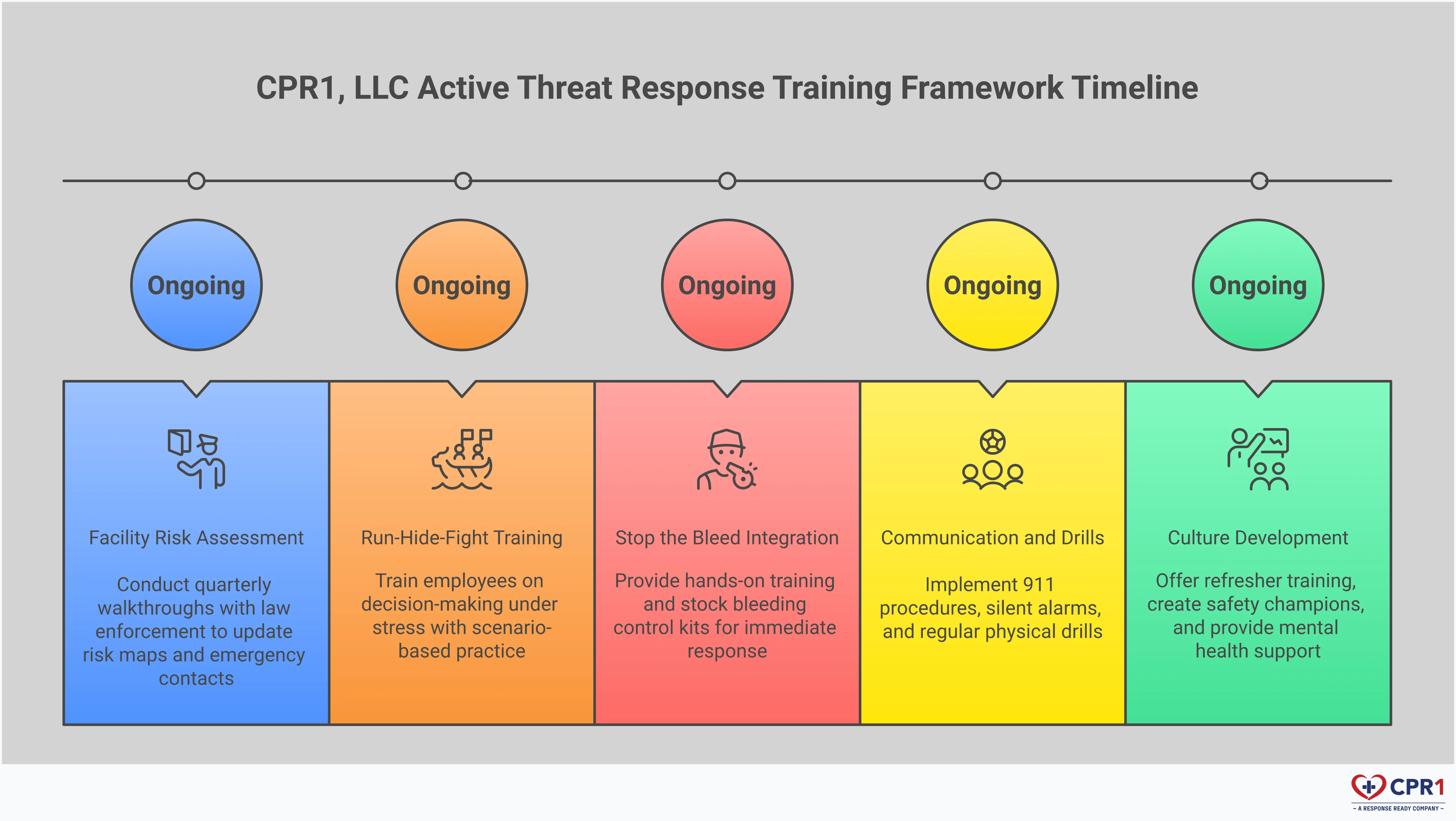
Training is the first step, but creating a plan that sticks is what truly prepares your team. A binder on a shelf isn’t enough. A lasting safety plan becomes part of your company’s DNA, empowering everyone to act confidently in a crisis. It’s about moving beyond a single training day to build a continuous cycle of preparedness. This involves addressing the human element—the fears and concerns of your team—and making practice a regular, low-stress part of your routine. It also means weaving your active threat response plan into your company’s broader emergency preparedness strategy, ensuring it works alongside other safety protocols. Ultimately, the goal is to build a genuine culture of safety where everyone feels responsible and equipped to protect themselves and each other. This approach transforms training from a requirement into a shared value.
Addressing Employee Concerns and Anxiety
It’s completely normal for your team to feel anxious about active threat training. The topic is serious, and many people worry the training will be frightening or overly intense. The biggest hurdle is often the “it won’t happen here” mindset, but open communication can help overcome this reluctance. Start by explaining that the goal is empowerment, not fear. Modern training focuses on building confidence and teaching practical skills. You can ease concerns by addressing common myths and clarifying that the focus is on proactive awareness and clear, decisive action—not scary, high-stakes simulations. When employees understand the purpose is to help them feel prepared, not panicked, they are much more likely to engage.
Planning for Drills and Refresher Courses
Like any critical skill, emergency response abilities fade without practice. A single training session isn’t enough to build the muscle memory needed to act under pressure. That’s why regular drills and refresher courses are essential. Think of them like fire drills—a routine practice that makes the correct response second nature. The key is to ensure everyone understands the purpose of the drill beforehand. Explain what to expect and what the goals are. Effective active shooter drills focus on reinforcing response options and improving communication, helping your team act decisively and cohesively if a real event ever occurs. Schedule these at least annually to keep skills sharp and your plan current.
Integrating Training into Your Overall Emergency Plan
Your active threat response plan shouldn’t be a standalone document. To be truly effective, it must be integrated into your company’s comprehensive Emergency Action Plan (EAP). Start with a thorough risk assessment to identify vulnerabilities specific to your workplace, from entry points to communication systems. Your plan should also align with existing HR policies on workplace violence, harassment, and threat reporting. By connecting these dots, you create a seamless safety framework where every piece supports the others. This holistic approach ensures that your active threat preparedness is part of a larger, more resilient safety strategy for your entire organization.
Building a True Culture of Safety
A lasting safety plan is built on a strong foundation: a genuine culture of safety. This goes beyond compliance checklists and annual training sessions. It’s about making safety a shared value that is championed by leadership and embraced by every employee. Encourage an environment where people feel comfortable reporting concerns without fear of reprisal. Make safety a regular topic of conversation in team meetings, not just after an incident. When you prioritize employee safety and empower your team with the knowledge and confidence to act, you shift from a reactive posture to a proactive one. This creates a workplace where everyone feels invested in keeping each other safe.
Related Articles
- Choosing Active Shooter Training: What to Look For
- The Ultimate Guide to Active Shooter Training
- Active Shooter Training: A Workplace Safety Guide
- How to Choose Active Shooter Training for Your Team
Frequently Asked Questions
Is this type of training really necessary for a small, low-risk business? It’s a common question, and the simple answer is yes. Active threat incidents are unpredictable and can happen anywhere, regardless of company size or industry. The goal of this training isn’t to create anxiety but to build a universal skill set for handling a crisis. It gives your team a plan, which replaces fear with confidence and helps people make clear-headed decisions. Think of it as being just as essential as having a fire extinguisher or a first aid kit.
Does ‘Fight’ mean you’re teaching my employees to be vigilantes? Not at all. This is a critical point and a common misunderstanding. The “Fight” component is an absolute last resort, to be used only when your life is in immediate danger and you cannot run or hide. It’s not about hand-to-hand combat. Instead, it’s about using whatever you can to disrupt or distract an attacker—throwing a fire extinguisher, using a chair as a barrier, or making noise. It’s a survival strategy meant to create an opportunity to escape.
How much time should we set aside for this training? The time commitment really depends on the format you choose. A basic online awareness course might only take an hour or two for employees to complete on their own schedule. A more comprehensive on-site training session that includes hands-on drills and first aid skills is typically a half-day or full-day event. The best approach is to talk with a training provider about your specific needs so they can recommend a program that fits your operational schedule.
What is the single most important first step to take after reading this? Before you even start looking at training providers, the best first step is to conduct a simple risk assessment of your own workplace. Walk through your space and think about potential escape routes, secure hiding places, and communication challenges. Getting your leadership team involved in this initial conversation helps build a foundation for a more formal plan and makes the eventual training much more relevant and effective.
How do we keep these skills fresh without constantly alarming our team? This is key to building a lasting safety culture. You don’t need to run intense, surprising drills all the time. Instead, integrate preparedness into your routine. You can hold short “tabletop” discussions in team meetings, walking through a potential scenario verbally. When you do schedule a physical drill, treat it like a fire drill—everyone knows it’s happening and what the goal is. This approach reinforces the skills in a calm, controlled way, making preparedness a normal part of your safety routine.


