


In a crisis, there are bystanders and there are first responders. The only thing separating the two is training. Having the skills to act decisively when someone collapses from cardiac arrest is incredibly empowering. It transforms you from a passive observer into a critical link in the chain of survival. Gaining this ability starts with understanding the fundamentals and getting hands-on practice. This guide is your first step toward becoming a confident responder. With the cpr certification process explained in full, you’ll learn not only the techniques for adults, children, and infants but also how to use an AED and handle choking emergencies. You have the capacity to save a life; let’s get you the training to do it.
Every second counts during a cardiac emergency. With over 395,000 out-of-hospital cardiac arrests happening annually in the U.S., CPR certification equips you to take action when it matters most. Whether you’re a healthcare worker, teacher, or just want to be prepared, CPR training ensures you’re ready to respond effectively.
Key Takeaways:
- Who Needs CPR Certification?
- Healthcare, education, retail, hospitality, and more.
- Training Options:
- Online + in-person blended courses.
- Programs like Basic Life Support (BLS) or Adult & Pediatric First Aid/CPR/AED.
- Cost:
- Individual courses start at $69.00. Group training available for businesses.
- Renewal:
- Certification lasts 2 years; renewal ensures you’re up-to-date.
Whether you’re fulfilling workplace requirements or learning for personal preparedness, CPR certification provides essential skills to save lives.## Understanding the Fundamentals of CPR Cardiopulmonary Resuscitation (CPR) is a sequence of life-saving actions that can sustain someone after their heart stops beating. While it might seem intimidating, the core principles are straightforward. Learning them gives you the power to be a critical link between a medical emergency and the arrival of professional help. Understanding what CPR does—and what it doesn’t do—is the first step toward building the confidence to act when seconds matter most. It’s not just for medical professionals; it’s a skill that anyone can and should learn. ### The Purpose of CPR: Buying Critical Time The primary purpose of CPR is to keep oxygenated blood flowing to the brain and other vital organs during cardiac arrest. Think of it as a manual backup system for the heart and lungs. When you perform chest compressions, you are physically pumping the heart to circulate blood. When you give rescue breaths, you are providing oxygen to the lungs. This process doesn’t typically restart the heart—that’s a common misconception often seen in movies. Instead, CPR buys precious time, preventing brain damage and keeping the body viable until an Automated External Defibrillator (AED) or an emergency medical team can restore a normal heart rhythm. #### Heart Attack vs. Sudden Cardiac Arrest It’s important to know the difference between a heart attack and sudden cardiac arrest (SCA), as they require different immediate responses. A heart attack is a “circulation” problem. It happens when a blockage in an artery stops blood flow to the heart muscle, which can cause chest pain and other symptoms while the person is usually still conscious. Sudden cardiac arrest, on the other hand, is an “electrical” problem. The heart’s electrical system malfunctions, causing it to stop beating unexpectedly. The person collapses, loses consciousness, and stops breathing normally. CPR is the correct response for someone in cardiac arrest. #### The Chain of Survival CPR is a vital piece of a larger system known as the Chain of Survival. This concept, emphasized by the American Heart Association, outlines the sequence of events that must happen quickly to give someone the best chance of surviving cardiac arrest. The links in the chain are: immediate recognition of cardiac arrest and calling 911, early CPR with an emphasis on chest compressions, rapid defibrillation with an AED, effective advanced life support from paramedics, and post-cardiac arrest care in a hospital. As a bystander, you are responsible for the first three links, making your actions absolutely critical to a positive outcome. ### Important CPR Statistics The numbers surrounding cardiac arrest are staggering and highlight why public CPR training is so essential. In the United States, more than 350,000 out-of-hospital cardiac arrests occur each year. The majority of these emergencies—about 70%—happen at home, which means the person you are most likely to perform CPR on is a family member or loved one. Unfortunately, the survival rate is tragically low, but it doesn’t have to be. When a bystander immediately performs CPR, they can double or even triple a person’s chance of survival. This single statistic shows the profound impact you can have just by being prepared. ## How to Perform CPR: A Step-by-Step Guide for Adults This guide provides the basic steps for adult CPR. Remember, reading these steps is a great start, but it is not a substitute for hands-on training where you can practice these skills and receive feedback from a certified instructor. ### Step 1: Assess the Scene and the Person Before you do anything, make sure the area is safe for you and the victim. Look for hazards like traffic, fire, or electrical wires. If the scene is safe, approach the person and check for responsiveness. Kneel beside them, tap their shoulder firmly, and shout, “Are you OK?” If they do not respond, they need immediate help. At the same time, quickly scan their chest for signs of normal breathing for no more than 10 seconds. It’s important to note that agonal gasps—which can sound like snorting or gurgling—are not normal breathing and are a sign of cardiac arrest. ### Step 2: Call 911 and Get an AED As soon as you determine the person is unresponsive and not breathing normally, you need to activate the emergency response system. If someone else is nearby, point directly at them and give clear instructions: “You, call 911 and find an AED!” Being specific prevents confusion and ensures action is taken quickly. If you are alone, call 911 yourself and put your phone on speaker so you can communicate with the dispatcher while you begin CPR. An Automated External Defibrillator (AED) is a critical tool that can shock the heart back into a normal rhythm, and the 911 dispatcher may be able to tell you where to find one nearby. ### Step 3: Begin Chest Compressions To begin chest compressions, kneel beside the person’s chest. Place the heel of one hand on the center of their chest, on the lower half of the breastbone (sternum). Place your other hand directly on top of the first hand and interlace your fingers. Position your body so that your shoulders are directly over your hands and lock your elbows to keep your arms straight. This posture allows you to use your body weight to deliver compressions, which is more effective and less tiring than using only your arm muscles. This technique is fundamental to providing high-quality CPR that can sustain a person until help arrives. #### Compression Rate and Depth The key to effective compressions is to push hard and fast. The recommended rate is between 100 and 120 compressions per minute. To help you stay on pace, you can think of the beat of a familiar song like “Stayin’ Alive” by the Bee Gees. For an adult, you need to push down at least two inches deep. It’s equally important to allow the chest to fully recoil, or rise back to its normal position, between each compression. This recoil allows the heart to refill with blood before the next push. Don’t be afraid of pushing too hard—your goal is to save a life. #### Proper Hand Placement and Technique Correct hand placement is crucial for maximizing blood flow and minimizing the risk of injury. By placing the heel of your hand on the center of the chest, between the nipples, you ensure you are compressing the heart between the sternum and the spine. Keeping your arms straight and your shoulders aligned over your hands allows you to use your body weight to generate force, making your compressions more powerful and sustainable. Mastering this form is a major focus of any hands-on CPR certification course, where instructors provide personalized feedback to ensure you can perform the skill correctly and confidently. ### Step 4: Open the Airway and Give Rescue Breaths If you’ve been trained in full CPR, you will provide rescue breaths in a cycle of 30 compressions to 2 breaths. After 30 compressions, open the person’s airway using the head-tilt, chin-lift technique. Place one hand on their forehead and gently tilt their head back, then use the fingers of your other hand to lift their chin. This simple maneuver lifts the tongue away from the back of the throat, clearing the airway. Pinch the person’s nose shut, take a normal breath, and form a complete seal over their mouth with yours. Give one breath lasting about a second, watching for their chest to rise. If it does, give a second breath. ### What is Hands-Only CPR? If you are not trained in full CPR or are hesitant to give rescue breaths, you can perform Hands-Only CPR. It is simple, effective, and recommended by the Mayo Clinic for untrained bystanders. After calling 911 and confirming the person is unresponsive, you simply begin chest compressions. Push hard and fast in the center of the chest at a rate of 100 to 120 compressions per minute without stopping until help arrives. For an adult who has suddenly collapsed, continuous chest compressions are the most critical element of CPR. Don’t let a reluctance to perform mouth-to-mouth resuscitation stop you from taking action—Hands-Only CPR can still save a life. ## Adapting CPR for Children and Infants While the goal of CPR is the same for all ages, the techniques must be adapted for the smaller, more fragile bodies of children and infants. Cardiac arrest in young people is often caused by respiratory issues, like choking or drowning, rather than the heart problems common in adults. This makes rescue breaths an especially critical component of the process. Knowing these key differences is essential for anyone who cares for or works with children. ### Key Modifications for Children (Age 1 to Puberty) When performing CPR on a child, you can use either one or two hands for chest compressions, depending on the child’s size. The compression depth should be about 2 inches, or one-third the depth of their chest. Because breathing problems are a common cause of cardiac arrest in children, rescue breaths are crucial. The cycle remains 30 compressions followed by 2 breaths. If you witness a child collapse, call 911 immediately. However, if you find a child who is already unconscious, the protocol is to perform CPR for two minutes *before* pausing to call 911 if you are alone. These nuances are covered in depth in an Adult & Pediatric First Aid/CPR/AED course. ### Special Considerations for Infants (Under 1 Year) Infants require an even more delicate approach. For chest compressions, use two fingers (the index and middle finger) placed in the center of the infant’s chest, just below the nipple line. The compression depth is much shallower—only about 1.5 inches, or one-third the depth of the infant’s chest. The rate of 100 to 120 compressions per minute stays the same. When giving rescue breaths, be very gentle. Tilt the head back slightly, cover the infant’s mouth and nose with your mouth, and give two small puffs of air, using just the strength of your cheeks. The cycle is still 30 compressions to 2 breaths.
How to Get CPR and First Aid Certified
Do You Meet the CPR Certification Requirements?
CPR certification programs aim to teach the critical skills needed to perform lifesaving techniques according to recognized guidelines. Although requirements may differ between providers, the primary goal is to ensure participants are trained in CPR methods and the correct use of automated external defibrillators (AEDs). CPR1 provides group training sessions that align with established certification standards. Check with your specific provider to see if there are any additional requirements.
Find the Right CPR Training Program for You
Modern CPR training provides flexible and reliable options to meet various certification needs.
Online vs. In-Person: Choosing Your Class Format
CPR training combines online learning with in-person practice for a balanced approach. CPR1’s blended courses include online theory sessions followed by hands-on practice to refine skills. Here’s a breakdown of CPR1 course formats:
| Training Format | Certification Duration | Key Components | Ideal For |
|---|---|---|---|
| Basic Life Support (BLS) | 2 years | Online + in-person practice | Healthcare providers |
| Adult & Pediatric First Aid/CPR/AED | 2 years | Online theory + hands-on skills | Workplace compliance |
| Adult First Aid/CPR/AED | 2 years | Focused adult CPR/AED training | Basic certification needs |
These formats are designed to meet strict training standards.
Who Provides Official CPR Certification?
CPR1 ensures all courses meet or exceed industry requirements, thanks to its experienced team and adherence to established guidelines.
CPR1.com Course Options
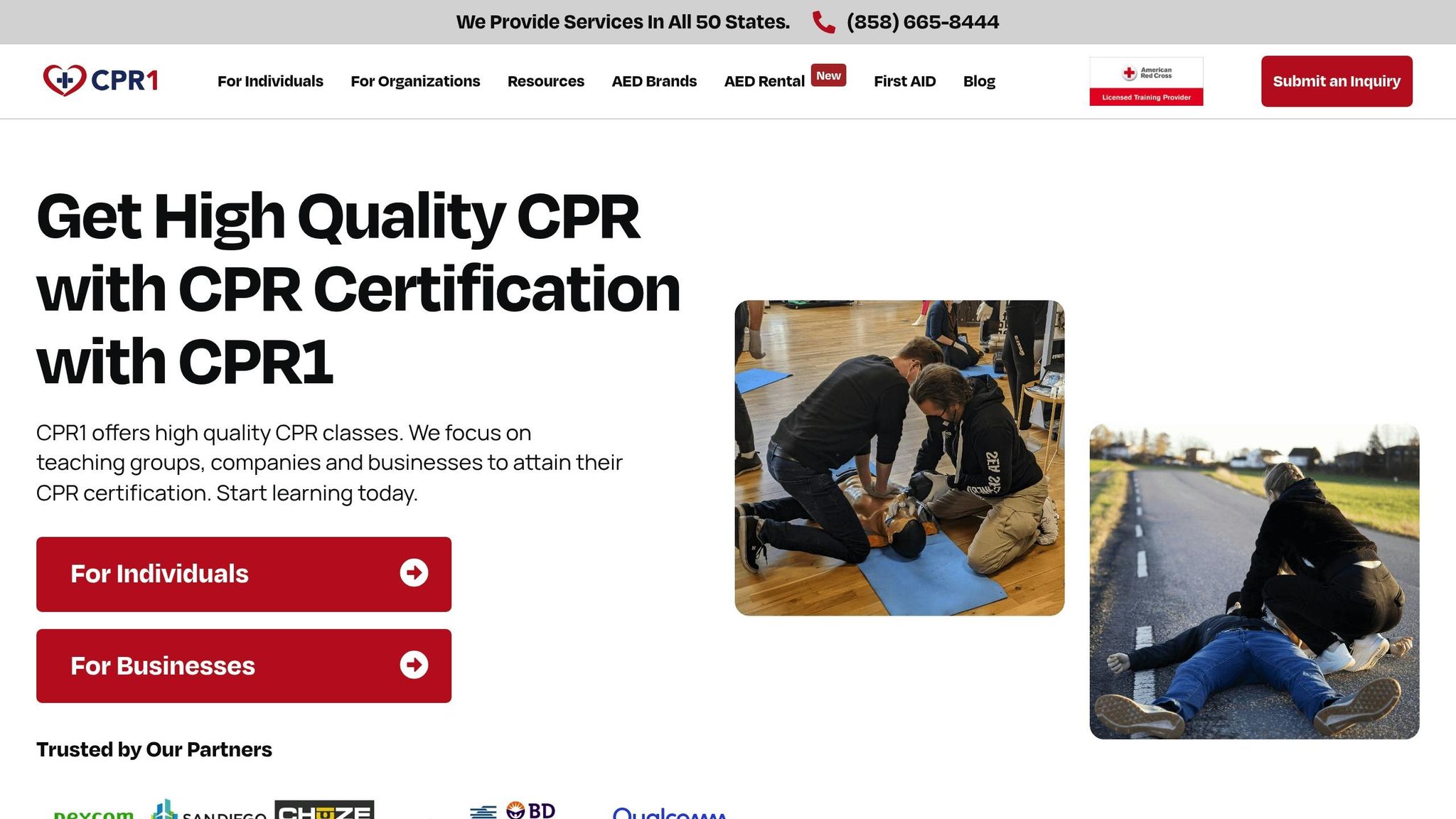 CPR1 offers several tailored course options to fit individual and group needs:
- Individual Certification Programs
- BLS Program: $79.00 – Provides essential training for healthcare professionals.
- Adult & Pediatric First Aid/CPR/AED: $69.00 – Covers a variety of emergency response scenarios.
- Group Training Solutions
- Business CPR and AED training for 10-25 participants: $785.00-$1,802.00.
- Includes hands-on AED practice and choking emergency management.
- Stop The Bleed Program
- $200.00-$500.00 – Focuses on managing major bleeding emergencies, including tourniquet use and wound care.
- Complements CPR certification for a more comprehensive emergency skill set.
Additionally, through the AED Total Solution, participants can access online tutorials and resources to support their certification process.
sbb-itb-20dcc80
Additional Skills Covered in Certification Courses
A comprehensive CPR certification course goes beyond the fundamentals of chest compressions and rescue breaths. It equips you with a suite of skills to handle a variety of common emergencies with confidence. Think of it as building a complete first-response toolkit. You’ll learn how to assess a situation quickly, identify the specific type of emergency, and apply the correct techniques for adults, children, and infants. This well-rounded training ensures you’re not just prepared for cardiac arrest but also for other life-threatening events you’re more likely to encounter at home, work, or in your community. These additional skills are what transform a bystander into a capable first responder.
How to Use an Automated External Defibrillator (AED)
One of the most critical skills you’ll learn is how to operate an Automated External Defibrillator (AED). These portable devices are designed to be used by anyone, but formal training removes any hesitation you might feel during a real emergency. An AED can analyze the heart’s rhythm and deliver an electrical shock to help it restart, which can be the difference between life and death. Our courses provide hands-on practice with training AEDs, so you become comfortable with the device’s simple voice prompts and pad placement. Knowing how to confidently use an AED is a powerful skill that dramatically increases a person’s chance of survival from sudden cardiac arrest.
How to Help Someone Who is Choking
Choking is a common and terrifying emergency that can happen anywhere, from a restaurant to a school cafeteria. Your CPR certification will teach you how to recognize the signs of choking and respond effectively. You’ll learn techniques like the Heimlich maneuver for adults and children, as well as safe methods for clearing an infant’s airway. This training is invaluable for parents, teachers, childcare providers, and anyone who works in the service industry. By mastering these skills, you gain the ability to act decisively and prevent a choking incident from becoming a tragedy, providing immediate and effective aid while waiting for professional help to arrive.
Legal Protections for Rescuers
One of the biggest barriers that can prevent someone from helping in an emergency is the fear of doing something wrong or facing legal consequences. That’s why understanding your rights and protections as a rescuer is a key part of any good CPR course. When you step in to provide aid, you are acting as a Good Samaritan, and laws are in place to protect you. Learning about these legal safeguards helps build the confidence you need to act without hesitation. It’s not just about knowing the physical skills; it’s also about having the peace of mind to use them when they’re needed most.
Understanding Good Samaritan Laws
Good Samaritan laws are designed to protect people who voluntarily provide emergency assistance to someone in need. These laws vary by state, but they generally shield you from liability as long as you act reasonably, in good faith, and within the scope of your training. During your CPR training, your instructor will cover the important legal information relevant to rescuers, ensuring you understand the protections in place. The goal is to encourage bystanders to get involved in emergencies. Knowing that the law is on your side allows you to focus on what truly matters: providing immediate care to someone whose life may depend on it.
The CPR Certification Process Explained
Step 1: Select the Right Course for You
Choose the course that aligns with your needs:
- Healthcare Professionals: The Basic Life Support (BLS) certification costs $79.00 and covers emergency responses for adults, children, and infants.
- Workplace Compliance: The Adult & Pediatric First Aid/CPR/AED course costs $69.00 and addresses a wide range of emergency situations.
When deciding, keep these factors in mind:
| Factor | What to Consider |
|---|---|
| Professional Needs | Does your workplace require a specific certification? |
| Time Commitment | Training includes an online module and a hands-on session (usually 2–4 hours). |
After selecting your course, you’ll move on to the training and testing phase.
Step 2: Complete Your Training and Test
Here’s how the process works:
- Online Component Begin with the online module provided by CPR1. It features video demonstrations, interactive scenarios, and a final assessment to test your knowledge.
- Hands-on Practice Once the online portion is done, attend an in-person session. You’ll practice CPR on mannequins, learn how to use an AED, handle choking emergencies, and assess emergency situations.
- Skills Assessment During the in-person session, you’ll demonstrate your ability to perform chest compressions, rescue breathing, AED usage, and other emergency response skills under the guidance of an instructor.
Step 3: Receive Your Certification
After successfully completing both the online and hands-on components, you’ll receive official certification documentation from CPR1. This serves as proof of your CPR certification and confirms that you’re prepared to handle emergencies effectively.
How to Keep Your CPR Certification Current
Once you’ve earned your certification, staying prepared is just as important.
When and How to Renew Your Certification
CPR certification needs to be renewed every two years to ensure you’re up to date. Here’s a quick look at CPR1’s renewal process:
| Certification Type | Renewal Timeline | Requirements |
|---|---|---|
| Basic Life Support (BLS) | Every 2 years | Complete blended course ($79.00) |
| Adult & Pediatric First Aid/CPR/AED | Every 2 years | Complete blended course ($69.00) |
| Adult First Aid/CPR/AED | Every 2 years | Complete blended course ($68.00) |
Staying Compliant in the Workplace
For organizations, meeting regulatory requirements for emergency response programs is non-negotiable. CPR1’s AED program management system simplifies this process by helping track certifications and maintain compliance. Here’s how it helps:
- Tracks CPR/AED certifications automatically
- Sends email alerts before certifications expire
- Monitors OSHA and state requirements
- Manages certification records efficiently
Why Regular Practice Keeps Your Skills Sharp
Keeping your skills sharp is crucial. Regular practice ensures you’re ready when it matters most. CPR1’s AED Total Solution program supports this by offering:
- Medical oversight for emergency protocols
- Routine equipment checks with reminders
- Skills refresher sessions
- Updates based on the latest guidelines
Your Next Step: Get CPR Certified
Each year, over 395,000 out-of-hospital cardiac arrests occur in the U.S., making CPR certification a critical skill for saving lives. CPR1 offers a straightforward certification process designed to equip individuals and organizations with the tools and knowledge needed to act in emergencies. With CPR1, both individuals and groups can access flexible training options tailored to their needs. Beyond meeting certification requirements, their programs prepare participants for real-life scenarios. Plus, the AED Total Solution ensures you’re always ready, thanks to automated certification tracking, equipment alerts, and compliance monitoring. The impact of CPR1’s training programs is clear. Donna Porter, City of Carlsbad CERT Team Coordinator, shares her experience:
“CPR1 came in with big promises and high expectations – I’m happy to say they’ve exceeded on every level!”
Geoff Albrecht, Director of Student Services at Oceanside Unified School District, highlights the ease and support offered by the AED Total Solution:
“AED Total Solution’s ease of set up and customer service far exceeded my initial expectations. They take the necessary time to reach out to each and every one of our customers, to make sure they are comfortable with the program and knowledgeable with the system.”
Ready to get certified? Contact CPR1 at in**@**r1.com today. Certification isn’t just about meeting standards – it’s about being prepared to save lives when every second matters.
FAQs
BLS vs. First Aid/CPR/AED: What’s the Difference?
The main difference between Basic Life Support (BLS) and Adult & Pediatric First Aid/CPR/AED courses lies in their focus and intended audience. BLS is designed primarily for healthcare professionals and emergency responders. It emphasizes high-level skills such as performing CPR on adults, children, and infants, using a bag-mask device, and working as part of a team during resuscitation efforts. In contrast, Adult & Pediatric First Aid/CPR/AED is aimed at the general public, including teachers, coaches, and caregivers. This course covers basic first aid, CPR techniques for adults, children, and infants, and how to use an automated external defibrillator (AED). It focuses on providing immediate care in emergencies until professional help arrives. Both certifications are valuable, but the right choice depends on your role and the situations you are likely to encounter.
How Do I Keep My CPR Certification Valid?
To ensure your CPR certification stays valid, you’ll need to renew it regularly, as most certifications expire every two years. Renewal typically involves completing a recertification course, which helps you stay updated on the latest CPR techniques and guidelines. Staying proactive is key – mark your calendar to track your certification’s expiration date and schedule your renewal in advance. If you’re part of an organization, consider using services that help manage compliance with AED laws and certification requirements to ensure you’re always up-to-date.
How Can My Business Set Up CPR and AED Training?
To set up an effective CPR and AED training program, businesses should start by creating a clear plan that includes compliance with legal requirements and employee participation. This may involve consulting with a physician for AED oversight, obtaining the necessary AED prescriptions, and registering devices according to local laws. Businesses can also benefit from comprehensive AED program management services to streamline the process. These services often include medical direction, device tracking, and automated reminders for maintenance and supply replacements. Ensuring employees are trained and certified through accredited programs is essential for maintaining workplace safety and compliance with current CPR standards.
Related posts
- 7 Essential Steps for Effective CPR in Emergency Situations
- 5 Common First Aid Mistakes and How to Avoid Them
- Basic First Aid Skills: Common Questions Answered


