




That first aid kit on the wall is a great start, but it’s only one piece of the puzzle. In a real emergency, what truly matters is having someone who feels confident enough to use those tools correctly. When a coworker is in crisis, hesitation costs precious minutes. This is where hands-on first aid training for employees makes all the difference. It bridges the critical gap between having supplies and having a team that can actually save a life, empowering everyone to act decisively and turn a box of bandages into a powerful, life-saving resource.
Key Takeaways
- Focus on building confidence, not just compliance: Meeting legal requirements is the starting point, but the real goal is to create a team that feels genuinely prepared to act. Frame training as a valuable life skill to foster a true culture of safety.
- Partner with experts for relevant training: The quality of your program depends on the instructor. Look for providers with real-world emergency experience who offer hands-on, customized courses that address your specific workplace risks.
- Make readiness an ongoing practice: First aid skills fade over time, so a one-time course isn’t enough. Keep your team prepared by scheduling regular refresher training and using simple reminders like quick-reference guides to reinforce what they’ve learned.
Why Your Team Needs Group First Aid Training
Organizing group first aid training is one of the most impactful steps you can take to protect your team. It moves safety from a policy document into a practical, shared skill set. When your employees are trained together, they learn how to respond as a coordinated team during an emergency, ensuring that anyone who gets sick or injured receives fast, effective care. This shared knowledge builds a powerful culture of safety where people feel confident and prepared to help one another.
In a crisis, panic and confusion can make a bad situation worse. Employees trained in first aid are equipped to stay calm and act decisively, providing clear instructions and immediate assistance. This training empowers them to become a source of stability when it’s needed most. Investing in these skills sends a clear message that you value your team’s well-being, which often makes everyone more mindful of potential hazards in the first place.
For many businesses, providing this training isn’t just a good idea; it’s a requirement. Depending on your industry, OSHA guidelines may mandate that you have certified first aid responders on-site. Group training ensures you meet these compliance standards while also preparing your team for real-world situations that can happen anywhere, from the factory floor to the office breakroom.
Ultimately, having more trained people on-site dramatically improves the odds of a positive outcome. When someone suffers a sudden cardiac arrest or a serious injury, the first few minutes are critical. A trained coworker can provide immediate CPR, use an AED, or control bleeding long before professional help arrives. By training your team, you aren’t just checking a box; you are building a network of first responders ready to save a life.
The Golden Rules of First Aid Response
In a high-stress emergency, it’s easy to feel overwhelmed. Having a clear set of principles to follow can make all the difference, helping you stay calm and take effective action. These five golden rules of first aid provide a simple, reliable framework for any situation. They guide you through the critical first steps of assessing the scene, caring for the injured person, and getting professional help on the way. Think of them as your mental checklist to ensure you’re providing the best possible care while keeping everyone, including yourself, safe.
Rule 1: Ensure Your Own Safety First
Before you rush in to help, take a deep breath and a crucial moment to assess the scene. Your safety is the absolute first priority. You can’t help anyone if you become a victim yourself. Scan the area for any immediate dangers—is there active traffic, a fire, downed power lines, or hazardous materials? In a workplace, this could mean looking for chemical spills or ensuring machinery is powered down. Only when you are certain the area is safe for you to enter should you approach the injured person. This isn’t selfish; it’s strategic. It ensures that you remain able to provide aid and prevents the emergency from escalating.
Rule 2: Assess the Injured Person
Once you’ve confirmed the scene is safe, your focus can shift to the individual. Your goal is to quickly figure out what’s wrong and what immediate care is needed. Start by checking for responsiveness. Gently tap their shoulder and ask loudly, “Are you okay?” If they don’t respond, you need to check for breathing. Look for the rise and fall of their chest for no more than 10 seconds. If they are unresponsive and not breathing or only gasping, it’s time to act fast. This is the moment to call 911, send someone to get an AED, and begin CPR. A quick and accurate assessment is the foundation for every action that follows, which is why hands-on CPR and first aid training is so vital.
Rule 3: Call for Professional Medical Help
Never hesitate to call for emergency services. As soon as you recognize a serious medical emergency, call 911 or have someone else make the call. It’s always better to have professional help on the way and not need it than to delay and wish you had called sooner. When you speak with the dispatcher, be prepared to provide clear information: your exact location, the nature of the emergency, how many people are injured, and what care is currently being given. Stay on the line and follow their instructions until help arrives. In many workplaces, there may be an internal emergency response team, but calling 911 should always be the first step in a life-threatening situation.
Rule 4: Address Severe Bleeding and Shock
Uncontrolled bleeding is a life-threatening emergency that requires immediate attention. If the person is bleeding severely, your priority is to stop or slow the blood loss. Take a clean cloth, bandage, or even a piece of clothing and apply firm, direct pressure to the wound. If the bleeding soaks through the material, don’t remove it—just add another layer on top and continue applying pressure. If possible, elevate the bleeding limb above the level of the heart. This simple action can make a huge difference while you wait for help. Programs like Stop the Bleed provide specialized training that empowers anyone to handle these critical situations with confidence.
Rule 5: Know When Not to Move Someone
If you suspect a head, neck, or spinal injury—perhaps from a fall, a car crash, or a direct blow—do not move the person unless they are in immediate danger. Moving someone with a potential spinal injury can cause permanent paralysis or even death. Keep them in the position you found them and stabilize their head and neck by holding it gently with your hands on both sides. The only time you should move them is if their life is at risk from an external threat, like a fire, or if you need to roll them onto their side to clear their airway or perform CPR. In those rare cases, do your best to keep their head, neck, and back aligned as you move them.
What Are Your Options for Group First Aid Training?
Once you decide to train your team, the next step is figuring out exactly what kind of training they need. Not all courses are created equal, and the right fit depends on your industry, daily risks, and compliance requirements. Most organizations start with the fundamentals, but many find they need more specialized skills to feel truly prepared. Let’s look at the main types of group training courses you can choose from to build a confident and capable team.
Start with the Basics: First Aid, CPR & AED
This is the foundational course for nearly every workplace. A combined First Aid, CPR, and AED class gives your team the essential skills to respond to the most common emergencies. Team members will learn how to handle everything from cuts and burns to life-threatening situations like sudden cardiac arrest. These courses cover how to assess a scene, manage medical and injury-related emergencies, and properly use an Automated External Defibrillator (AED). Think of this as the must-have training that prepares employees to act confidently until professional help arrives. It’s the perfect starting point for offices, schools, and retail environments.
When You Need More: Advanced and BLS Programs
For some teams, basic training isn’t enough. If you work in healthcare, dentistry, or another high-risk field, an advanced course like Basic Life Support (BLS) is often required. BLS goes deeper than standard CPR, focusing on high-performance team dynamics, advanced airway management, and scenarios specific to clinical settings. This training is designed for medical professionals and first responders who need to provide a higher level of care. It ensures your team can work together seamlessly during a critical medical event, using industry-standard protocols and techniques for the best possible patient outcomes.
Specialized Training: Pediatric First Aid
If your organization works with children, standard first aid training might not be enough. Kids aren’t just small adults; they face different risks and require specific care. A Pediatric First Aid CPR AED course focuses on emergencies common in children and infants, such as choking on small objects, managing allergic reactions, and performing CPR correctly for smaller bodies. This specialized training is essential for schools, daycare centers, and community youth programs. It gives your staff the skills they need to respond effectively and provides parents with the peace of mind that their children are in safe hands. It’s a critical layer of preparation for anyone responsible for the well-being of kids.
Flexible Learning: In-Person, Blended, and Virtual Options
Getting your entire team trained doesn’t have to be a scheduling nightmare. Modern first aid programs offer flexible formats to fit how your team works best. Traditional in-person classes are fantastic for hands-on practice and team building, allowing everyone to learn together with an instructor. For teams with packed schedules, a blended learning approach is a great solution. Employees complete the coursework online at their own pace and then attend a shorter, in-person session to practice their skills. There are even fully virtual options where teams learn online and complete their hands-on assessment with an instructor over a video call. At CPR1.com, we offer onsite group training that brings our expert instructors directly to your workplace, making it convenient to get your team certified.
Tailored Training for Your Workplace
Your workplace might have unique risks that call for specialized training. For example, construction sites, manufacturing plants, and industrial settings often face hazards that aren’t covered in a standard first aid class. In these cases, you may need courses on topics like Bloodborne Pathogens, which is crucial for anyone who could be exposed to blood or bodily fluids. Other specialized options include Stop the Bleed training for controlling severe hemorrhaging or fire extinguisher training. For many high-risk industries, this type of specific safety training is required by OSHA to ensure compliance and protect your employees from job-specific dangers.
Mandatory Training: Bloodborne Pathogens
For many teams, especially in healthcare, public safety, or any industry where employees are designated first aid responders, training on Bloodborne Pathogens is non-negotiable. According to OSHA regulations, this training is required for any employee whose job might expose them to blood or other potentially infectious materials. This isn’t just about checking a compliance box; it’s about giving your people the critical knowledge to protect themselves from serious health risks. A proper course teaches them how to handle exposure incidents, use personal protective equipment (PPE) correctly, and prevent the spread of infections like HIV and Hepatitis B and C. It empowers them to act safely and confidently when providing aid in a real emergency.
How to Choose the Right Training Provider
Finding the right training partner is about more than just checking a box for compliance. The quality of the instruction directly impacts your team’s confidence and ability to act decisively in an emergency. A great provider doesn’t just teach from a manual; they create an engaging, hands-on experience that makes the skills stick. You’re looking for a partner who understands your industry’s specific risks and can tailor the training to fit your environment. When you vet potential providers, think about their instructors’ backgrounds, the flexibility of their programs, and the overall value they offer. This ensures your investment leads to a team that is truly prepared to handle a crisis, not just one that holds a certification card.
First Things First: Check Their Credentials
The person leading your training can make all the difference. Look for providers whose instructors have real-world emergency response experience. Many of the best trainers are current or former firefighters, paramedics, and nurses who bring practical stories and life-saving insights into the classroom. When you’re speaking with a potential provider, ask about their team. Are their instructors certified by nationally recognized organizations? What is their professional background? An experienced instructor can answer tough questions and adapt scenarios to your workplace, ensuring the training feels relevant and memorable. This expertise is what turns a standard lesson into a confidence-building session.
What Will Your Team Actually Learn?
Not all workplaces are the same, so your first aid training shouldn’t be one-size-fits-all. The curriculum for an office team will look very different from one designed for a manufacturing plant or a school. A quality provider will help you select a course that addresses the most likely emergencies your employees could face. They should also offer flexible formats. While online courses can be convenient for covering theory, nothing replaces hands-on practice. On-site training, where an instructor comes to your facility, is often the most effective option because it allows your team to practice skills in the exact environment where an emergency might happen.
Let’s Talk Budget: Pricing and Group Rates
While budget is always a factor, don’t let cost be the only thing that guides your decision. The cheapest option isn’t always the best value. Think about what’s included in the price: are course materials, certification cards, and hands-on equipment all covered? A slightly higher price might reflect more experienced instructors or a more comprehensive, tailored program. Most providers offer group training packages that make it more affordable to certify your entire team. Getting more people trained is always the goal, as it significantly increases the chances that a skilled responder will be nearby when an incident occurs. Request quotes from a few providers to find the best fit for your needs and budget.
What Are the Legal Requirements for Workplace First Aid?
Staying compliant with workplace safety laws is a top priority, but it’s about more than just checking a box. These regulations exist to ensure your employees get immediate, effective care when an accident happens. While the rules can seem complex, they generally boil down to one simple principle: every workplace must have a plan for providing prompt medical attention. Think of it less as a legal hurdle and more as a foundational part of your company’s culture of safety. When your team knows you’re prepared for emergencies, it builds trust and confidence that goes a long way.
The primary framework for this comes from the Occupational Safety and Health Administration (OSHA), which sets the federal standard for workplace safety. However, many states have their own additional requirements, especially for industries with higher risks like manufacturing or construction. This means a one-size-fits-all approach rarely works. Understanding both federal and state guidelines is the first step in building a first aid program that not only meets legal standards but also creates a genuinely safe environment for your team. Let’s break down what you need to know to make sure your program is effective and fully compliant.
What Does OSHA Require?
OSHA’s rules for first aid are designed to be flexible, but they are non-negotiable. The core requirement is that employers must ensure injured workers get first aid quickly. According to OSHA’s first aid standard, you have two main options to achieve this. The first, and most reliable, is to have one or more employees trained in first aid and CPR on-site during every shift. The second option is to be in “near proximity” to an infirmary, clinic, or hospital.
If you plan to rely on outside emergency services, you can’t just assume they’ll be there. You must verify ahead of time that they can respond quickly to your location. Since “near proximity” isn’t clearly defined, having trained staff on-site is always the safest and most effective strategy to ensure compliance and protect your team.
Defining “Near Proximity”: Emergency Response Times
So, what does “near proximity” actually mean? It’s less about miles and more about minutes. For workplaces with a high risk of serious injuries—like falls, electrocution, or anything that could cause someone to stop breathing—emergency medical services must be able to arrive within 3 to 4 minutes. For lower-risk environments like a typical office, that window extends to about 15 minutes. However, as OSHA clarifies, relying solely on a 911 call is a gamble. Traffic, dispatch delays, and the time it takes for an ambulance to find your specific location can easily push response times beyond these critical windows. This is why having trained personnel on-site is the most reliable way to ensure immediate care, turning a potentially tragic outcome into a manageable one.
When On-Site First Aiders Are Mandatory for High-Risk Jobs
For some industries, having trained first aid providers on-site isn’t just a best practice—it’s the law. OSHA has specific, stricter rules for jobs where the risk of severe injury is high. Industries like logging, construction, maritime operations, and electric power transmission cannot rely on outside emergency services. The potential for life-threatening accidents is so great that these workplaces are required to have their own trained responders ready to act at a moment’s notice. These industry-specific standards underscore a critical point: when seconds count, a trained coworker is the most valuable asset you have. This ensures that no matter how remote the job site, your team has immediate access to life-saving care.
Checking Your State’s Requirements
While OSHA provides the federal baseline, it’s not the final word on safety requirements. Many states, particularly those with high-risk industries like construction, manufacturing, or healthcare, have their own state-specific safety plans and mandates that go beyond federal rules. These regulations might require more frequent training, a higher number of certified first responders per capita, or specialized training for industry-specific hazards.
It’s your responsibility as an employer to research and comply with your state and local laws. For example, some states require certain businesses to have an AED on-site or mandate specific training for childcare providers. A good training partner can help you identify the unique requirements for your industry and location, ensuring your program is fully compliant.
How to Arrange Your Group Training Session
Organizing first aid training for your entire team might seem like a big project, but breaking it down into a few simple steps makes it completely manageable. By focusing on your team’s specific needs and planning ahead, you can set up a session that is effective, engaging, and genuinely prepares your employees to act confidently in an emergency.
Core Components of a Workplace First-Aid Program
A truly effective first-aid program is much more than a well-stocked kit on the wall. It’s a complete system designed to prevent incidents and ensure a rapid, confident response when they happen. According to OSHA, a successful program is built on four key pillars that work together to create a culture of safety. By focusing on leadership, hazard assessment, prevention, and training, you can build a program that not only meets compliance standards but also genuinely protects your team. Let’s walk through each of these essential components.
Management Leadership and Employee Involvement
A strong safety culture starts at the top. When leadership actively champions first aid and safety, it sends a powerful message that employee well-being is a core company value. This means more than just approving a budget; it means participating in safety meetings, promoting training opportunities, and leading by example. At the same time, getting your employees involved is just as critical. They are on the front lines and often have the best insights into potential workplace hazards. Creating a system for them to report concerns and contribute to safety planning gives them a sense of ownership and makes your program far more effective.
Worksite Analysis to Identify Hazards
You can’t prepare for risks you don’t know exist. A thorough worksite analysis is your first step in understanding the specific dangers your employees face every day. This involves systematically walking through your facility to identify potential hazards, whether it’s slippery floors in a kitchen, heavy machinery in a warehouse, or ergonomic risks in an office. Documenting these findings helps you prioritize which issues to address first and directly informs the type of first aid supplies and training your team needs. This proactive approach allows you to address problems before they turn into emergencies, forming the foundation of a smart and targeted safety plan.
Hazard Prevention and Control Measures
Once you’ve identified potential hazards, the next step is to control them. This involves implementing practical measures to either eliminate the risk or minimize its potential for harm. These controls can range from engineering solutions, like installing safety guards on equipment, to administrative changes, such as updating safety protocols and ensuring clear signage. It also includes making sure you have the right emergency equipment readily available, like properly stocked first aid kits and accessible AEDs. For many companies, this also means implementing an AED program management system to track device readiness and ensure everything is functioning correctly when needed.
Comprehensive Safety and Health Training
All the planning and equipment in the world won’t help if your team doesn’t have the confidence to act. Comprehensive, hands-on training is the component that ties everything together, empowering your employees to respond effectively in a crisis. This training should go beyond theory and give your team practical experience with skills like CPR, AED use, and bleeding control. At CPR1.com, our instructors use their real-world emergency experience to deliver engaging, on-site courses tailored to the specific hazards you identified in your worksite analysis. This ensures your team doesn’t just get certified; they become genuinely prepared to make a difference when it matters most.
Start by Assessing Your Workplace Risks
Before you book anything, take a look at your work environment. The type of first aid training your team needs depends entirely on the specific risks they face every day. An office setting has very different potential hazards than a construction site or a school. Review your company’s incident reports or OSHA logs to see what kinds of injuries are most common. This will help you move beyond a generic course and choose training that addresses real-world scenarios for your industry. A thorough risk assessment ensures the skills your team learns are directly relevant to their safety, making the training far more valuable.
How Many Employees Should Be Trained?
Once you have a clear picture of your workplace hazards, the next logical question is, “How many people do we actually need to train?” The answer isn’t a one-size-fits-all number. It depends on your risk assessment, the size of your team, and how your business operates. The goal is to ensure that no matter when or where an emergency happens, a trained responder is always close by and ready to act. This means thinking beyond just the 9-to-5 shift at your main location and considering coverage for all hours, departments, and even remote workers. Having a plan ensures you meet compliance standards and build a truly resilient safety net for your team.
Recommendations for Low-Risk vs. High-Risk Workplaces
For low-risk environments like offices or retail stores, a good rule of thumb is to have at least one trained first aid provider available. As your team grows beyond 50 people, you should aim for at least one responder for every 100 employees. However, in high-risk workplaces such as construction sites or manufacturing facilities, the ratio needs to be much higher. For these environments, a safer guideline is to have at least one trained responder for every 50 employees. These are general recommendations, and it’s always better to err on the side of caution. Having more trained staff ensures someone is always available, even if a designated responder is sick, on vacation, or busy with another task when an emergency strikes.
Planning for Shifts and Remote Workers
Your safety plan needs to cover everyone, everywhere, at all times. If your company operates in shifts, you must have adequate first aid coverage for every single one, including nights and weekends. The same principle applies if you have multiple locations or employees who work remotely. For lone workers, the plan needs special consideration. They should be equipped with portable first aid kits and have a reliable way to call for help in an emergency. At CPR1.com, we often help businesses create flexible training schedules to ensure every shift and location has certified responders ready to act, keeping your entire workforce protected.
Nailing Down the When and Where
Once you know what kind of training you need, it’s time to handle the logistics. For most organizations, onsite group training is the most effective option because it allows your team to learn together in a familiar environment. Look at your team’s schedule to find a day and time that causes the least disruption to your operations. You’ll need a space that is large enough for everyone to comfortably practice hands-on skills, like performing CPR on manikins. Confirm the details with your training provider, including any equipment they’ll bring and what you need to provide. Planning these details ahead of time ensures a smooth and productive training day for everyone involved.
How to Get Your Team Excited to Participate
The final step is to communicate the plan to your employees. Frame the training as a valuable benefit, not just a mandatory task. Investing in first aid and CPR training shows your team that you genuinely care about their safety and well-being. Explain what the course will cover, how long it will take, and emphasize that they will gain life-saving skills they can use at work, at home, and in their community. When employees understand the personal value of the training, they are more likely to be engaged and retain what they learn. This proactive approach helps build a stronger, more inclusive workplace safety program where everyone feels prepared.
What to Expect During Your Training Day
Once you’ve scheduled your group session, you and your team might wonder what the day will actually look like. A great first aid course is far from a boring lecture. It’s an active, engaging experience designed to build real-world confidence. Our instructors, many of whom come from Fire and EMS backgrounds, focus on making sure everyone leaves feeling prepared, not just certified. The goal is for your team to feel capable and ready to act calmly and effectively if an emergency ever happens.
Get Ready for Hands-On Practice
The most effective way to learn life-saving skills is by doing them. Your training day will be built around hands-on practice and realistic scenarios. Instead of just watching slides, your team will be on their feet, practicing CPR on manikins, learning how to use an AED, and applying bandages. This active approach is crucial because it helps build muscle memory. When an emergency creates panic and confusion, that hands-on practice is what helps people respond correctly without hesitation. Our onsite group training is designed to be interactive, ensuring everyone gets the practice they need to feel truly prepared.
How Your Team Gets Certified
At the end of the course, there will be a skills assessment to make sure everyone can confidently perform the techniques they’ve learned. Think of it less as a test and more as a final confidence check. The instructor will observe each person to confirm they can correctly apply their new skills in a simulated situation. After successfully completing the training and assessment, each team member will receive their First Aid, CPR, and AED certification. This card is more than just proof of completion; it’s a validation of their ability to help a coworker, client, or friend in need.
Making the Training Relevant to Your Workplace
One size does not fit all when it comes to workplace safety. A construction site faces different risks than a corporate office or a school. That’s why your training will be tailored to your specific environment. The instructor will focus on the most likely emergencies your team could face, whether it’s responding to a fall, managing a bleeding injury, or handling a cardiac event. We also ensure our curriculum is up-to-date with the latest guidelines, so your team is always equipped with current knowledge. By focusing on relevant risks, the training becomes more meaningful and prepares your employees for the unique challenges of their workplace.
Let’s Bust Some Common First Aid Training Myths
When it comes to workplace safety, what you don’t know can hurt you. Misconceptions about first aid training can lead to a false sense of security, leaving your team unprepared when an emergency strikes. Let’s clear up a few common myths so you can build a program that genuinely protects your people. The most damaging misconception is treating first aid training as a compliance checkbox rather than a life-saving capability. When you shift your perspective, you see the real value: empowering your employees with the skills to act decisively during a crisis. A truly prepared team is one where people feel confident, not just compliant.
Myth: “It’s just a compliance checkbox.”
Viewing first aid training as a simple box to check for OSHA is a missed opportunity. While meeting workplace safety regulations is important, the real goal is to equip your team with the ability to save a life. An emergency isn’t a theoretical event; it’s a real moment where a confident coworker can make all the difference for a colleague, a customer, or a visitor. Focusing only on compliance can lead to low engagement and poor skill retention. Instead, frame training as an essential life skill that protects the entire team, turning a requirement into a powerful and positive part of your company culture.
Myth: “A first aid kit is all we need.”
Stocking a first aid kit is a great first step, but it’s only half the battle. A kit helps, but only if someone trained knows how to use it right. Without proper training, a well-stocked cabinet of supplies is just a box of tools with no operator. The same goes for an AED. Having one on-site is critical, but its effectiveness depends on someone knowing how to deploy it quickly and correctly. Effective hands-on training gives your employees the confidence to open that kit, grab what they need, and take immediate, effective action without hesitation.
Myth: “We only need to do this once.”
First aid skills are perishable. If your team last trained years ago, they may be using outdated techniques or may have forgotten crucial steps under pressure. Medical guidelines and best practices also evolve. The American Heart Association periodically updates its recommendations for CPR and emergency care. Relying on old information can be ineffective or even harmful. That’s why best practice is to train as many people as possible and schedule regular refresher courses. Consistent practice keeps skills sharp and ensures your team is always ready to respond with the most current, effective methods.
How to Make Sure the Training Sticks
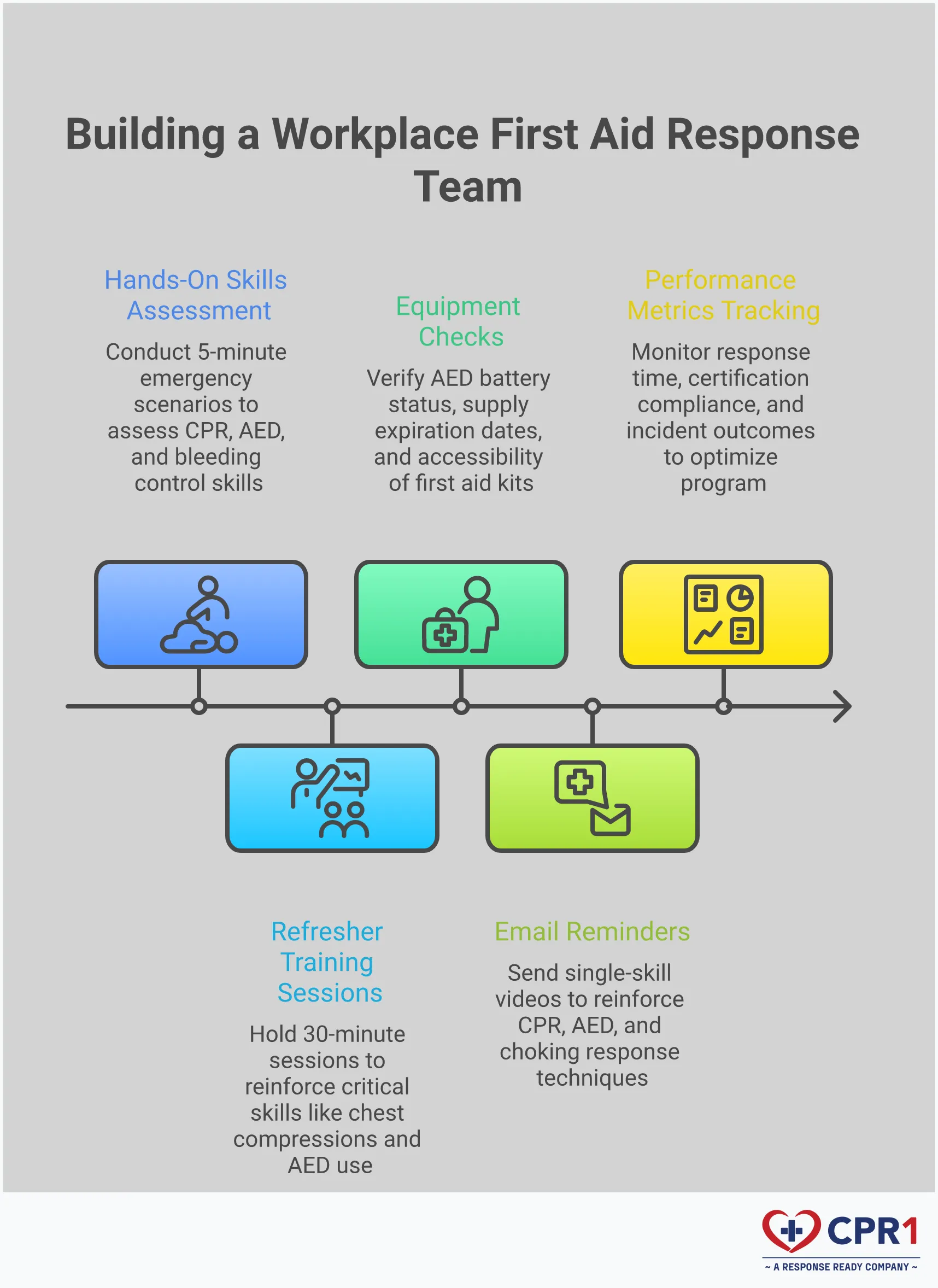
Once your team is certified, the next challenge is making sure their skills stick. In a real emergency, confidence is just as important as knowledge, and that confidence comes from feeling prepared long after the training day is over. The key is to treat first aid readiness as an ongoing practice, not a one-time event.
By creating a supportive environment where skills are regularly reinforced, you help ensure that when an incident occurs, your team can respond quickly and effectively. Simple, consistent efforts to keep first aid top of mind can make all the difference. Here are two practical ways to help your employees retain what they’ve learned and stay ready to act.
Plan for Regular Refresher Courses
First aid certifications are typically valid for two to three years, but life-saving skills can fade much faster. Research suggests that skill retention can decline in as little as six months. To counter this, the Health and Safety Executive (HSE) strongly recommends annual refresher training. These sessions keep essential techniques, like the proper steps for CPR, fresh in everyone’s mind. Regular training also ensures your team stays current with any updates to first aid protocols. You can easily arrange for onsite group training to make it convenient for your team to stay sharp and confident.
Give Them Cheat Sheets and Quick Guides
While hands-on training is irreplaceable, accessible reminders help bridge the gap between training sessions. A first aid kit is a great start, but it’s most effective when people know exactly how to use its contents. Consider creating simple, visual guides and placing them in common areas like break rooms or near first aid stations. These could be posters outlining the signs of a stroke, wallet cards with CPR steps, or checklists for responding to common injuries. These guides serve as quick, practical memory aids that reinforce training and give employees an extra layer of confidence if they need to step in and help.
How to Overcome Common Training Challenges
Organizing training for your entire team can feel like a puzzle, especially when you’re juggling schedules, budgets, and varying levels of enthusiasm. But these common hurdles don’t have to derail your safety goals. With a bit of planning and the right partner, you can create a training program that works for everyone and makes a real impact. The key is to find flexible solutions that fit your company’s unique needs and to frame the training in a way that gets your team genuinely invested.
Working Around Busy Schedules and Tight Budgets
Finding a time that works for every employee can be one of the biggest logistical headaches. This is where flexible training formats make all the difference. Bringing a certified instructor directly to your workplace for on-site training is often the most efficient solution, as it eliminates travel time and allows you to schedule the session around your operational needs. For teams with complex schedules, a blended learning approach that combines online coursework with a shorter, in-person skills session can also be a great fit. When it comes to budget, remember that creating a robust first aid training strategy is an investment in your team’s safety and well-being. Group rates for on-site courses are typically more cost-effective than sending individuals to separate classes.
How to Keep Everyone Engaged (and Awake)
If your team views training as just another mandatory meeting, they’re less likely to retain critical information. The best way to secure their buy-in is to shift the focus from compliance to confidence. When your team understands that these skills are about empowering employees to protect their colleagues and loved ones, the training becomes more meaningful. Look for instructors who use hands-on scenarios and tailor the content to your specific work environment. Practicing skills in a familiar setting makes the training more memorable and relevant. It also helps to remind your team that first aid techniques evolve, so regular refreshers are essential for keeping their skills sharp and effective.
Was the Training Worth It? Here’s How to Tell
Once your team completes their training, the final step is to gauge how effective it was. Measuring success isn’t just about confirming you checked a compliance box; it’s about ensuring your investment translates into real-world confidence and a safer workplace. A successful program leaves your employees feeling capable and prepared to act in an emergency.
The best way to understand the impact of your training is to look at it from two angles: what your team thinks and what the data shows. By collecting direct feedback, you get a clear picture of the employee experience and can identify areas for improvement. At the same time, tracking certifications and readiness metrics gives you a concrete, at-a-glance view of your organization’s preparedness. Combining these two approaches will help you build a sustainable and effective safety program.
Ask Your Team for Feedback
The most direct way to measure success is to ask your team what they thought. Anonymous surveys or informal group discussions are great for gathering honest feedback. Ask specific questions like, “Which part of the training was most valuable?” or “Do you feel confident you could use an AED right now?” This input helps you understand what resonated and what might need to be adjusted for future sessions. You can also assess performance through practical application. Consider running occasional, low-pressure emergency drills to see how employees respond. Observing their actions can highlight their confidence and identify any knowledge gaps in a safe, controlled setting.
Keep Track of Certifications and Team Readiness
Keeping clear, organized records is essential for measuring and maintaining your team’s readiness. You need to know who is certified, in what skills, and when their certifications are set to expire. A simple spreadsheet can work for smaller teams, but for larger organizations, a dedicated system is often better. Using an AED compliance management platform can automate renewal reminders and generate reports, making it easy to ensure you always have enough certified responders on duty. Many training providers, including us at CPR1.com, can also help you manage your team’s certification status, simplifying the entire process for you.
Related Articles
- OSHA Approved First Aid Training: A Simple Guide
- CPR Training for Businesses: A Complete Guide
- First Aid Professionals: A Guide to Top Trainers
- Top 6 Agencies for Emergency Care Training
- 8 Tips for Medical Emergency Drills for the Workplace
Frequently Asked Questions
How many of our employees should we get certified? While there isn’t a strict number set by OSHA, the goal is to ensure a trained responder is always available and can get to an injured person within a few minutes. A good strategy is to train key people across all departments and shifts. Think about who is always on-site and spread out geographically in your building. The more people you train, the stronger your safety net becomes, which significantly improves the chances of a positive outcome in an emergency.
Is an online-only course enough to meet OSHA requirements? An online-only course is great for learning the theoretical knowledge, but it won’t be enough for full certification or to meet most workplace safety standards. OSHA requires that employees have hands-on practice to be considered fully trained. Life-saving skills like CPR and using an AED require muscle memory that can only be built through physical practice on manikins. The most effective programs use a blended approach, combining online learning with an in-person skills session.
What’s the real difference between a standard First Aid/CPR course and BLS? Think of it this way: a standard First Aid, CPR, and AED course is designed for everyone. It gives people the essential skills to respond to common emergencies in almost any setting, from an office to a school. Basic Life Support (BLS), on the other hand, is an advanced course specifically for healthcare professionals and first responders. It focuses on high-performance team resuscitation, advanced airway techniques, and clinical scenarios. Unless you work in a medical setting, the standard course is likely the right fit for your team.
How can we make sure our team actually remembers the training a year from now? That’s a great question, because skills definitely fade over time. The best way to keep knowledge fresh is to schedule brief, annual refresher courses. These sessions reinforce the most critical steps and keep your team up-to-date on any new guidelines. You can also post simple, visual guides with CPR steps or signs of a stroke in common areas like break rooms. These quick reminders help keep the information top of mind long after the initial training day.
Our workplace is a low-risk office. Is this training really necessary for us? Even in the safest environments, medical emergencies like a sudden cardiac arrest or a severe allergic reaction can happen without warning. While the risk of injury might be low, the need for a rapid response is universal. Having trained employees on-site is the most reliable way to ensure someone gets immediate care in those critical first few minutes. It moves your team from being bystanders to being a group of capable helpers, which is valuable no matter where you work.
Related CPR1 Training Resources
Use these CPR1 resources to compare compliance requirements, certification options, and onsite training paths:


