


- Published
PALS Certification: A Complete Guide for Healthcare Providers
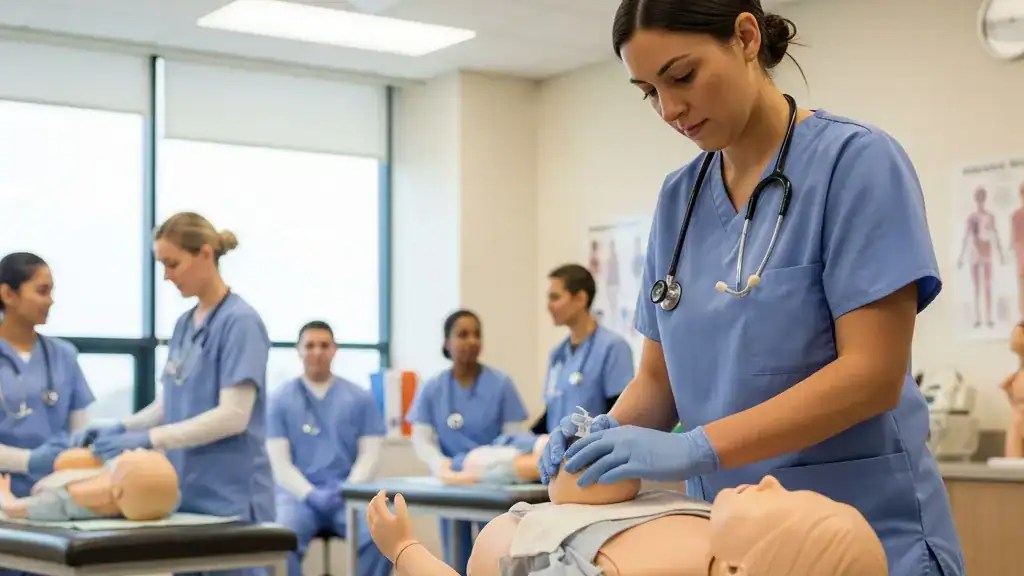
Pediatric Advanced Life Support (PALS) certification prepares healthcare providers to recognize and treat life-threatening emergencies in infants and children. Developed by the American Heart Association (AHA), the PALS course teaches systematic assessment, effective resuscitation, and team-based care for critically ill pediatric patients. For nurses, physicians, paramedics, and other providers who work with children, PALS certification is often a job requirement and always a clinical advantage.
This guide breaks down what PALS certification involves, who needs it, how it compares to BLS and ACLS, what the course covers, and how to prepare so you pass on your first attempt.
What Is PALS Certification?
PALS stands for Pediatric Advanced Life Support. It is an advanced certification course created by the American Heart Association that focuses on emergency assessment and treatment of seriously ill or injured children, from birth through adolescence.
The course builds on Basic Life Support (BLS) skills and adds pediatric-specific algorithms, pharmacology, and team dynamics. Where BLS covers the fundamentals of CPR and airway management, PALS goes deeper into:
- Systematic approach to pediatric assessment (the Assess-Categorize-Decide-Act model)
- Recognition and management of respiratory distress, respiratory failure, and shock in children
- Pediatric cardiac arrest algorithms (including bradycardia, tachycardia, and pulseless arrest)
- Effective resuscitation team communication and role assignment
- Post-cardiac arrest care for pediatric patients
- Pharmacology for pediatric emergencies (epinephrine, amiodarone, adenosine, and other drugs with weight-based dosing)
PALS certification is valid for two years. After that, providers must take a renewal course to maintain their credential.
Who Needs PALS Certification?
PALS is designed for healthcare professionals who respond to pediatric emergencies. Common roles that require or benefit from PALS certification include:
- Emergency department nurses and physicians who treat pediatric patients
- Pediatric ICU (PICU) staff and neonatal intensive care nurses
- Paramedics and EMTs providing prehospital care to children
- Respiratory therapists managing pediatric airways
- Anesthesiologists and CRNAs working in pediatric surgical settings
- Pediatricians and family medicine physicians in office or clinic settings
- School nurses and camp medical staff responsible for children’s health
Many hospitals require PALS certification for anyone who works in emergency, critical care, or pediatric units. Ambulance services often require it for advanced-level paramedics. Even if your employer does not mandate it, PALS certification signals to hiring managers that you have the specialized skills to handle the highest-stakes pediatric situations.
PALS vs. BLS vs. ACLS: What Is the Difference?
Healthcare providers often need multiple certifications. Here is how PALS fits into the broader picture alongside BLS and ACLS:
| Feature | BLS | ACLS | PALS |
|---|---|---|---|
| Full name | Basic Life Support | Advanced Cardiovascular Life Support | Pediatric Advanced Life Support |
| Patient population | All ages | Adults (primarily) | Infants and children |
| Prerequisite | None | BLS | BLS |
| Difficulty level | Foundational | Advanced | Advanced |
| Key focus | CPR, AED, choking | Adult cardiac arrest algorithms, ECG interpretation, pharmacology | Pediatric assessment, pediatric arrest algorithms, respiratory emergencies |
| Course length | 3-4 hours | 14-16 hours (2 days) | 14-16 hours (2 days) |
| Certification period | 2 years | 2 years | 2 years |
BLS is the foundation that both ACLS and PALS build upon. If you work in an emergency department that sees both adults and children, you likely need all three. If your role focuses on pediatrics, BLS plus PALS covers your requirements.
For a detailed comparison of ACLS and PALS specifically, see our guide on the differences between ACLS and PALS certification.
PALS Certification Requirements and Prerequisites
Before enrolling in a PALS course, you need to meet these prerequisites:
- Current BLS certification. PALS assumes you already know high-quality CPR, bag-mask ventilation, and AED operation for all age groups. You must hold a current BLS Provider card (AHA) or equivalent before starting PALS.
- Healthcare provider status. PALS is intended for licensed or credentialed healthcare professionals. This includes physicians, nurses, paramedics, respiratory therapists, physician assistants, nurse practitioners, and students in healthcare programs.
- Pre-course self-assessment. The AHA requires PALS students to complete an online pre-course self-assessment covering ECG rhythm recognition, pharmacology, and practical application. This is not graded, but it identifies knowledge gaps you should address before class.
Course Format Options
PALS is offered in several formats to fit different schedules:
- Classroom (instructor-led): Traditional two-day course with lectures, skills stations, and simulations. Best for hands-on learners who want direct instructor feedback.
- Blended learning (HeartCode PALS): Complete the cognitive portion online at your own pace, then attend a shorter in-person skills session. This reduces classroom time while still requiring hands-on demonstration of competency.
- Renewal/update courses: Shorter courses for providers renewing their certification. These review updates to guidelines and focus on skills testing rather than full instruction.
Fully online PALS certification (with no in-person component) exists through some third-party providers, but many employers do not accept online-only credentials. Check your employer’s policy before choosing a format. AHA-affiliated courses with a hands-on skills component carry the widest acceptance.
What to Expect in a PALS Course
A full PALS provider course typically runs 14 to 16 hours over two days. Here is what the course covers and how you will be evaluated.
Course Content
- Systematic approach to pediatric assessment: The Assess-Categorize-Decide-Act framework for evaluating a sick or injured child. This includes the Pediatric Assessment Triangle (appearance, work of breathing, circulation to skin) as a rapid visual tool.
- Respiratory emergencies: Upper airway obstruction, lower airway disease, lung tissue disease, and disordered control of breathing. You will learn to distinguish between respiratory distress and respiratory failure and intervene appropriately.
- Shock management: Hypovolemic, distributive, cardiogenic, and obstructive shock in pediatric patients. Fluid resuscitation, vasopressor selection, and when to escalate care.
- Cardiac arrest algorithms: Bradycardia with a pulse, tachycardia with a pulse, and pulseless cardiac arrest. Each algorithm includes decision trees for medication administration, electrical therapy, and reassessment intervals.
- Post-cardiac arrest care: Stabilization, targeted temperature management, and transport decisions after return of spontaneous circulation (ROSC).
- Effective team dynamics: Closed-loop communication, role clarity, mutual respect, and constructive intervention during resuscitation. PALS emphasizes that pediatric resuscitation is a team effort.
Skills Stations and Megacode Simulation
The hands-on portion of PALS includes rotating skills stations where you practice specific interventions (airway management, IO access, medication delivery) and a megacode simulation. The megacode is a full scenario where you lead or participate in a pediatric resuscitation from start to finish. An instructor evaluates your ability to apply algorithms, communicate with your team, and adapt when the patient’s condition changes.
Written Exam
The PALS provider course concludes with a written multiple-choice exam. The passing score is typically 84% (42 out of 50 questions). Questions cover algorithms, drug dosages, rhythm recognition, and clinical decision-making. If you studied the pre-course material and participated actively in class, the exam should not be a surprise.
PALS Certification Cost and Renewal
How Much Does PALS Certification Cost?
PALS certification costs vary by provider, location, and format:
- Initial PALS provider course: $200 to $400 depending on the training center
- PALS renewal course: $150 to $300
- HeartCode PALS (blended): $150 to $250 for the online portion, plus a skills session fee of $50 to $150
- AHA course materials: Often included in the course fee; if purchased separately, the PALS Provider Manual costs approximately $40 to $60
Some employers reimburse PALS certification costs as a professional development benefit. Check with your HR department before paying out of pocket. Group rates are also available when multiple team members certify together. For a broader look at training costs, see our breakdown of how much CPR and related certifications cost.
Renewal Timeline
PALS certification is valid for two years from the date of completion. The AHA recommends scheduling your renewal course before your card expires, since a lapsed certification may require you to retake the full initial course instead of the shorter renewal. Many healthcare employers track certification dates and will flag upcoming expirations, but the responsibility ultimately falls on you.
How to Prepare for Your PALS Certification
PALS has a reputation for being one of the more demanding AHA courses. The content is dense, the algorithms are specific, and the megacode simulation puts you on the spot. Here is how to prepare so you walk in confident.
Before the Course
- Complete the pre-course self-assessment early. Do not save it for the night before class. Use it to identify the topics where you need extra study time.
- Review BLS skills. PALS builds on BLS. If your chest compressions, ventilation technique, or AED operation is rusty, practice before the course. You will be expected to perform high-quality BLS without prompting.
- Memorize the core algorithms. Bradycardia, tachycardia, and cardiac arrest algorithms are the backbone of the course. Know the drug names, doses, and the decision points at each step. Weight-based dosing (mg/kg) is tested in the exam and in simulations.
- Study pediatric ECG rhythms. You need to recognize sinus rhythm, sinus bradycardia, supraventricular tachycardia (SVT), ventricular tachycardia (VT), ventricular fibrillation (VF), and asystole on a rhythm strip.
- Read the PALS Provider Manual. The AHA manual is the primary study resource. Skim it once for the big picture, then study algorithm chapters in depth.
During the Course
- Ask questions. Instructors are there to help, and PALS covers complex material. Asking for clarification during skills stations is far better than guessing during the megacode.
- Practice out loud. When running through algorithms, say the steps aloud. Verbalizing your thought process during simulations is part of demonstrating competency and builds the habit of closed-loop communication.
- Take notes on clinical pearls. Experienced PALS instructors often share practical tips from their own clinical experience that are not in the textbook. These insights help connect classroom knowledge to real-world care.
Common Mistakes to Avoid
- Skipping the pre-course assessment and showing up unprepared for the pace of the class
- Forgetting weight-based drug dosing (always calculate dose based on kg, not estimated weight)
- Jumping straight to medications without confirming effective BLS (compressions and ventilation come first)
- Failing to verbalize actions and decisions during the megacode (silent leadership gets marked down)
- Ignoring team dynamics (PALS evaluates how well you communicate, not just what you know)
Frequently Asked Questions
Is PALS certification hard?
PALS is more demanding than BLS because it covers advanced algorithms, pediatric pharmacology, and team-based simulations. However, providers who complete the pre-course self-assessment, study the algorithms, and review the PALS Provider Manual typically pass on their first attempt. The course is designed to teach you, not trick you.
Can you get PALS certification online?
Some providers offer fully online PALS courses, but many employers and hospitals do not accept certifications without a hands-on skills component. The AHA’s HeartCode PALS program allows you to complete the knowledge portion online and then attend a shorter in-person skills session. This blended format is widely accepted and saves classroom time.
How much does a PALS card cost?
Initial PALS provider courses typically cost between $200 and $400. Renewal courses run $150 to $300. Blended courses (online plus skills session) may be slightly less expensive. Course materials are usually included in the fee. Check with your employer about reimbursement options, as many healthcare organizations cover certification costs for their staff.
What is the difference between PALS and BLS?
BLS (Basic Life Support) covers fundamental CPR, AED use, and choking management for all age groups. PALS builds on BLS and adds advanced interventions specific to pediatric patients, including cardiac arrest algorithms, drug therapy, rhythm interpretation, and systematic assessment frameworks. BLS is a prerequisite for PALS.
How often do you need to renew PALS?
PALS certification must be renewed every two years. Renewal courses are shorter than the initial provider course and focus on guideline updates and skills verification. Plan to schedule your renewal before your current card expires to avoid having to retake the full course.
Disclaimer for information purposes only:
The information provided on this website is intended for general educational and informational purposes only. It is not medical advice and should not be used as a substitute for professional diagnosis, treatment, or care. Always consult a qualified healthcare or medical professional regarding any health-related questions or concerns.
While we strive to ensure the information shared is accurate and up to date, no guarantees are made regarding completeness, accuracy, or applicability to any individual situation. Use of this content is at the reader’s sole discretion and risk.
This website is part of the Response Ready family of emergency preparedness and training resources, including CPR & first aid training and compliance services, AED sales and program support, AED program management software, and medical oversight solutions provided through our affiliated platforms:
• AEDLeader.com
• ResponseReady.com
• AEDTotalSolution.com
• MDSIMedical.com
By accessing or using this website, you agree to release, indemnify, and hold harmless the website owners, authors, contributors, and affiliated entities from any claims, losses, damages, or liabilities arising from the use or reliance on the information presented.

Save Lives with the Right AED Today
Buy Trusted AEDs from AED Leader Today!
Get Certified in CPR and Make a Difference!


