




An automated external defibrillator (AED) delivers a life-saving electrical shock. But this shock doesn’t restart a stopped heart. Instead, it stops the chaotic electrical signals that cause cardiac arrest. This gives the heart a crucial chance to reset to a normal rhythm. The power behind that shock isn’t one-size-fits-all. The strength, measured in aed joules, changes based on the device and the person. Here, we’ll break down the science of defibrillator voltage and explain how aed voltage and amps work together to save a life.
Restoring a normal heart rhythm can need more than one shock, and in some cases, medication is also needed. Understanding how defibrillator voltage works during cardiac arrest is key. The level of shock matters, too. It ensures that the right energy is delivered for effective defibrillation.
Why Every Second Counts: Defibrillation by the Numbers
When someone experiences a sudden cardiac arrest (SCA), the clock starts ticking immediately. The situation is very urgent. The numbers clearly show why a quick response, especially with an AED machine, is vital. Outside of a hospital, survival rates for SCA are often tragically low.
However, the story changes dramatically when the right equipment is available. For cardiac arrests caused by “shockable rhythms” like ventricular fibrillation, immediate defibrillation can make the difference between life and death. In these specific cases, having an AED on hand and knowing how to use it can dramatically improve the chances of survival, turning a bystander into a first responder who can truly save a life.
Survival Rates and Sudden Cardiac Arrest
The reality of sudden cardiac arrest is that survival often depends on being in the right place at the right time. While overall survival rates outside of a hospital setting can be less than 10%, this figure doesn’t tell the whole story. The most common cause of SCA is an electrical problem in the heart, leading to a chaotic, non-pumping rhythm. An AED is specifically designed to correct this. For individuals with these “shockable rhythms,” survival rates can jump to as high as 50% if an AED is used promptly. This is why having accessible AEDs in workplaces, schools, and community centers is not just a good idea—it’s a fundamental part of creating a safe environment where people have a real fighting chance.
The 3-Minute Rule for Survival
Every minute that passes without defibrillation during a cardiac arrest is critical. The chance of survival can decrease by as much as 10% for every minute that goes by. Think about that—after just a few minutes, the odds can become insurmountable. The sweet spot for a successful outcome is within the first three to five minutes. If defibrillation is administered in this window, the chance of survival can be between 50% and 70%. This is why relying solely on emergency medical services isn’t enough; the average response time can easily exceed this window. Having an AED on-site and people trained to use it bridges that crucial gap, empowering people to act decisively when every single second counts.
How a Defibrillator Shock Works
It’s a common misconception that a defibrillator “restarts” a heart that has completely stopped. In reality, it does something more precise. During ventricular fibrillation, the heart’s electrical signals become chaotic and disorganized, causing the heart muscle to quiver instead of pumping blood. An AED delivers a controlled electrical shock that acts like a hard reset for the heart’s entire electrical system. This powerful jolt stops the chaotic activity, giving the heart’s natural pacemaker a chance to regain control and restore a normal, steady rhythm. It’s a brief but powerful intervention designed to fix a specific electrical malfunction, not to bring a flatlined heart back to life.
Resetting the Heart’s Electrical System
The primary goal of defibrillation is to stop two specific life-threatening heart rhythms: ventricular fibrillation (V-Fib) and pulseless ventricular tachycardia (V-Tach). In both conditions, the heart is electrically active but in a state of chaos, unable to pump blood effectively. The electric shock from an AED causes a large portion of the heart muscle to depolarize, or reset, all at once. This simultaneous reset wipes the slate clean, silencing the erratic electrical noise. This brief pause allows the sinoatrial node, the heart’s natural pacemaker, to fire a normal impulse and re-establish a coordinated, effective heartbeat. An AED automatically analyzes the heart’s rhythm and will only advise a shock if it detects one of these dangerous patterns.
Defibrillation vs. Cardioversion
While both defibrillation and cardioversion use an electrical shock to treat abnormal heart rhythms, they are not the same. The key difference is timing. Defibrillation is an unsynchronized, high-energy shock used in emergency situations for chaotic, life-threatening rhythms like V-Fib, where there is no coordinated electrical activity to sync with. In contrast, cardioversion is a synchronized, lower-energy shock. It’s timed to be delivered at a specific point in the heart’s cycle to correct serious but less chaotic rhythms. Modern AEDs are designed for one purpose: emergency defibrillation. They take the guesswork out of the equation for the user, ensuring the right kind of shock is delivered for a sudden cardiac arrest.
Understanding Defibrillator Voltage and Energy Delivery
When people think of electricity, voltage often comes to mind first. It’s the standard for battery strength, and the power outlets supply worldwide.
Early defibrillation efforts used volts as a measure. This was the beginning of grasping and delivering life-saving electrical therapy.
- In 1947, cardiac surgeon Claude Beck revived a 14-year-old patient. He used four 110-volt direct-current shocks with electrodes during open-heart surgery.
- In 1956, surgeon Paul Zoll introduced a new closed-chest defibrillation technique. This method used shocks up to 750 volts. It was a big step forward in cardiac care.
- In 1957, William Kouwenhoven of Johns Hopkins University built a 250-pound external defibrillator. It delivered 480-volt AC shocks to help restart an adult heart. This was a key advancement in portable defibrillation.
Modern AEDs use joules to measure energy. They deliver the needed energy to treat cardiac arrest. In the past, early defibrillation shocks were measured in volts.
A Simple Analogy: Voltage, Current, and Joules
To understand how an AED works, it helps to think of electricity like water in a hose. Voltage is the water pressure, or the force pushing the water out. The current is the actual flow of water. Joules, then, would be the total amount of water you’ve used to put out a fire. In defibrillation, voltage is the electrical “pressure” that pushes the charge through the body. An AED uses a high voltage to create a strong enough push. This creates a current—the flow of electricity—that travels to the heart to stop its chaotic rhythm. The total energy delivered during that shock is measured in joules. Most modern AEDs deliver a shock between 120 and 200 joules, which is the effective dose needed to reset the heart. While the science sounds complex, the device does all the work, which is something we emphasize in our CPR and AED certification courses to build rescuer confidence.
What Is Voltage?
In the International System of Units (SI), voltage is the difference in electric potential between two points.
- Electrical potential
- Electrical potential difference
- Electromotive force
A volt shows the change in electric potential between two points, according to the Encyclopedia Britannica.
One volt is the difference in electric potential between two points. It occurs when one ampere of current flows and one watt of power is used. This is also the voltage across a one-ohm resistor with one ampere flowing through it.
A 9-volt battery’s power relies on the resistance between it and the device. In medical settings, this device can be the heart.
Voltage indicates the electrical potential in a circuit. Yet, it doesn’t fully explain how defibrillation works. The heart is affected by the transmyocardial current. That’s why modern devices measure and deliver energy using a different unit.
What About Electrical Current?
An ampere is the flow of one coulomb of charge each second. It occurs across a one-ohm resistance with a one-volt difference.
Only 100 milliamps can stop a heart. That’s why electric fences use low current. They carry thousands of volts but keep the current safe. This prevents serious harm to animals or people if touched.
The Role of Joules and Impedance
Impedance, in ohms, is the total resistance that slows current flow during defibrillation. As impedance increases, less electrical current reaches the heart.
Automated external defibrillators check the patient’s impedance using electrode pads. They then adjust the energy output in joules. This ensures that enough current reaches the heart.
By definition:
A joule equals one watt-second. This is the energy created when a one-amp current flows for one second through a one-ohm resistor.
How Many Joules Does an AED Deliver?
Biphasic defibrillators usually start at 120 joules. They can reach up to 200 joules. Energy levels increase as needed. Studies show that shocks up to 360 joules don’t harm the heart much. But, lower energy doses can lower the risk of skin burns. They might also help the heart recover better based on animal research.
Biphasic shocks are better for treating shockable rhythms. That’s why all modern external and internal defibrillators now use biphasic waveforms. These deliver lower-energy shocks. They replace the higher-energy monophasic shocks that doctors used before.
Special Considerations for Children
Using an AED on a child requires a few important adjustments. Because children have smaller bodies, they need a lower dose of electrical energy than adults. Most AEDs accomplish this with special pediatric pads. These pads, sometimes called pediatric attenuators, are designed to reduce the energy of the shock to a level that is safe and effective for a child. The general rule is to use pediatric pads for any child under 8 years of age or who weighs less than 55 pounds. Some devices even have a specific pediatric mode or key that automatically adjusts the energy dose, making the process even simpler for the rescuer.
But what happens if pediatric pads aren’t available? In a life-or-death situation, the guidelines are clear: use the adult pads. A shock from adult pads is significantly better than no shock at all. The critical step is to ensure the pads don’t touch. To prevent this, you can place one pad on the center of the child’s chest and the other on their back. This front-and-back placement is a standard technique covered in training. Situations like these highlight why hands-on training is invaluable. A quality course prepares you for these real-world variables, covering specific steps for infants and children so you can respond with confidence.
A Look at Shock Energy Sequences
The Philips HeartStart FRx and Defibtech Lifeline use a biphasic waveform. This waveform has impedance compensation and exhibits exponential truncation. They usually deliver 150 joules for adults and 50 joules for children. The technician measures the impedance at 50 ohms.
The HeartSine Samaritan PAD 350P, 360P, and 450P models use a special SCOPE™ waveform. This technology changes the output. It gives the correct energy dose for each patient.
- 150 J for the first shock, 150 J for the second shock, and 200 J for the third shock in adults
- 50 J for the first shock, 50 J for the second shock, and 50 J for the third shock in children
Each model has factory settings, but the energy delivered can change. This depends on the patient’s impedance.
The Philips HeartStart FRx adjusts its shock by measuring impedance. It delivers about 128 joules at 25 ohms and can deliver up to 158 joules at 180 ohms. It also optimizes pediatric energy levels. They usually range from 43.4 to 52.4 joules.
Defibrillation impedance can increase due to body hair, tissue resistance, or damaged AED cables. Electrode pads use a conductive adhesive. This helps direct the shock from the pads through the skin to the heart. Using expired pads, dried gel, or placing them on wet skin or thick chest hair can lower effectiveness. So, proper preparation is important.
How Long Does a Defibrillator Shock Last?
The shock might feel strong, but it lasts only about one hundredth of a second. There’s just a small gap between the first and second phases.
The shock phase lasts different times based on patient impedance. In adults, it ranges from 3 to 17 milliseconds. For children, it’s shorter, at 7 to 11 milliseconds. The HeartSine Samaritan PAD 350P has a phase pause of 0.4 milliseconds. This stays the same, no matter the impedance.
How Battery Life Affects Performance
Modern automated external defibrillators use small 9-volt batteries. This keeps them lightweight and easy to carry, so they can be quickly used in emergencies.
The Philips HeartStart FRx uses a 9-volt lithium manganese dioxide battery. This battery can give up to 200 shocks or last about four hours when new and used at room temperature.
The HeartSine Samaritan PAD 350P uses an 18-volt lithium manganese dioxide battery. It also comes with an electrode cartridge. It provides over 60 shocks or six hours of monitoring when new. Even after four years, it can still deliver more than 10 shocks.
The Defibtech Lifeline DCF-100 comes with a 9-volt lithium battery for self-checks. You can buy high-capacity lithium manganese dioxide battery packs separately for extra power.
- The DBP-1400 battery pack delivers 15 volts and 1400mAh. It supports up to 125 shocks or eight hours of use. Plus, it has a standby life of five years.
- The DBP-2800 battery pack provides 15 volts and 2800mAh. It can deliver up to 300 shocks or last for 16 hours of use. In standby mode, it stays functional for up to seven years.
AEDs have advanced significantly since the bulky 250-pound portable defibrillators of the 1950s.
What About Manual Defibrillators?
Modern manual defibrillators, like AEDs, use biphasic shocks measured in joules. The main difference is that manual devices let users pick the energy level for each shock. This is better than depending on automatic calculations.
Manual defibrillators are best for infants. They provide lower doses than pediatric pads. Only trained professionals, like doctors or paramedics, should use them. They understand advanced cardiac life support.
Get certified in CPR

Adult & Pediatric First Aid/CPR/AED — Blended Learning
Self-paced Red Cross course you complete online, then meet for a quick in-person skills check. Earns a 2-year certification.

CPR, AED & First Aid Certification
Instructor-led training where your team practices the exact response steps in this article on real manikins and AED trainers.
Types of Defibrillators
Automated External Defibrillators (AEDs)
Automated External Defibrillators, or AEDs, are the devices you see in airports, gyms, and offices. They are designed for public use, allowing anyone to provide life-saving help during a sudden cardiac arrest, even with minimal training. An AED’s key feature is its simplicity; it analyzes the person’s heart rhythm through electrode pads and determines if a shock is needed. The device provides clear voice prompts, guiding the user through every step, from pad placement to performing CPR. This automation removes the guesswork and fear from a high-stress emergency, empowering bystanders to act confidently and save a life.
Modern AEDs are incredibly sophisticated. They automatically check the patient’s impedance—the body’s resistance to electrical current—and adjust the energy output accordingly. This ensures the heart receives the right amount of energy, measured in joules, for an effective shock. Because they only deliver a shock when a life-threatening arrhythmia is detected, they are extremely safe to use. This smart technology is why public access defibrillation programs are so successful and why having an AED on-site is a critical part of any emergency preparedness plan for a business, school, or community organization.
Manual External and Internal Defibrillators
Unlike AEDs, manual defibrillators are used exclusively by trained medical professionals like paramedics, nurses, and doctors. While they also use biphasic shocks measured in joules, the critical difference is that the operator must interpret the heart rhythm and manually select the energy level for the shock. This requires deep medical knowledge and the ability to make split-second clinical decisions. You’ll typically find these devices in hospitals, ambulances, and other advanced medical settings where professionals can use their full range of features, including monitoring vital signs and pacing the heart.
The precise control offered by manual defibrillators makes them particularly valuable in certain situations. For example, they are often preferred for infants, as a clinician can deliver a much lower and more specific energy dose than what standard pediatric AED pads can offer. Because their use requires advanced skills, proper certification is non-negotiable. Professionals who operate these devices typically hold certifications in Advanced Cardiac Life Support (ACLS) or Basic Life Support (BLS), ensuring they can use the equipment safely and effectively as part of a coordinated medical response.
Implantable Cardioverter-Defibrillators (ICDs)
An Implantable Cardioverter-Defibrillator (ICD) is a small, battery-powered device placed surgically inside the body, much like a pacemaker. It is designed for individuals who have a known high risk for life-threatening heart arrhythmias. An ICD constantly monitors the patient’s heart rhythm, 24 hours a day. If it detects a dangerous rhythm, it automatically delivers a precisely calibrated electrical shock to restore a normal heartbeat. This provides immediate, round-the-clock protection that an external device cannot offer, acting as a constant guardian for those with chronic heart conditions.
Wearable Cardioverter Defibrillators (WCDs)
A Wearable Cardioverter Defibrillator (WCD) is a portable, external device that serves as a temporary safeguard for patients at risk of sudden cardiac arrest. Typically designed as a vest worn under clothing, a WCD monitors the heart continuously. If it detects a life-threatening rhythm, it alerts the patient and can deliver a treatment shock to restore a normal rhythm. WCDs are often prescribed for individuals who are waiting for an ICD implant, recovering from a cardiac event, or have a temporary heart condition. It acts as a bridge, providing protection until a long-term solution is in place or the risk has passed.
The 3 Steps of a Defibrillator Shock
Automated defibrillation follows a simple three-step procedure.
Proper Electrode Pad Placement
Where you place the electrode pads is critical. The goal is to sandwich the heart between them so the electrical shock can travel through it effectively. For adults, the most common method is to place one pad on the upper right side of the bare chest, just below the collarbone. The second pad goes on the lower left side of the chest, a few inches below the armpit. It’s important to make sure the chest is dry and to remove excessive hair if it prevents the pads from sticking firmly. Following the visual instructions on the pads themselves will help you correctly position the pads every time. For children, the placement is often different—one pad in the center of the chest and the other on the back—to prevent them from touching.
Step 1: Analyzing the Heart’s Rhythm
When you put AED pads on the bare skin of someone in cardiac arrest, the device checks for a shockable heart rhythm. It’s important to avoid touching the person during this analysis to prevent interference.
Shockable Rhythms
There are two heart rhythms that an AED can identify as shockable:
- Ventricular fibrillation (v-fib)
- Pulseless ventricular tachycardia (v-tach)
These rhythms involve chaotic electrical activity that can be corrected with a shock. The defibrillator halts the irregular signals. This allows the heart to reset and regain a normal rhythm.
Non-Shockable Rhythms
Some heart rhythms, like asystole and pulseless electrical activity (PEA), can’t be shocked. Asystole shows no electrical activity. PEA has organized signals but lacks a pulse. In both situations, defibrillation does not work.
Common Myth: Shocking a “Flatline”
We’ve all seen it in movies: a patient flatlines, and a doctor yells “Clear!” before delivering a powerful shock that brings them back to life. While it makes for great television, it’s not how defibrillation works in the real world. An AED is designed to correct a chaotic, disorganized heart rhythm—not to restart a heart that has stopped completely. A “flatline,” known medically as asystole, means there is no electrical activity at all. Trying to shock a heart in asystole is like trying to reboot a computer that isn’t plugged in; there’s simply no electrical signal for the device to reset.
When an AED analyzes a heart in asystole, it will correctly advise “No Shock Advised.” This doesn’t mean the person can’t be saved, but it does mean the immediate priority is different. The correct response is to begin or continue providing high-quality CPR immediately. By performing chest compressions, you manually circulate blood and oxygen to the brain and other vital organs, buying critical time until emergency medical services arrive with advanced treatments. This is why proper training is so essential—it teaches you how to respond effectively when a shock isn’t the answer and empowers you to be a true bridge to survival.
Step 2: Getting the “Shock Advised” Prompt
Once the AED analyzes the heart, it will show if a shock is needed. If so, it begins drawing energy from the battery and prepares to deliver it. Charging typically takes up to 8 seconds for 150 joules and about 12 seconds for 200 joules. You will often see or hear cues that indicate the charging status.
After charging, the AED either shocks on its own or tells the user to press the shock button. This depends on the model. If no shock is given in 30 seconds, or if the rhythm can’t be shocked, the device safely releases the stored energy.
Step 3: Immediately Resume CPR
Once the shock is delivered, the AED will show that it is safe to touch the patient and will guide you through CPR. If trained, follow the 30-to-2 compression-to-breath ratio; otherwise, continue with hands-only compressions.
The AED rechecks the heart rhythm every two minutes and announces if another shock is needed. Even if no shock is needed, keep the pads on. This way, the device can track and react if the heart rhythm becomes shockable.
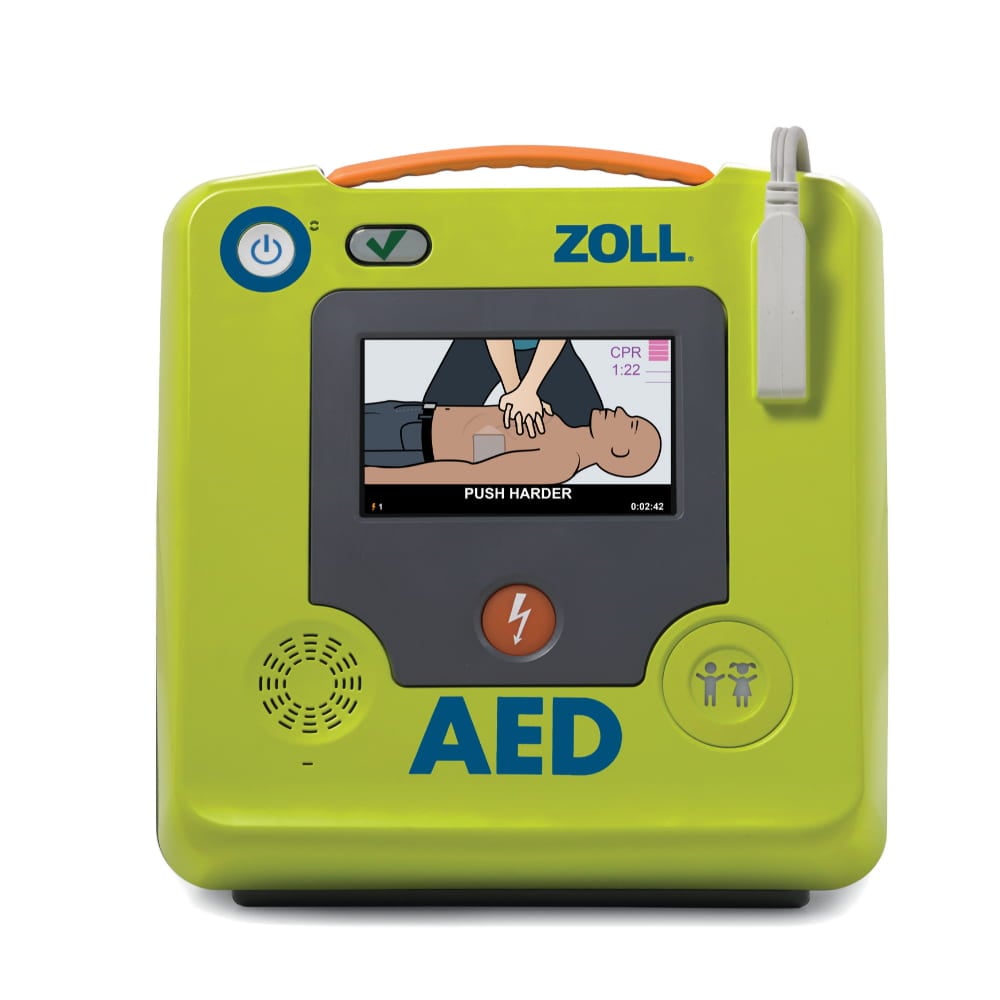
ADAPTIVE BIPHASIC ENERGY
ZOLL AED 3
Rectilinear Biphasic waveform with escalating 120-200J output, adjusted to patient impedance — exactly the energy delivery this article describes.
Why CPR is Still Essential
While an AED is the only tool that can correct a shockable heart rhythm, it doesn’t work in a vacuum. Cardiopulmonary resuscitation (CPR) is the critical bridge that keeps a person alive until a defibrillator can be used. During sudden cardiac arrest, the heart stops pumping blood effectively. CPR, specifically high-quality chest compressions, manually circulates oxygenated blood to the brain and other vital organs, preventing irreversible damage. Think of it this way: CPR keeps the engine primed while the AED works to fix the electrical problem. Without it, the chances of a successful outcome drop dramatically with each passing minute.
Furthermore, CPR is just as important after a shock is delivered. A common misconception is that the heart immediately returns to normal function. In reality, after an AED delivers a shock to “reset” the heart’s electrical system, the heart muscle is often weak and needs help to resume pumping effectively. That’s why protocols call for two minutes of immediate CPR post-shock. This helps the heart regain its strength and rhythm. CPR and defibrillation are a powerful team; one is rarely successful without the other, which is why comprehensive training is so vital for any potential rescuer.
Why Defibrillator Voltage Matters to You
It’s important to understand voltage, current, and energy in defibrillation. This knowledge is key during sudden cardiac arrest. AED program managers and rescuers should keep a few key points in mind:
- When the AED says to “stand clear,” do not touch the patient or anything they are touching, especially metal. The human body conducts electricity. Touching during analysis or shock delivery can disrupt the process. It may also accidentally shock the rescuer.
- Remove medicated patches, like nicotine ones, before using AED pads. They can block the current and raise the risk of skin burns. Use gloves and ensure the area is completely clean after removal.
- Don’t place AED pads directly on a pacemaker or ICD. These devices can block the shock from getting to the heart. They might also get damaged. Instead, position the pads a few inches away or use an alternate placement.
- Thick chest hair can block pad contact. This increases resistance and lowers shock effectiveness. Shave the area with speed to help the pads stick and allow current to flow. Many AED kits include a razor for this reason.
Your Defibrillator Questions, Answered
An AED delivers a strong shock measured in volts, amperes, or joules. This shock can stop a life-threatening heart rhythm. It also boosts a sudden cardiac arrest victim’s chance of survival by three times.
Defibrillation doesn’t always work. Some causes of cardiac arrest don’t respond, even with advanced technology. Still, when used quickly with quality CPR, it offers the best chance for survival and recovery.
FAQs
How Many Volts Does an AED Use?
AED voltage varies depending on the device and patient needs. Early defibrillators used shocks measured in volts. Now, modern AEDs measure energy in joules. An AED can deliver 150 to 200 joules of energy. To do this, it may use thousands of volts inside, usually between 1,200 and 2,000 volts. This amount depends on the patient’s impedance.
Voltage vs. Energy: What’s the Difference?
Defibrillator voltage is the electrical force that drives current through the body. The energy delivered is measured in joules. Today’s AEDs focus on joules. This reflects the energy that reaches the heart during a shock. It also considers impedance.
Why Does AED Voltage Change Per Patient?
AED voltage adjusts based on a person’s body resistance, known as impedance. Factors like chest hair, wet skin, or implanted devices can affect this resistance. The device adjusts the voltage to ensure the right current reaches the heart. This keeps the shock effective.
Is a Higher Defibrillator Voltage Better?
Not necessarily. The right energy dose in joules matters more than high voltage for defibrillators. Most modern AEDs use biphasic waveforms. These waveforms are safer and more efficient. They deliver effective shocks at lower voltages. This reduces the risk of skin burns and heart damage.
How Do AEDs Adjust Their Energy Delivery?
Automated external defibrillators check the patient’s impedance. Then, they calculate the AED voltage needed to deliver the right amount of energy. This ensures enough current gets to the heart, no matter your body type or skin condition.
Do All AEDs Have the Same Voltage?
No, automated external defibrillator voltage can differ by brand and model. Some use fixed energy levels, while others adjust based on patient condition. Some models begin at 150 joules. They can increase if needed. Others adjust each shock based on impedance.
The Right Shock at the Right Time
To see how automated external defibrillators save lives, it’s important to know how voltage, current, and energy interact. Modern AEDs use joules instead of volts. This change allows them to deliver precise shocks tailored to each patient’s needs. The voltage a defibrillator uses to restore a normal heart rhythm varies. This variation depends on impedance, where the pads are placed, and the waveform type. Not every case of sudden cardiac arrest can be fixed with defibrillation. But using an AED quickly, along with good CPR, gives the best chance of survival. Understanding AED voltage is crucial. It helps both professionals and everyday people save lives when seconds matter.

Not sure which AED or training fits you?
A CPR1 product expert walks you through it — no obligation.
Talk to a CPR/AED Expert →A Brief History of the Defibrillator
The compact, user-friendly AEDs we see in offices, schools, and airports today have a fascinating history. They didn’t just appear overnight; they are the result of decades of medical innovation. The journey from massive, hospital-only machines to the portable lifesavers we rely on is marked by key breakthroughs that completely changed how we respond to cardiac emergencies. This evolution made it possible for almost anyone to step in and help save a life, moving defibrillation from the operating room into the community.
Early Discoveries and Milestones
The story of defibrillation really takes off in the mid-20th century. In 1947, cardiac surgeon Claude Beck made history when he successfully revived a 14-year-old boy during open-heart surgery using direct-current shocks. While groundbreaking, this method required an open chest. A major leap forward came in 1956 when Dr. Paul Zoll developed a closed-chest technique, applying shocks up to 750 volts without invasive surgery. Just a year later, William Kouwenhoven from Johns Hopkins University created a 250-pound external defibrillator. It was cumbersome, but it proved that a life-saving shock could be delivered externally, paving the way for the portable devices we have now.
The Move to Modern, Portable Devices
The evolution from those early behemoths to today’s sleek devices involved more than just shrinking the size; the technology itself became much smarter. A critical shift was moving from measuring electrical force in volts to measuring delivered energy in joules. This allows modern AEDs to provide a more precise and effective shock. Today’s devices use biphasic waveforms, which deliver energy more efficiently, starting at around 120 to 200 joules. This is a safer approach that reduces the risk of burns and heart damage compared to the high-voltage shocks of the past.
Another key advancement is the “automated” part of the AED. These devices are designed to analyze a person’s impedance—or the body’s resistance to electrical current—and adjust the energy delivery accordingly. Factors like body hair or poor pad contact can increase impedance, but a modern AED compensates to ensure the heart receives an effective shock. This intelligent technology is what makes it possible for anyone, not just medical professionals, to confidently use an AED to save a life. It’s a world away from the 250-pound machines that required expert operation.
Key Takeaways
- An AED is a reset button, not a restart switch: A defibrillator shock stops the chaotic electrical signals causing cardiac arrest, giving the heart a chance to restore its own natural rhythm. It cannot shock a heart that has completely stopped (a “flatline”).
- The right energy dose is delivered automatically: Modern AEDs measure a person’s physical resistance and adjust the shock’s energy, measured in joules, accordingly. This smart technology ensures the shock is both safe and effective for that specific individual.
- CPR is the critical partner to every shock: Defibrillation works best when paired with high-quality CPR. Chest compressions keep oxygenated blood flowing to the brain before a shock and help the heart muscle recover its strength immediately after.
Related Articles
- How Defibrillator Voltage Works: Theory & Applications | CPR1
- AED Archives — CPR1
- Monophasic vs Biphasic AEDs | Key Differences in Shock Delivery — CPR1
Ready to Learn CPR and Save Lives?
Get certified in CPR, First Aid, and AED use with our accredited courses. Online and in-person options available for individuals, families, and businesses.
Browse CPR Training Courses →


